Comparison
CodeSee was acquired by GitKraken in 2023 and is no longer available as a standalone product. Compare what CodeSee offered to Glue's AI-powered codebase intelligence for product managers and engineering leaders.
CodeSee was acquired by GitKraken in 2023 and is no longer available as a standalone product. If you were a CodeSee user — or if you're searching for what replaced it — this comparison explains what changed and why Glue takes a different approach to the same fundamental problem: helping teams understand their codebases.
I was a CodeSee user before the acquisition. At Salesken, we used their service maps to onboard new engineers onto our real-time voice AI architecture. When the standalone product went away, we felt the gap. That gap is part of why I'm building Glue.
CodeSee positioned itself as a code visibility platform for development teams. The core pitch: developers spend 60% of their time reading and understanding code, so visibility tools should reduce that friction.
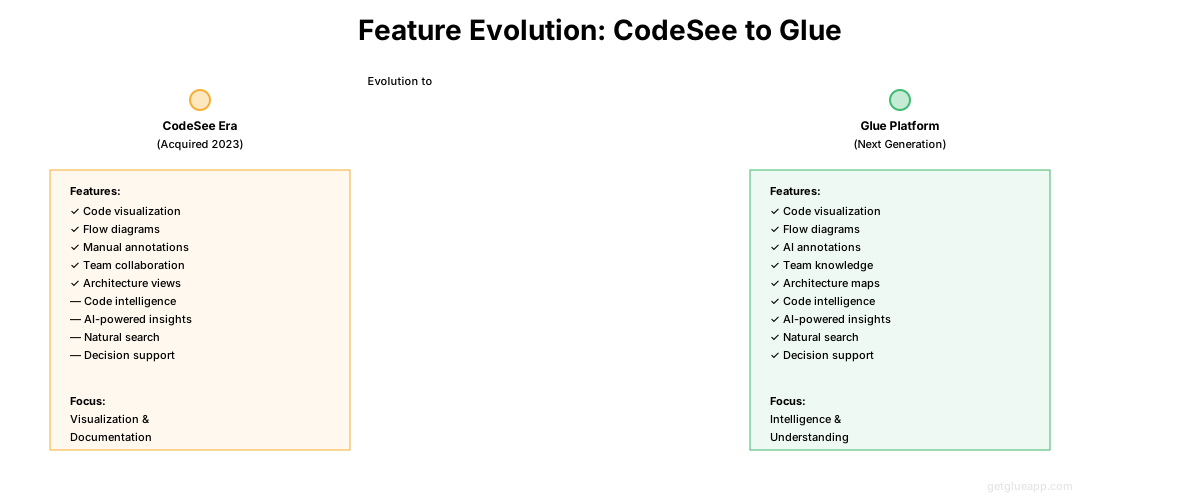
CodeSee offered codebase maps (visual representations of how code connects across repos), service maps (architecture diagrams with service dependencies), visual code reviews (understanding impact before merging PRs), function-level visualization, interactive code tours, and CodeSee AI for generated summaries.
The platform was built by developers, for developers. It addressed a real problem: codebases are hard to understand visually, and manually documenting them is tedious and always out of date. At Salesken, our architecture diagrams in Confluence were 6 months stale within weeks of being drawn. CodeSee's auto-generated maps solved that for the services they supported.
CodeSee was acquired by GitKraken because code visibility is table-stakes for modern development tools. Rather than stay independent, CodeSee integrated into GitKraken's broader DevEx platform. This made sense for GitKraken but meant CodeSee users lost the specialized product and got a feature within a larger tool.
The trade-off: users gained access to GitKraken's ecosystem but lost the focused product that specifically solved the visibility problem. I talked to three other engineering leaders in Bengaluru who had the same reaction — they'd built CodeSee into their onboarding workflows, and the acquisition disrupted that.
CodeSee focused on visualization for developers. Glue focuses on AI-powered understanding for product and engineering leaders. Different audience, different approach.
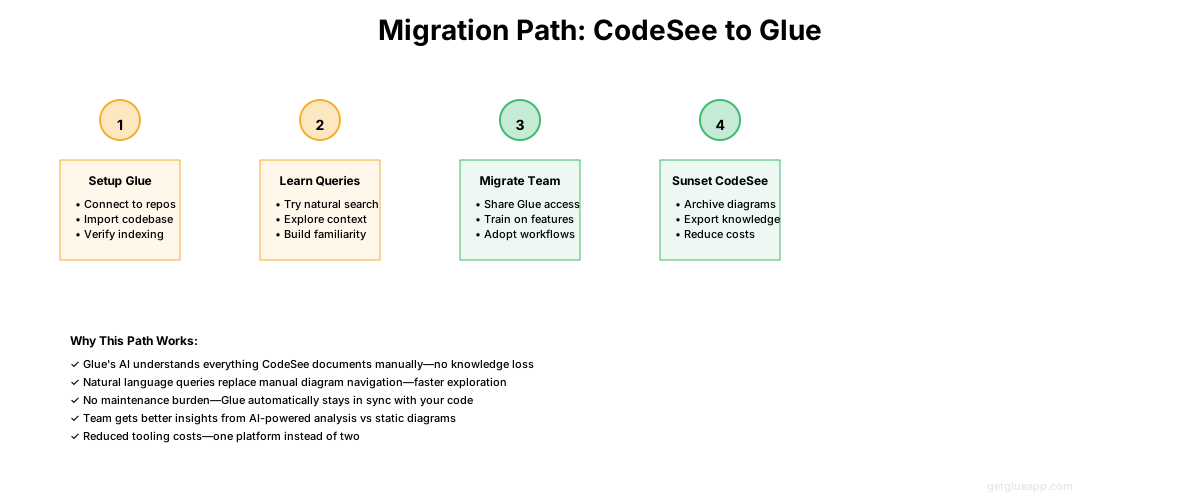
Codebase Q&A in plain English. Instead of browsing maps, you ask questions. "How does the checkout flow work?" "What services handle notifications?" Glue returns actual code references, call graphs, and implementation details. No visual literacy required.
Competitive feature mapping. Glue analyzes competitor products alongside your codebase to identify feature gaps. You see what you're missing — not just that code exists, but how your features compare, scored 0-100%.
Product-focused insights. Product managers understand what's possible with implementation specs that name specific files, dependencies, and architectural patterns. Research informs product decisions, not just code reviews.
Auto-generated documentation. Generated from code structure and kept current without manual effort. At UshaOm, where I ran a 27-engineer team, we had a full-time engineer spending 20% of his time updating architecture docs. They were still wrong half the time. Auto-generation from code eliminates that category of work.
| Feature | CodeSee (GitKraken) | Glue |
|---|---|---|
| Visual code maps | Core feature — interactive visualization | Not available |
| Service maps | Architecture diagrams | System structure via AI analysis |
| PR review visualization | Visual impact of PRs | Not applicable |
| Code tours | Guided walkthroughs | Not available |
| Natural language Q&A | Not available | Ask anything about your codebase |
| Dependency mapping | Visual dependency maps | AI-analyzed dependency graph |
| Code ownership | Not available | Git-history-derived ownership |
| Knowledge silo detection | Not available | Identifies knowledge concentration |
| Bus factor analysis | Not available | Calculates bus factor per module |
| Feature discovery | Not available | Catalogs product features from code |
| Competitive gap analysis | Not available | Scores feature gaps against competitors |
| Primary audience | Developers | PMs, Engineering Managers, CTOs |
| Current status | Acquired by GitKraken (2023) | Active, independent product |
When CodeSee was acquired in 2023, existing users had three paths:
Migrate to GitKraken. CodeSee features integrated into GitKraken's platform. Convenient if you already used GitKraken for Git management, but the standalone code visibility features were simplified.
Find an alternative. Many CodeSee users wanted something beyond what GitKraken offered — not just code visualization, but deeper codebase understanding. This is the audience we built Glue for.
Go without. Some teams decided code visibility tools weren't essential and returned to manual approaches: README files, architecture diagrams in Confluence, tribal knowledge. At Salesken, we briefly went this route after the acquisition. Within two months, our onboarding time for new engineers increased by 3 weeks because the self-service understanding layer was gone.
CodeSee bet on visualization: show developers a map of their code, and they'll understand it better. This works for certain use cases — onboarding, PR review — but has real limitations.
Maps get overwhelming for large codebases. Thousands of files don't fit on a screen. At Salesken, our service map had 40+ nodes and was essentially unreadable without aggressive filtering. Maps show structure, not meaning — "these files are connected" but not "this is the critical payment flow that handles 60% of revenue." And maps require interpretation by someone who already understands the code, which is a chicken-and-egg problem for onboarding.
Glue bets on understanding. Ask questions in plain English, get specific answers. "How does checkout work?" returns the same answer whether the codebase has 100 files or 100,000. Answers include meaning ("the checkout flow involves 4 services, the payment service has high complexity and a bus factor of 1"). Answers are accessible to non-engineers — no code literacy required.
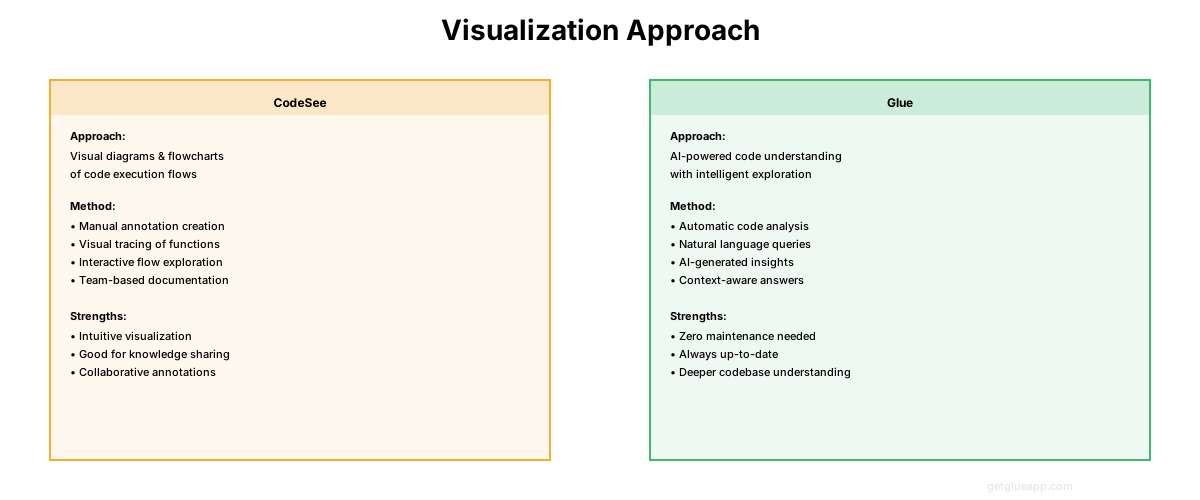
Neither approach is wrong. But for product teams that need to make decisions about the codebase without reading code, natural language Q&A is more practical than visual maps. A PM will never learn to read a dependency graph. A PM can ask "what happens if we change the email template?"
If you used CodeSee primarily for:
The biggest difference you'll notice: CodeSee was a tool you looked at. Glue is a tool you talk to. The interaction model is fundamentally different, and for most non-developer use cases, conversation turns out to be more natural than navigation.
Glue doesn't generate visual dependency maps. If your team specifically needs visual service diagrams — for architecture reviews, for compliance documentation, for presentations — you'll want a separate diagramming tool alongside Glue.
Glue's AI analysis is also only as good as the code structure it can parse. Implicit dependencies (runtime config, environment variables, feature flags that change behavior) are harder to detect automatically than explicit imports and function calls. We're getting better at this, but it's not solved.
CodeSee's visual maps, when they worked, gave an immediate spatial understanding that text-based Q&A doesn't replicate. Some people think spatially. For them, the loss of CodeSee is real, and Glue is a different kind of tool, not a direct replacement.
What is the difference between Glue and CodeSee?
CodeSee focused primarily on code visualization and dependency mapping for individual developers. Glue is a comprehensive codebase intelligence platform that provides architecture analysis, technical debt tracking, competitive intelligence, and product insights for both engineering and product teams.
Is CodeSee still available?
CodeSee's availability has changed over time. Glue provides similar codebase visualization capabilities along with deeper intelligence features including automated code health monitoring, dependency analysis, and product-level insights that go beyond what CodeSee offered.
Keep reading
Related resources