
AI code assistants (GitHub Copilot, Cursor, Claude Code) and codebase intelligence platforms solve fundamentally different problems: code assistants generate code line-by-line from a limited context window of the current file, while codebase intelligence analyzes an entire codebase's architecture, dependencies, ownership, and code health to provide system-level understanding. The key distinction is that agentic coding tools accelerate individual developer output, but codebase intelligence makes the whole team—including PMs, EMs, and CTOs—smarter about what the system actually does.
I posted something on LinkedIn a few weeks ago that got more engagement than I expected. The core observation: developers now write 3x more code than they did two years ago, but the people responsible for deciding what to build — the PM, the EM, the CTO — are still getting their codebase knowledge from a developer who has to stop coding to explain it.
22 people commented. The pushback was illuminating. Aalok Pandit said just point Cursor at the repo and ask. Rishabh Aggarwal said devs already have Copilot, and GitHub will probably build this anyway. Sailesh Sahu at Agoda said his team already solves this with Glean, Sourcegraph, and Cursor in Slack.
They're right. If you're a developer exploring code, the tooling is excellent. I use these tools myself every day.
But the people who kept coming back in DMs weren't developers. They were PMs scoping features who couldn't understand the impact of what they were asking for. CTOs deciding what to prioritize without seeing the structural constraints in the code. EMs trying to understand why something is taking 3x longer than expected. These people will never open an IDE.
That's the gap I'm building Glue to close. And it's a gap that gets wider every time a team adopts an agentic coding tool.
What AI Code Assistants Actually Do
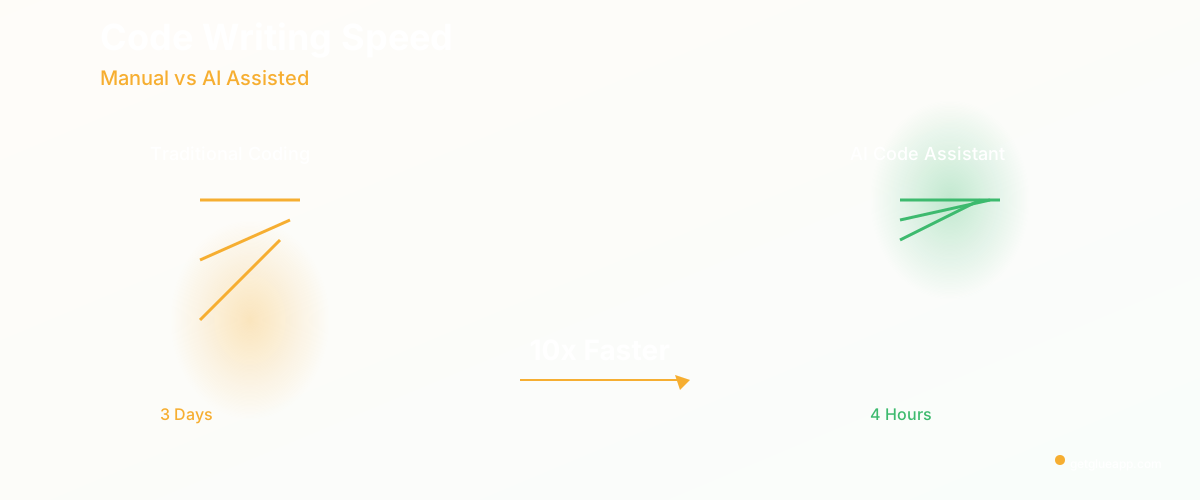
The last three years have been defined by AI coding tools. GitHub Copilot showed the world that LLMs could write reasonable code. Cursor made AI pair programming feel natural. Claude Code lets developers specify entire features in plain English. These tools solve a real problem: the friction of typing.
They generate syntax, autocomplete logic, create boilerplate. Copilot suggests the next line. Cursor builds features. Claude Code reasons through entire implementations. They're all solving the same core problem: reducing the time from idea to functional code.
But they don't solve the problem of understanding what was written. And that distinction matters more than most people realize.
The Gap: Writing Faster Without Understanding More
Here's the trap. When you write code by hand, the friction of typing actually serves a purpose. You think about what you're writing. You reason through the logic. You internalize the structure. That friction is a feature, not a bug.
AI code assistants remove that friction. You type less. You think less about the implementation details. You understand less of the resulting code.
Multiply that across a team. Every feature built by an agentic tool feels like it appeared from nowhere. You didn't watch it evolve. You didn't participate in the small decisions that shape architecture. You get a pull request with 2,000 lines of code that works, but nobody knows what it does or why it's structured that way.
I experienced a version of this at Salesken before the AI coding era. We had a senior engineer who built our entire audio processing pipeline over three months. Beautiful code. Great tests. Then he left. Nobody else understood the pipeline. We spent six weeks reverse-engineering code that one person had written, and that was code written by hand with comments and documentation. Imagine that problem at 10x the code generation speed.
Michael Morrison, who's led product at Google and LinkedIn, described it perfectly in a comment on my post: for years, codebase access limitations have kept PMs and tech leads locked out. Even when they could answer the question themselves, they don't have access. By design or by accident.

What Agentic Coding Means for 2026
Agentic coding tools don't just write code. They build entire features autonomously. Give them a spec and they design the database schema, write the API endpoints, build the frontend components, add logging and error handling, write tests, and deploy to staging.
Cursor's Cascade mode does this. Claude Code does this. The Y Combinator batch of 2025 had multiple companies selling autonomous coding agents.
The velocity gain is real. Teams are shipping dramatically faster. Features that took two weeks now take two days.
But if agents are writing code at 10x speed, you need 10x better understanding of what you have. You need to see the entire codebase at a glance. You need to know which services depend on each other. You need to understand the data model. You need to catch safety issues before they hit production.
You need codebase intelligence. Not in competition with AI code assistants. As the necessary complement to them. The assistant is your accelerator. The intelligence platform is your guardrail.
The Tool Landscape in 2026
AI Code Assistants (Writing Tools)
| Tool | Approach | Best For |
|---|---|---|
| GitHub Copilot | Inline autocomplete | Line-by-line coding acceleration |
| Cursor | AI-native editor with Cascade | Feature-level autonomous building |
| Claude Code | Conversational coding agent | Complex multi-file implementations |
| Devin | Fully autonomous coding agent | End-to-end feature development |
| Windsurf | AI-integrated IDE | Context-aware code generation |
Codebase Intelligence (Understanding Tools)
| Tool | Approach | Best For |
|---|---|---|
| Glue | Natural language codebase Q&A + agents | PMs, managers, CTOs understanding code |
| Sourcegraph | Code search and navigation | Developers finding code patterns |
| CodeSee (GitKraken) | Visual code maps | Developers visualizing dependencies |
How This Actually Plays Out in Practice
I'll give you a concrete example from a team we're working with. Series B SaaS company, 40 engineers, using Cursor heavily. Their deployment frequency tripled in two months after adopting Cursor. Great news.
Then their PM tried to scope a feature that touched the notification system. She asked the team: "What happens if we change the email template? What else uses that template? What services send notifications?" Three engineers gave three different partial answers. Nobody had the full picture. The notification system had been built incrementally by Cursor over four sprints, and the architecture wasn't what anyone would have designed deliberately.
With codebase intelligence, the PM could have asked those questions directly and gotten answers in minutes. Not by reading code. By asking "what depends on the notification template?" and seeing the answer with the full dependency graph.
This isn't hypothetical. This is what we built Glue to do. And honestly, we're still not perfect at it. The dependency detection works well for explicit imports and function calls. Implicit dependencies (runtime config that determines behavior, feature flags that change code paths) are harder to detect automatically. We're getting better, but it's not solved.
Why Understanding Matters More Than Speed
I watched this play out over three years at Salesken. We had genuinely fast developers. But the team's productivity wasn't limited by how fast individuals could write code. It was limited by how well the team collectively understood what existed. Sprint planning took too long because nobody could confidently estimate impact without first spending hours reading code. Incident response was slow because the dependency graph lived in people's heads. Onboarding new engineers took months because the codebase had outgrown any one person's ability to hold it in memory.
After 12 months of fast individual coding without proportional investment in understanding, we were spending close to 40% of our time on maintenance and firefighting. The initial velocity advantage had been consumed by understanding debt.
Speed without understanding is temporary. Speed with understanding compounds.
What This Means for Product Teams
If you're a PM in 2026, you face a new challenge: your engineers are shipping faster than ever, but the codebase is growing faster than anyone can understand. Features appear overnight. Dependencies multiply. Architecture evolves without anyone making explicit decisions about it.
You need a way to keep up. Not by reading code (you shouldn't have to). Not by scheduling more meetings with engineers (they're busy shipping). But by having a system that understands the codebase and answers your questions instantly.
That's codebase intelligence. Srinivas Joshi raised the concern I think about constantly: what if the tool gets it wrong? If it says "tech debt is high here" and it's not, you've created a new problem. The only answer I trust is being specific, not opinionated. Not "this area is risky." More like: this file, this method, 6 nested conditionals, untouched for 14 months, no test coverage, handles a payment flow used by 40% of users. Something an engineer can verify in 30 seconds.
That's the bar we're building to.
Related Reading
- AI for Product Teams Playbook: The 2026 Practical Guide
- GitHub Copilot Doesn't Know What Your Codebase Does
- Cursor for Product Managers: The Next AI Shift Nobody Is Talking About
- Devin AI Alternatives: Why You Need Agents That Monitor, Not Just Code
- The Product Manager's Guide to Understanding Your Codebase
- Reduce Developer Onboarding from 6 Months to 6 Weeks
- You Can't Read Code. Here's What to Do About It.
- Code Intelligence Platforms
Frequently Asked Questions
What is the difference between an AI code assistant and codebase intelligence?
An AI code assistant like GitHub Copilot generates code suggestions line-by-line based on the current file. Codebase intelligence platforms like Glue understand your entire codebase structure, dependencies, and architecture to provide context-aware insights for engineering and product decisions.
What is codebase intelligence?
Codebase intelligence is the automated analysis and understanding of an entire software codebase, including its architecture, dependencies, code health patterns, and development history. It goes beyond code search to provide actionable insights about how systems are structured and how they evolve.
Can AI code assistants understand my whole codebase?
Most AI code assistants operate on a limited context window of the current file and nearby files. They cannot understand system-wide architecture, cross-service dependencies, or organizational code patterns. Codebase intelligence platforms are specifically designed to analyze and reason about entire codebases — which is why teams see better results when they pair Copilot with system-level intelligence tools.