Your team uses 10+ tools that don't talk to each other. Every week without a connected system costs you time, money, and competitive ground.
No credit card · Setup in 60 seconds
Capabilities
One system. Full product visibility. Measurable results.
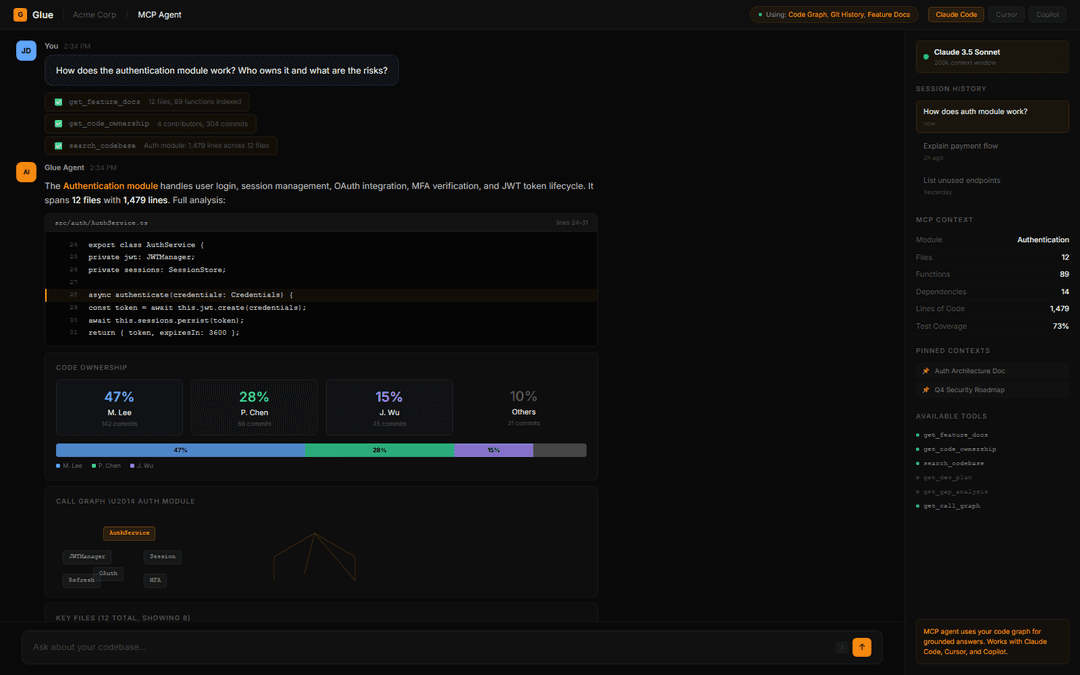
"Do we have SSO?" "What's causing the checkout errors?" "How is onboarding adoption trending?" Today: Slack thread → engineer interruption → 2-3 day wait → maybe an answer. With Glue: type the question. Get an answer backed by code, error logs, and analytics in 8 seconds.
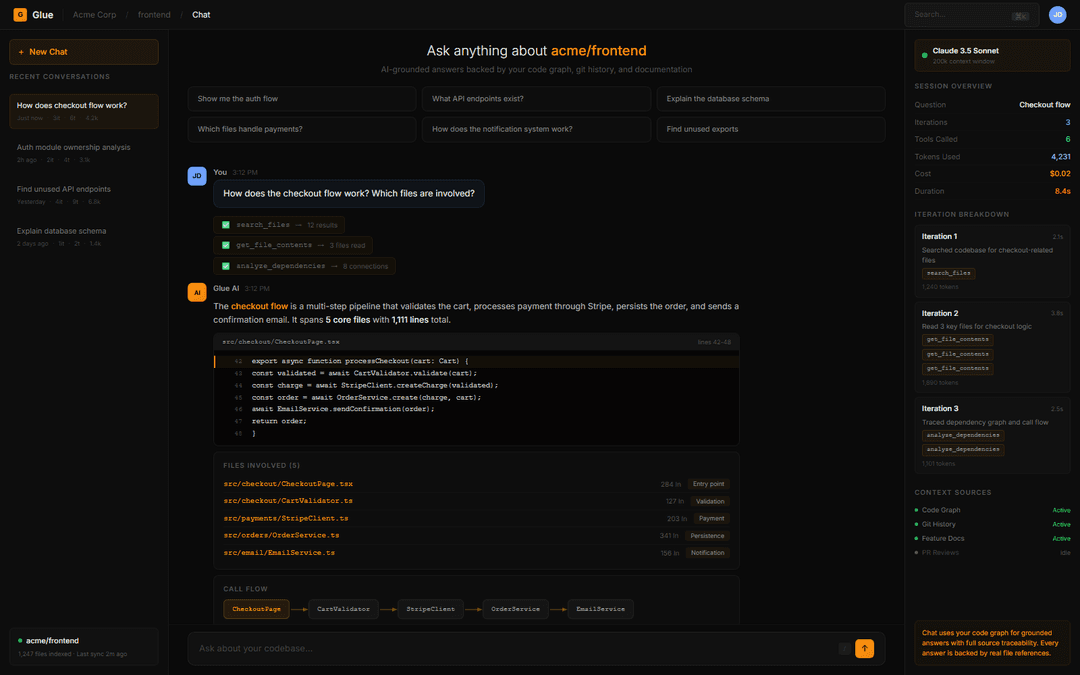
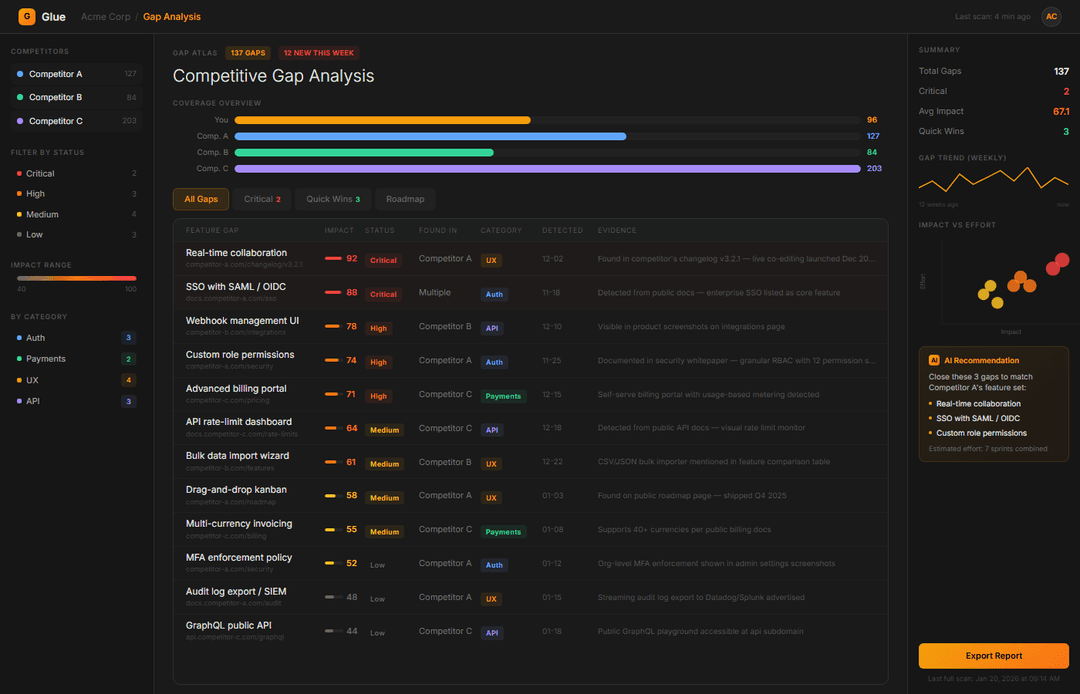
Today you check Sentry for errors, PostHog for usage, Jira for tickets, Slack for context, GitHub for code. None connected. Glue connects them. Error spikes map to features. Usage trends tie to workflows. Tickets link to architecture. One system, full picture.
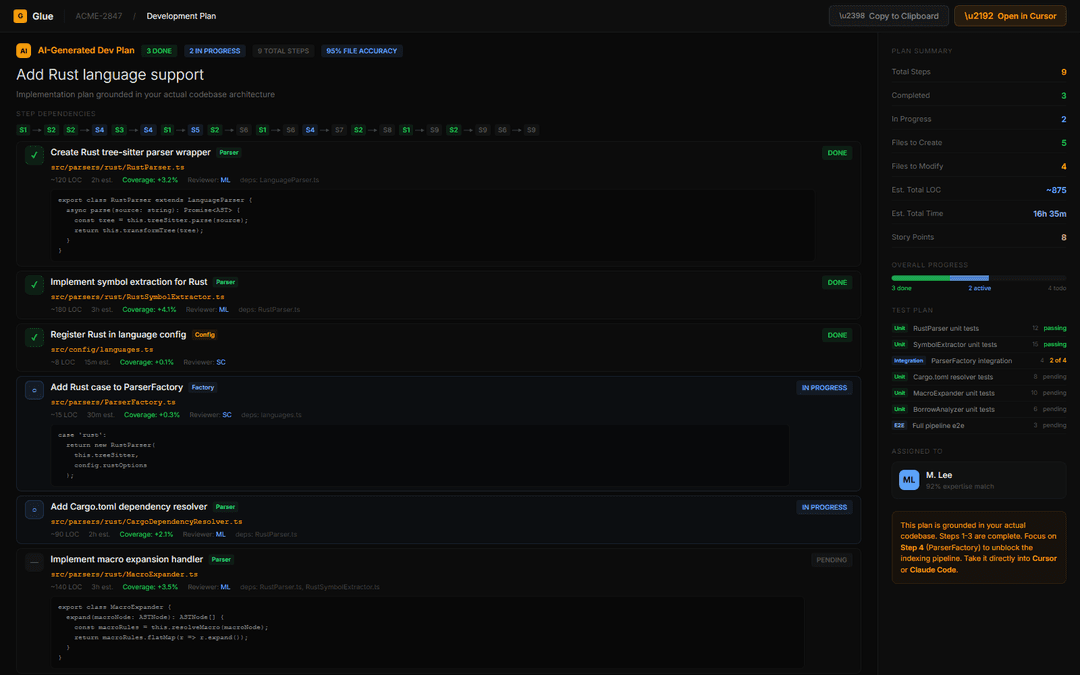
70% of project failures trace to requirements. Not bad engineers — bad specs. Glue generates specs from your actual architecture — code, error patterns, usage data. Exact files. Real patterns. Risks flagged before anyone estimates.
"Alert me when error rates spike." "Draft a ticket when adoption drops." "Post a weekly health report to Slack." Describe what you want in plain English. Glue builds the workflow — pulling from code, errors, analytics, and tickets — and runs it automatically.
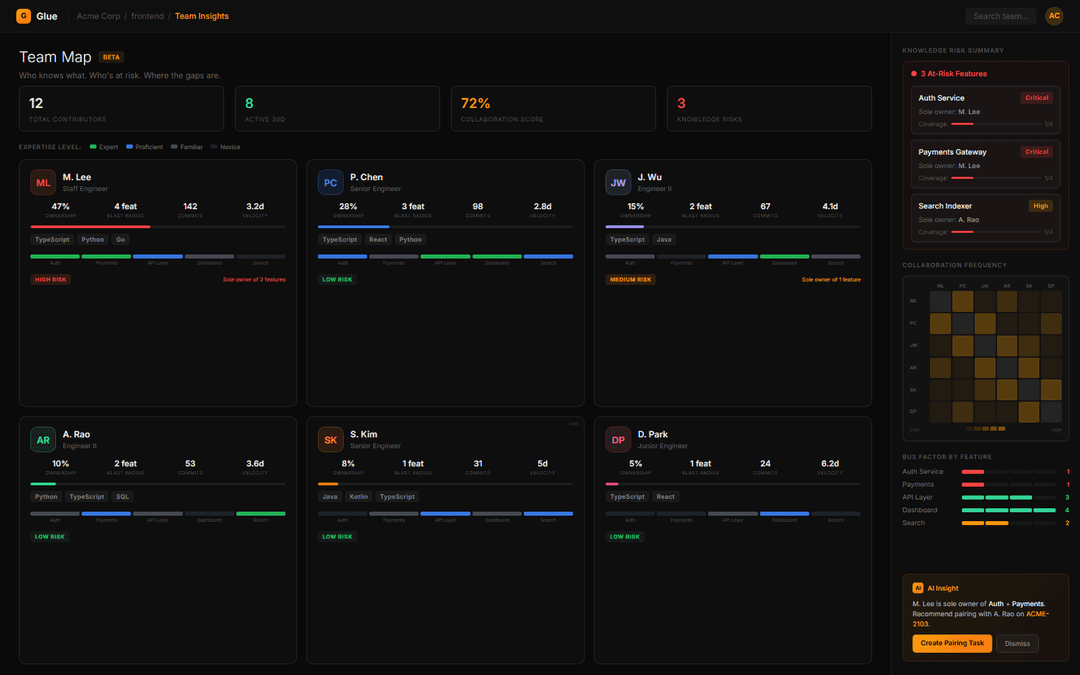
3-6 months to full productivity. Weeks reading outdated docs. 'Just ask Sarah' as the onboarding plan. Glue cuts ramp time 4×. New hires explore the entire product — code, errors, analytics — from day one.
The numbers
wasted per $1B invested
Failed projects start with fragmented visibility — no one sees the full product.
PMI
of failures → requirements
Specs written without full product context are the root cause.
Fohlio 2024
per dev per week
Lost to context-switching between fragmented tools. That's 42% of every engineer's time.
Stripe
of PM time is firefighting
More than half of PM hours chasing information across disconnected tools.
Pragmatic Institute
competitive selling score
Teams can't sell against what they can't see. The gap costs $2-10M/year.
Crayon 2024
of projects exceed budget
Root cause: no one sees the full product picture.
McKinsey
Details
Answers grounded in code, errors, and analytics — not guesses.
Engineers keep their 23-minute focus blocks. PMs get instant answers.
Answers draw from code, Sentry, PostHog, Jira, and Slack — connected.
Sentry errors automatically mapped to the features they affect.
PostHog analytics tied to actual product workflows.
Not a quarterly report. A living system that updates continuously.
Specs name the exact files, follow your patterns, flag dependencies.
Hidden dependencies surfaced before the sprint, not during.
Plans follow your team's conventions, not generic advice.
Describe the goal. Glue figures out the data, triggers, and actions.
Agents read from code, errors, analytics — then act on Slack, Jira, email.
Auto-fire for alerts. Auto-draft for review. PM-initiated for strategy.
Ask the product, not senior engineers. No interruptions required.
Auto-generated documentation that updates as code changes.
Eliminate the negative-value onboarding period.
No fluff. Just answers.
No credit card · Setup in 60 seconds · Works with any stack