
Competitive intelligence for SaaS product teams fails when it tracks only external signals — competitor marketing, pricing changes, G2 ratings — without matching that knowledge against your own product's technical reality. Effective competitive analysis requires three layers: market monitoring (what competitors say), feature-level comparison (what they've actually built), and internal codebase intelligence (what your own system can realistically deliver).
By Vaibhav Verma
A VP of Product at a $50M ARR fintech company told me something that stuck with me: "I spend $180K a year on competitive intelligence tools. I know what our competitors say on their marketing pages. I know their pricing changes within 24 hours. I can tell you their G2 rating to two decimal places. But I have no idea what they've actually built."
She had subscriptions to Crayon, Klue, and SimilarWeb. Her team ran quarterly competitive analyses. They tracked win/loss ratios by competitor. And none of it told her the thing she actually needed to know: which competitor features were deeply integrated versus bolted on, which capabilities were architectural advantages versus marketing claims, and where her own product was genuinely differentiated at the code level versus just the messaging level.
This is the blind spot in how SaaS companies do competitive intelligence. They track what competitors say. They don't track what competitors can actually do. And the difference between those two things is where deals are won and lost.
Why Competitive Intelligence Matters More Now
The SaaS market has compressed. In most categories, the top five competitors offer 80% of the same features. Pricing is converging. UI patterns are converging. The real differentiation is in the 20% that's different - and understanding that 20% requires more than scanning a competitor's feature page.
Gartner estimates that 65% of B2B purchase decisions are competitive - meaning the buyer is evaluating you against at least one alternative. In competitive deals, the product team that understands the real gaps (not the perceived gaps) wins more often.
But most competitive analysis stays at the surface. Product teams compare feature checklists. Marketing teams compare messaging. Sales teams compare what they hear on calls. Nobody compares what's actually been built, how mature it is, or how the underlying architecture constrains what each product can do next.
A 2024 Crayon report found that 92% of companies say competitive intelligence is important, but only 37% say they're doing it effectively. The gap isn't effort. It's depth. Teams are collecting competitive data without turning it into competitive understanding.
The Competitive Intelligence Tools Landscape
Let me map the current CI tooling landscape honestly, because understanding what each category does well reveals what's missing.
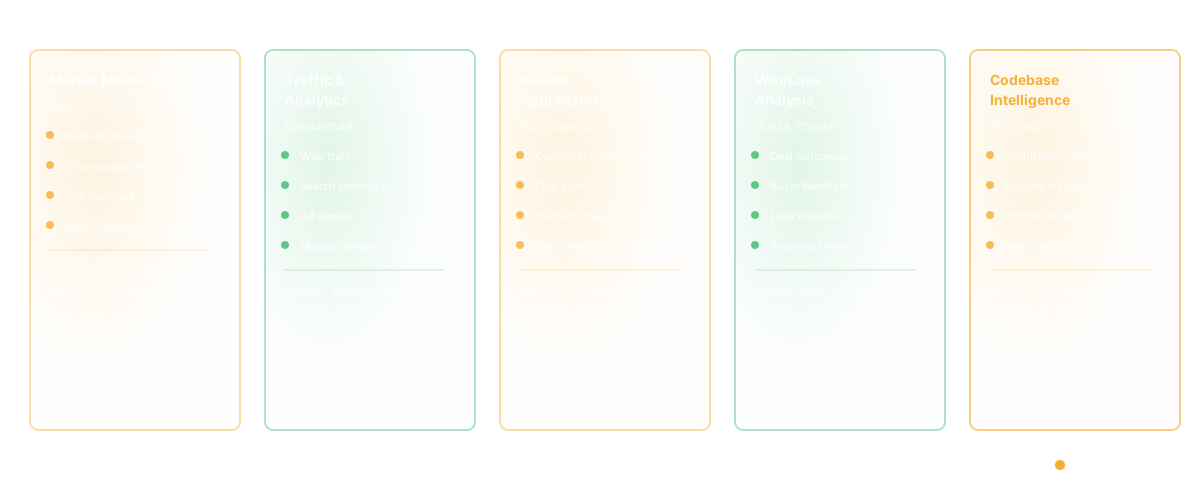
Market monitoring tools (Crayon, Klue, Kompyte) track competitor website changes, pricing updates, job postings, press releases, and content. They're excellent at knowing when something changed. They're weak at understanding what the change means for your product strategy. Knowing that a competitor updated their pricing page doesn't tell you whether their new enterprise tier reflects a real capability expansion or just a packaging exercise.
Traffic and market analytics (SimilarWeb, Semrush, Ahrefs) show competitor web traffic, search rankings, ad spend, and digital marketing strategy. Essential for understanding market positioning and demand. Irrelevant for understanding product capability.
Review aggregators (G2, TrustRadius, Capterra) surface customer sentiment about competitors. Valuable for identifying pain points. Unreliable for feature assessment, because customers describe what they experience, not what the product can technically do.
Win/loss analysis (Clozd, DoubleCheck) interviews buyers to understand why deals were won or lost. Excellent for sales strategy. Less useful for product strategy because buyers rarely articulate technical gaps - they talk about perceived value, pricing, and relationship dynamics.
The missing category: codebase intelligence. None of the tools above can tell you how your own product compares to competitors at the architecture level. None can tell you which features in your codebase are mature and well-tested versus which are fragile and lightly maintained. None can answer the question that actually drives product strategy: "where is our product genuinely stronger, and where is it genuinely weaker?"
Feature Gap Analysis That Goes Deeper Than Checklists
The standard approach to feature gap analysis is a comparison matrix. You list your features, you list competitor features, you identify the gaps, you prioritize filling them. Every product manager has built one.
The problem is that feature matrices treat all features as equivalent. "Real-time collaboration: Yes/No." But the PM who just checks the box doesn't know whether the competitor's real-time collaboration is a native capability built into their architecture or a third-party widget bolted onto the side. The difference matters enormously for competitive positioning, because a native implementation is defensible and extensible while a bolted-on one is fragile and limited.
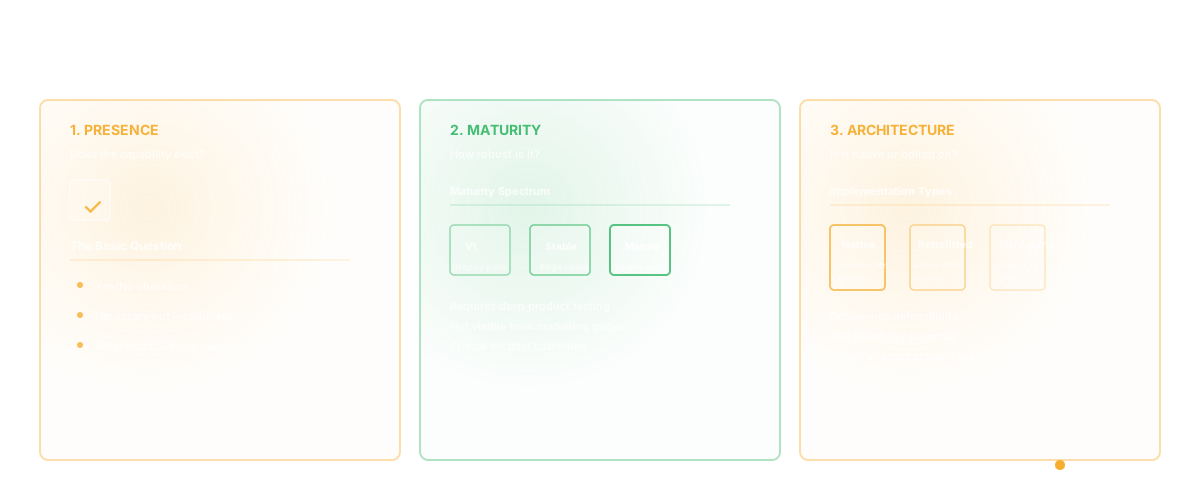
Better feature gap analysis requires three dimensions, not one.
Feature presence: does the capability exist? This is the checkbox. Necessary but insufficient.
Feature maturity: how robust is the implementation? Is it a V1 that handles the happy path, or a mature capability that handles edge cases, scales under load, and integrates with the rest of the product? You can assess this through deep product testing, not just feature scanning.
Architectural support: is the product's architecture designed for this capability, or was it retrofitted? A product built on an event-driven architecture has a structural advantage for real-time features. A product that added real-time as an afterthought will hit scaling limits that the architecturally-native product won't.
Most CI programs only measure the first dimension. The second and third are where competitive strategy actually lives.
Connecting Competitive Intelligence to Your Own Codebase
Here's the part that almost nobody does, and it's the part that changes everything: turning the lens inward.
You can spend six months analyzing competitors. But if you don't have an honest, technical assessment of your own product's strengths and weaknesses, your competitive strategy is built on half the picture.
I've sat in roadmap meetings where the PM confidently said "we need to build X because Competitor A has it." Fair enough. But when engineering looked at the codebase, they discovered we already had 70% of the capability - it was just buried in a service that had been built for a different use case and never surfaced in the product. The "gap" wasn't missing functionality. It was missing visibility into our own product.
The reverse happens too. A team assumes they're competitive on a feature because it exists in their product, without realizing the implementation is so fragile that it breaks under moderate load. They're losing deals and blaming sales, when the real problem is that their feature doesn't actually work as well as the competitor's.
This is why I believe competitive intelligence and codebase intelligence are inseparable. Glue exists to give product teams an honest, automated view of what they've actually built - architecture, dependencies, maturity, technical debt, knowledge concentration. When you combine that with external CI data, you get a competitive picture that's grounded in reality rather than assumptions.
A CI program built on Crayon plus Glue looks like this: Crayon tells you when Competitor A launches a new integration. Glue tells you whether your architecture supports building the same integration in two weeks or two months. The combination turns competitive awareness into competitive response.
Building a Competitive Intelligence Program
If you're starting from scratch, here's the sequence that works. I've helped three companies build this from zero, and the ones that succeeded all followed roughly this progression.
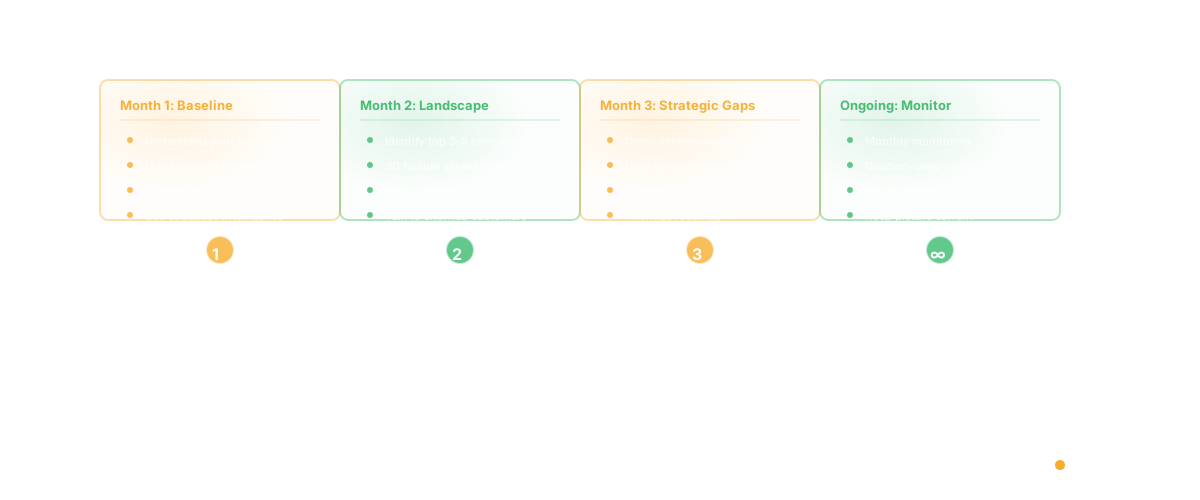
Month 1: Establish your baseline. Before you analyze competitors, understand yourself. What are your product's genuine strengths at the technical level? What are its weaknesses? Where is the architecture flexible, and where is it constrained? Use codebase intelligence to get this picture without requiring your engineers to spend weeks documenting it. This becomes your competitive foundation - the honest assessment against which everything else is measured.
Month 2: Map the competitive landscape. Identify your top 3-5 competitors. For each, build a three-dimensional feature assessment: presence, maturity, architectural support. Use trial accounts for depth. Use CI tools for breadth. Talk to churned customers who switched to competitors and ask specific questions about what capabilities drove the switch.
Month 3: Identify strategic gaps. Cross-reference your own capabilities (from month 1) with competitor capabilities (from month 2). The gaps that matter are the ones where competitors are architecturally strong and you're architecturally weak - these are hard to close quickly. Gaps where you're architecturally strong but haven't surfaced the feature are easy wins.
Ongoing: Monthly monitoring, quarterly deep dives. Set up automated monitoring through Crayon or similar tools. Review competitor changes monthly. Do deep-dive competitive analyses quarterly. Re-assess your own codebase continuously through Glue so your internal picture stays current.
The cadence matters more than the depth of any individual analysis. A team that does lightweight competitive monitoring every month will outperform a team that does one comprehensive competitive analysis per year, because markets move faster than annual cycles.
The Win Rate Connection
Competitive intelligence programs are expensive. The tools, the analyst time, the research. So does it work?
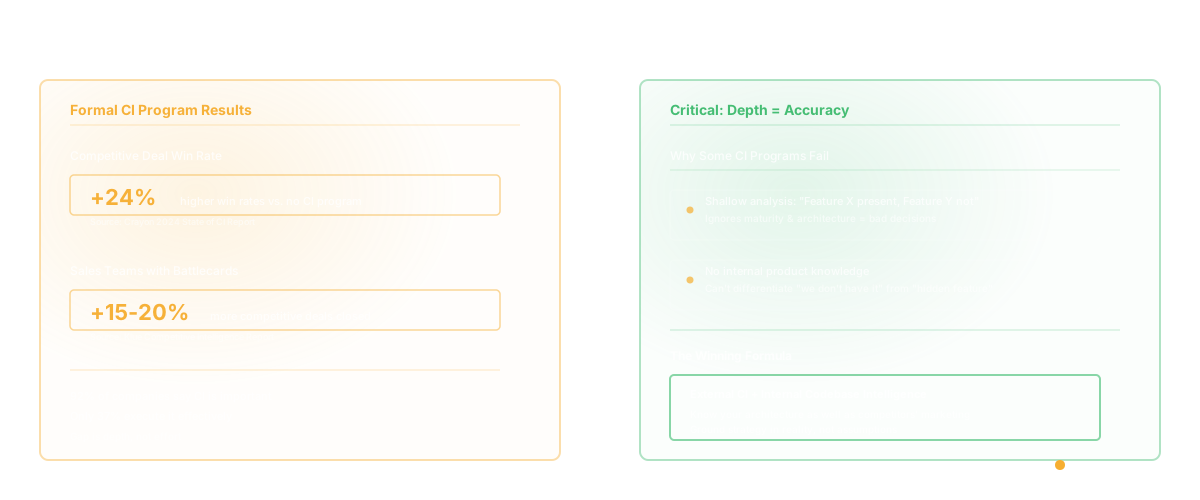
The data says yes, if the intelligence actually reaches decision-makers. Crayon's 2024 State of Competitive Intelligence report found that companies with formal CI programs had 24% higher win rates in competitive deals. Klue's what I've seen is that sales teams with competitive battlecards close 15-20% more competitive deals.
But those numbers assume the intelligence is accurate. And accuracy depends on depth. A battlecard that says "we have Feature X, they don't" is useless if Feature X is fragile and Feature Y (which the competitor has and you don't) is what the buyer actually cares about.
The companies that get the highest ROI from competitive intelligence are the ones that ground their external analysis in internal honesty. They don't just know what competitors have. They know, precisely and technically, what they have and how it compares.
The Uncomfortable Competitive Truth
Most product teams overestimate their own product and underestimate their competitors. This isn't arrogance - it's a natural consequence of asymmetric information. You see your product's best features daily. You see competitors' best features only through their marketing.
The antidote is systematic honesty. Know your codebase as well as you know your competitors' marketing pages. Know your architectural constraints as well as you know your feature list. Know your technical debt as well as you know your positioning.
Competitive intelligence without self-knowledge is just marketing research. Competitive intelligence combined with deep product understanding is a strategic weapon.
Frequently Asked Questions
Q: What competitive intelligence tools do SaaS companies use?
The standard stack includes market monitoring tools (Crayon, Klue, Kompyte) for tracking competitor changes, analytics platforms (SimilarWeb, Semrush) for traffic and market data, review aggregators (G2, TrustRadius) for customer sentiment, and win/loss analysis tools (Clozd) for deal-level insights. The gap in most programs is internal product intelligence — understanding your own codebase through codebase intelligence well enough to make honest comparisons.
Q: How do you do competitive analysis as a product manager?
Start with your own product. Get an honest technical assessment of your capabilities, maturity, and constraints. Then analyze competitors on three dimensions: feature presence (do they have it?), feature maturity (how robust is it?), and architectural support (is their system designed for it?). Cross-reference to find genuine gaps versus marketing gaps.
Q: What is feature gap analysis?
Feature gap analysis identifies capabilities that competitors have and you don't, or vice versa. The basic version is a checklist comparison. The useful version adds maturity assessment (how robust is each implementation?) and architectural analysis (does the product's architecture support the capability natively or is it bolted on?). The best gap analyses combine external competitor assessment with internal codebase intelligence. AI product discovery tools can accelerate this process.
Related Reading
- AI Product Discovery: Why What You Build Next Should Not Be a Guess
- Product Intelligence Platform: What It Is and Why You Need One
- AI for Product Management: The Difference Between Typing Faster and Thinking Better
- The Product Manager's Guide to Understanding Your Codebase
- Product OS: Why Every Engineering Team Needs an Operating System
- Software Productivity: What It Really Means and How to Measure It
- What Is AI Competitive Analysis?
- What Is Competitive Gap Analysis?
- Glue for Competitive Gap Analysis