Comparison
LinearB measures team velocity and DORA metrics. Glue analyzes codebase complexity and dependencies. Complementary tools for understanding engineering performance.
I've evaluated dozens of engineering tools across three companies. What matters isn't the feature list — it's whether the tool actually changes how your team makes decisions.
LinearB is a DORA metrics platform that measures software delivery performance: deployment frequency, lead time, change failure rate, and mean time to recovery. It's built for engineering leaders who want data on delivery velocity and reliability. Glue is built for teams who need to understand why those metrics are what they are.
LinearB aggregates data from your git history, CI/CD systems, and issue trackers to calculate DORA metrics - the industry standard for measuring engineering performance.
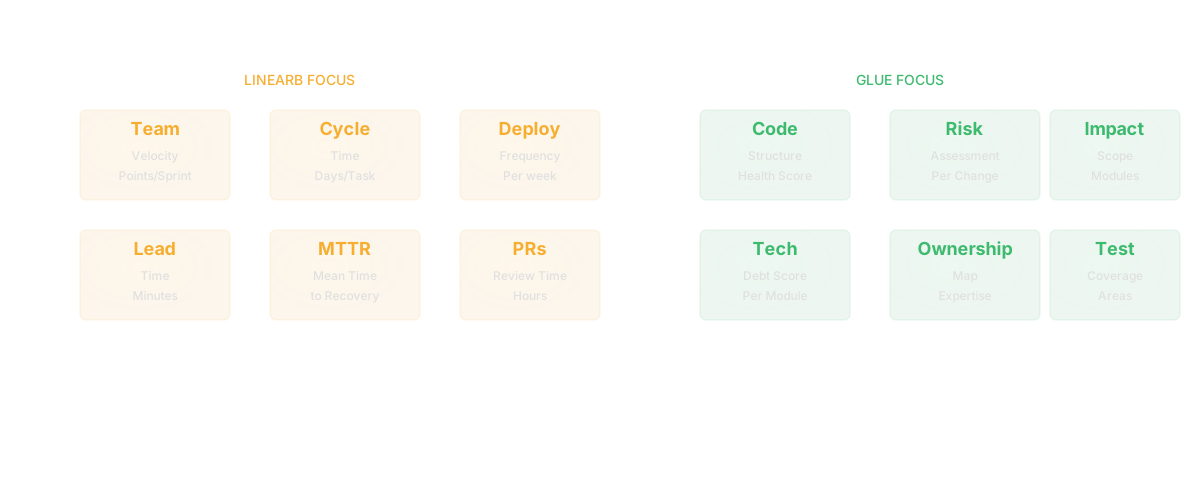
LinearB also provides team-level insights: which teams are shipping faster, where bottlenecks exist in your deployment process, and how your metrics compare to industry benchmarks.
For CTOs and VPs of Engineering trying to measure delivery performance, LinearB provides the data. Are we shipping faster or slower than last quarter? Do we have more or fewer incidents? How do we compare to similar companies?
Glue measures the system that produces those metrics. When LinearB shows your deployment frequency has declined, Glue can answer: why? Are your modules getting more complex? Are dependencies increasing? Is ownership becoming fragmented?
LinearB shows the symptom (declining velocity). Glue shows the structural cause (increasing complexity, architectural coupling, unclear ownership).
LinearB is backward-looking and aggregated: "Here's what we shipped and how fast." Glue is current and structural: "Here's what the codebase shows about why we can or cannot ship fast."
Example: LinearB shows deployment frequency dropped from 2x/day to 1x/week. That's a red flag. But what's causing it? LinearB can't answer. Glue can: the modules in your critical path have become more tightly coupled; you used to be able to deploy services independently, now you need to coordinate across five teams. That's a structural problem requiring refactoring, not a process problem requiring process optimization.
Another example: LinearB shows your change failure rate (percentage of deployments that cause incidents) has increased. That's bad data. But again, why? Glue shows: your most-changed modules have also increased in complexity; reviews are rightfully taking longer because risk is higher; coverage is lower in the modules most frequently modified. These are structural patterns that LinearB's metrics detect but can't explain.
| Capability | LinearB | Glue |
|---|---|---|
| DORA metrics | Comprehensive | Not applicable |
| Deployment frequency | Yes | Not applicable |
| Lead time measurement | Yes | Not applicable |
| Change failure rate | Yes | Not applicable |
| Team benchmarking | Detailed | Not applicable |
| Structural cause identification | No | Yes |
| Code complexity and risk | No | Yes |
| Architectural dependency analysis | No | Yes |
| Ownership clarity | No | Yes |
| Change pattern context | No | Yes |
| System health indicators | No | Yes |
If your primary need is measuring software delivery performance, LinearB is essential. You need DORA metrics, you want to track whether velocity is improving, and you need to understand where process bottlenecks exist. You're building a data-driven engineering culture based on metrics.
LinearB also provides benchmarking data that helps you understand whether your delivery metrics are competitive.
Choose Glue when LinearB shows that something is off with your metrics, but you need to understand why. When your CTO is trying to explain to the board why velocity has declined (LinearB shows the decline; Glue explains the structural reason). When you need to understand whether a metric problem is process-related (solvable by optimizing workflow) or system-related (requires architectural change).
Choose Glue if you've invested in LinearB but still feel like you're treating symptoms rather than root causes. Glue provides the structural context that makes metric improvements stick.
| Feature | LinearB | Glue |
|---|---|---|
| DORA metrics | Core feature — comprehensive tracking | Not a metrics platform |
| Deployment frequency | Tracked automatically | Not tracked |
| Lead time measurement | Tracked with breakdowns | Not tracked |
| Change failure rate | Correlated with deployments | Not tracked |
| Team benchmarking | Industry comparisons included | Not applicable |
| Code complexity analysis | Limited | Deep structural analysis |
| Dependency mapping | Not available | Full dependency graph |
| Knowledge silo detection | Not available | Identifies knowledge concentration |
| Bus factor analysis | Not available | Calculates bus factor per module |
| Architecture understanding | Not available | Maps system structure |
| Root cause analysis | Shows metric trends | Explains structural causes |
| Feature discovery | Not available | Catalogs existing product features |
| Competitive gap analysis | Not available | Scores gaps against your code |
| Best for | Measuring delivery performance | Understanding codebase structure |
Week 1: LinearB shows the problem. Your DORA dashboard shows deployment frequency dropped 40% over the last quarter. Lead time increased from 2 days to 5 days. Your VP of Engineering sees the red flags.
Week 2: The team investigates. Engineering leads review the data. "We're slower because we have more meetings." "No, it's because of the new compliance requirements." "Actually, our tests are taking longer." Everyone has a theory. Nobody has proof.
Week 3: Glue shows the root cause. Glue's analysis reveals: the core data service has grown from 12 to 47 internal dependencies over the past 6 months. Three modules that used to be independent now share a database schema. The bus factor for the payment module dropped from 3 to 1 because two engineers transferred teams.
The velocity decline isn't a process problem — it's a structural problem. No amount of meeting optimization will fix it. You need refactoring and cross-training.
The takeaway: LinearB told you velocity declined. Glue told you why and what to do about it.
Most engineering organizations benefit from both tools at different organizational levels:
LinearB offers a free tier for small teams and paid plans for organizations needing advanced analytics and benchmarking. Glue's pricing is available on request.
The ROI calculation is different for each:
Q: Should we use both LinearB and Glue?
Yes. LinearB measures your delivery performance. Glue explains what the code structure shows about why those metrics are what they are.
Q: LinearB shows deployment frequency has declined. Does Glue help?
Yes. Glue explains whether the decline is because processes slowed down (solvable with workflow changes) or systems got more complex (requires architectural changes). That's the critical distinction.
Q: Can Glue replace LinearB for performance metrics?
No. Glue doesn't measure deployment frequency, lead time, or incident rates. If you need those metrics, LinearB is the right tool.
Q: Can LinearB replace Glue for understanding velocity?
LinearB shows you velocity metrics. Glue shows you the structural reasons behind those metrics. LinearB is diagnosis, Glue is root cause.
Q: How do LinearB insights and Glue insights work together?
Example workflow: LinearB shows Team A's lead time is 3x Team B's. That's a red flag. Glue reveals: Team A owns the core data module with high complexity and tight coupling. Team B owns isolated services. Now you know the issue isn't team capability - it's system structure. You need refactoring, not process optimization.
Q: How does LinearB compare to Jellyfish and Swarmia?
LinearB focuses on PR-level cycle time and developer workflow optimization, Jellyfish tracks engineering investment against business outcomes, and Swarmia measures developer experience and team productivity. Each serves different stakeholders. See our LinearB vs Jellyfish vs Swarmia comparison for a detailed breakdown.
Keep reading
Related resources