Comparison
Swarmia measures team workflow and cycle time. Glue measures system structure and complexity. Understand the difference.
I've evaluated dozens of engineering tools across three companies. What matters isn't the feature list — it's whether the tool actually changes how your team makes decisions.
Swarmia is a productivity analytics tool that measures HOW teams are working. Glue measures WHAT systems teams are working on. They answer completely different questions about why engineering velocity is what it is.
Swarmia aggregates data from your git history, pull requests, and deployment systems to provide metrics on team flow: cycle time (time from commit to production), PR review time, deployment frequency, working agreements compliance, and team health patterns.
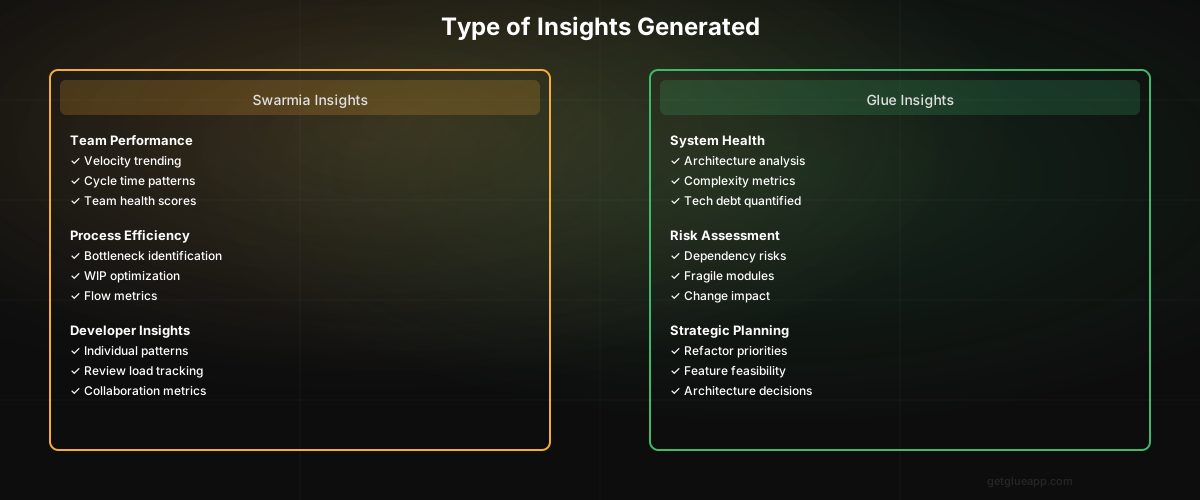
For an EM or productivity-focused leader, Swarmia answers: "How is my team flowing?" Are PRs getting reviewed quickly or are they sitting? How long does code take to reach production? Are we deploying multiple times a day or once a month? How is our deployment consistency? Swarmia also highlights bottlenecks in your workflow: "PRs in this repo spend 3x longer in review than expected."
Swarmia operates at the process level. It measures the mechanics of how work moves through your system.
Glue operates at the system level. It measures the codebase structure, complexity, and ownership patterns that determine how hard certain work is.
When Swarmia shows that Team A's cycle time is 3 days and Team B's is 7 days, Glue explains: Team A owns modules with average complexity of 5; Team B owns modules with average complexity of 12. Team A's modules are owned by a single team; Team B's modules have split ownership. That's why the cycle time differs - not a process problem, a system problem.
Or another example: Swarmia shows deployment frequency has declined from 4 deployments per day to 1 per week. Glue reveals: the modules in your critical path have become more tightly coupled; they used to be relatively independent, now you need to coordinate across five teams to deploy safely.
Swarmia measures the speed of the machine. Glue measures the state of what the machine is working on.
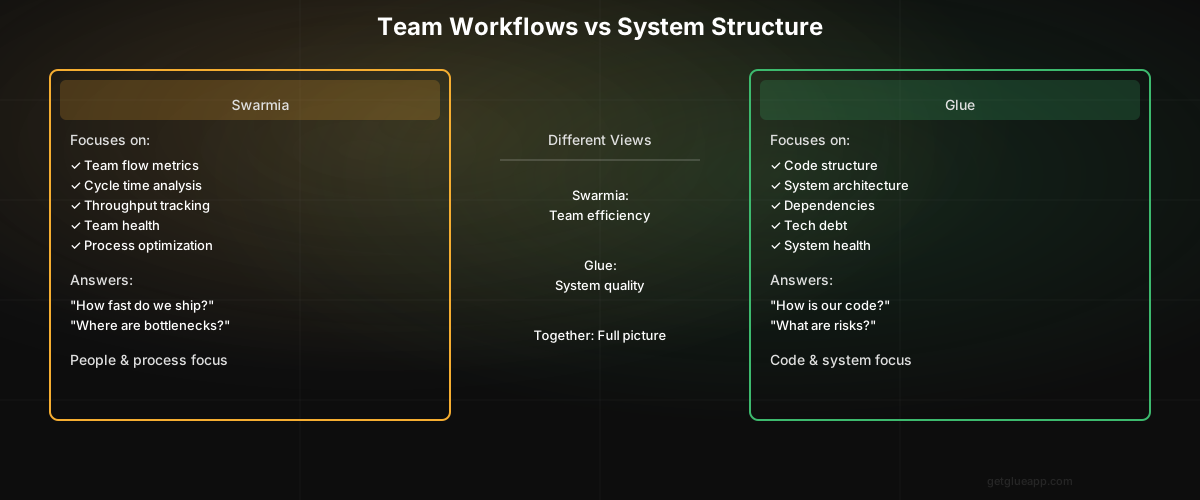
Both can show the same symptom (declining cycle time), but for different reasons. Swarmia might show: your PRs are staying open longer because reviewers are slower. Glue might show: your cycle time is longer because the module is more complex, so reviewers are rightfully taking longer because changes are riskier.
These require different solutions. If Swarmia shows the problem, you add more reviewers. If Glue shows the problem, you refactor the module.
For a leader trying to improve team velocity, this distinction is critical. You can optimize team workflows with Swarmia (reduce PR review cycle time, improve deployment frequency), but if the codebase is the bottleneck, workflow optimization won't help. You need structural changes, which is what Glue reveals.
| Capability | Swarmia | Glue |
|---|---|---|
| Cycle time measurement | Core feature | Not applicable |
| PR review time analysis | Detailed | Not applicable |
| Deployment frequency | Yes | Not applicable |
| Working agreements tracking | Yes | Not applicable |
| Bottleneck identification (process) | Yes | Not applicable |
| Team flow visualization | Yes | Not applicable |
| Code complexity and structure | No | Core feature |
| Architectural dependencies | No | Yes |
| Ownership clarity | Limited | Core feature |
| Change pattern analysis | Limited | Yes |
| System-level bottlenecks | No | Yes |
| Process-level bottlenecks | Yes | No |
Choose Swarmia if you want to optimize team workflows and measure process efficiency. If your goal is reducing cycle time, improving PR review time, or understanding deployment reliability, Swarmia is the right tool. You're operating at the process level and want data on how teams are executing.
Swarmia is also better if you need to track working agreements and culture metrics like focus time and after-hours work.
Choose Glue when you've optimized your processes (Swarmia shows you're flowing well), but teams are still slow. When your CTO suspects the problem isn't process, it's architecture. When you need to understand whether declining velocity is a team capability issue or a system structure issue.
Choose Glue if you're planning a team reorganization and need to understand codebase structure first - owning the right modules matters more than optimizing workflow.
Q: Should we use both Swarmia and Glue?
Yes. Swarmia optimizes the process. Glue optimizes the system. Both matter for velocity.
Q: Our Swarmia metrics look good, but we still feel slow. Why?
That's exactly where Glue helps. If your processes are efficient but velocity is still low, the bottleneck is likely system structure, not team workflow. Glue identifies which modules are structural bottlenecks.
Q: Can Glue help us improve our Swarmia metrics?
Yes. Refactoring modules that Glue identifies as problematic often improves cycle time because complexity decreases. But the connection is indirect - Glue shows you WHAT to fix (module structure), Swarmia shows you HOW FAST you're fixing it.
Q: Does Swarmia show architectural problems?
Swarmia can hint at them (e.g., "this repo has longer review times"), but it doesn't analyze the codebase directly. Glue does that directly.
Q: If I'm just trying to ship faster, which tool matters more?
Both, but in sequence. First use Glue to understand if the bottleneck is the system (architecture, complexity, dependencies) or the process (review time, deployment workflow). Then optimize accordingly. If it's a system problem, Swarmia optimization won't help much.
Q: Can we use Swarmia metrics to measure the impact of refactoring identified by Glue?
Yes. Use Glue to identify a problematic module, refactor it, then use Swarmia to measure whether cycle time improved for that module's work.
Q: How does Swarmia compare to LinearB and Jellyfish?
Swarmia prioritizes developer experience and team-level workflow insights, LinearB focuses on PR cycle time and delivery bottlenecks, and Jellyfish maps engineering investment to business impact. Each platform solves a different problem. Read our LinearB vs Jellyfish vs Swarmia comparison for a detailed breakdown.
Keep reading
Related resources