Use Case
Use real - time codebase intelligence during sprint planning, execution, and retrospectives to improve velocity prediction and reduce mid - sprint surprises.
At UshaOm, sprint planning took three hours every Monday. By Wednesday, the plan was already wrong. At Salesken, I started measuring why — and the answer was always the same: bad estimates built on incomplete information.
Most sprint planning happens in a vacuum. Teams estimate work without understanding the actual complexity of what they're touching. The payment system that seems straightforward turns out to be tightly coupled to five other modules. The "quick refactor" uncovers hidden dependencies. The feature that should take two weeks takes four because the codebase context nobody had at planning time reveals itself mid-sprint.
The sprint intelligence loop solves this by making codebase intelligence available at the moments when it matters most: during planning, execution, and retrospectives. Before teams plan work, they know the complexity. During the sprint, they track what's actually changing and emerging dependencies. During retro, they understand the codebase factors that shaped their velocity.
Sprint planning relies on estimates, and estimates rely on assumptions. The assumption is that the team knows the codebase well enough to predict effort. This works if your codebase is small or your team has deep institutional memory. It breaks the moment you scale.
Teams split across domains. Senior engineers leave. New features layer on top of legacy code. Module dependencies shift over time. What seemed simple six months ago is now coupled to systems that have changed three times over. The knowledge about your codebase becomes increasingly distributed and stale.
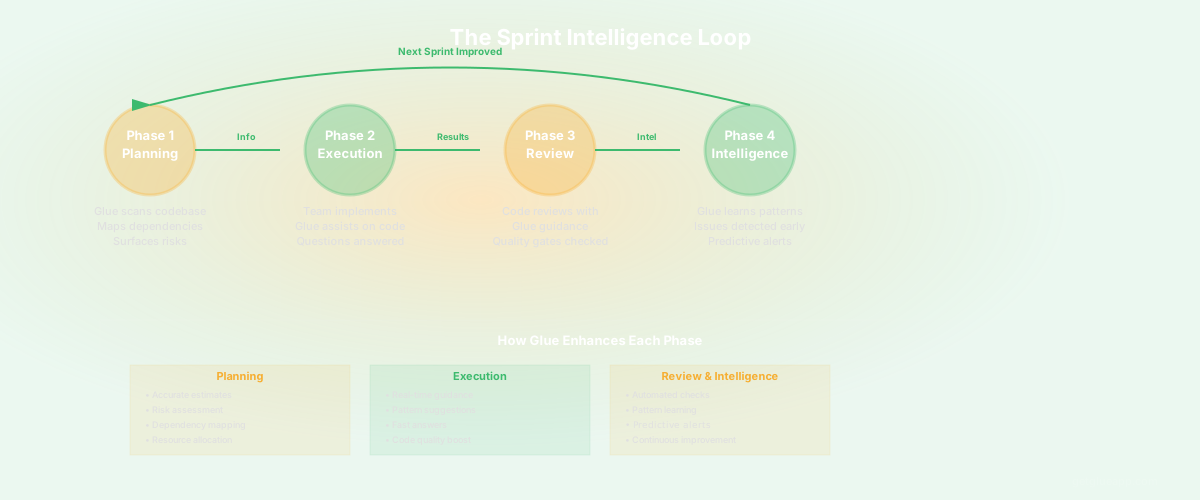
During planning, this unknown complexity manifests as either wildly optimistic estimates (because the team doesn't know what they don't know) or wildly conservative estimates (because people are afraid of the surprises). Neither helps you plan effectively.
Then the sprint happens. Midway through, the team discovers complexity they didn't anticipate. A change in one module breaks assumptions in another. Dependencies that weren't obvious at planning time become obvious at integration time. The sprint velocity drops. The team reruns the math on what they can actually deliver.
The retrospective tries to extract lessons. Why was velocity lower than expected? Usually the answer is some version of "we didn't understand the code as well as we thought." But there's no systematic signal. It's tribal knowledge. Next sprint, the same thing happens.
Some teams try to solve this by having architects review all sprint work before planning. This works until your codebase is large or your architecture org is bottlenecked. Then you're waiting for architecture review to finish planning. The meetings get longer. The value of the review decays because it happens too far from execution.
Others try to solve it with better documentation. Keep your architecture diagrams updated. Maintain dependency maps. This works if discipline is high and the codebase is stable. Most teams are neither. The documentation drifts. By the time you use it in planning, it's six months stale.
Some attempt to solve it with more conservative estimates and buffer time. If you always add 30% to every estimate to account for unknowns, you'll be closer to reality. But this is not a solution, it's damage control. You're acknowledging that planning is unreliable but not making it reliable. You're just padding the numbers.
The underlying problem with all of these approaches: they treat codebase intelligence as optional or optional-later. They don't integrate it into the sprint rhythm. It's something you do if you have time, but if the planning meeting is already at two hours, architecture review gets cut.
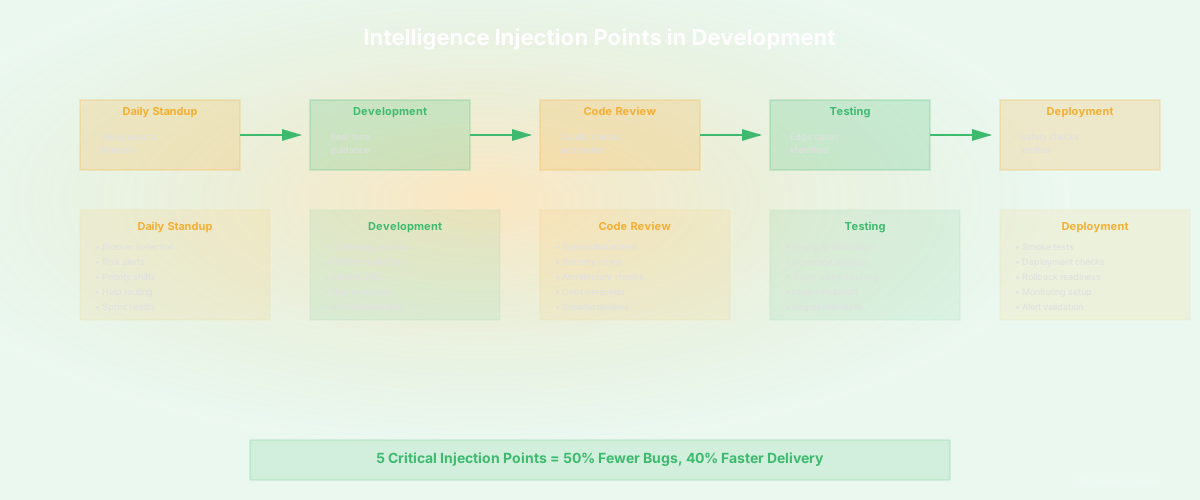
Glue makes codebase intelligence a lightweight part of the sprint cycle - not an additional process, but a shift in what data is available at each decision point.
Before the sprint planning meeting, the team running planning asks Glue specific questions about the areas they're about to work on:
"What's the complexity distribution in our payment module? Are there specific areas with high coupling?"
Glue shows: payment module is relatively stable, but there are three tight clusters. One cluster (transaction processing) is coupled to the ledger system and has five different authors over the past year. Another (subscription logic) is coupled to the webhook handler. A third (error handling) is widely imported across the system.
Now the planning team knows: if they're planning to touch subscription logic, they need to consider webhook system implications. If they're touching error handling, it's a cross-system concern.
"Who owns what in the areas we're planning to work on?"
Glue shows: subscription logic has two primary authors (both on the backend team), but payment error handling was touched by someone who left three months ago, and the current knowledge is distributed. This surfaces a risk. If they plan complex changes to error handling, they need to plan knowledge transfer time, not just implementation time.
"What changed in the UI rendering system in the past month?"
Glue shows: three different changes, all from the same engineer. They're related to performance optimization. If the sprint is planning features that touch rendering, the team should know that this area is in active churn and there might be undocumented changes or adjacent refactors underway.
Result: the planning meeting starts with context. Not assumptions. Context. Estimates shift. The team says, "Actually, subscription changes touch the webhook system, we should involve that team early." Or, "The error handling area is fragile, we should do this as a separate story with more review time."
Three days into the sprint, a developer starts working on a story. They ask Glue: "What are the actual dependencies of the payment service module? I want to understand what I might break."
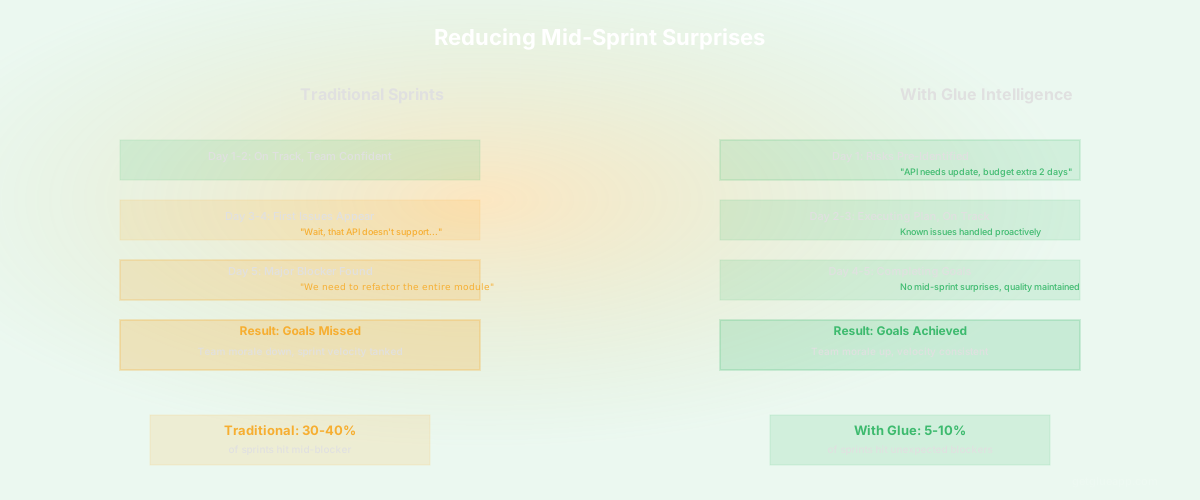
Glue shows a dependency graph. It's not theoretical. It's the actual import graph from the codebase. The developer sees that their changes could ripple to the dashboard, the billing reports, and the webhook processor. They flag this. They coordinate with the teammates working on those systems. They add integration tests. A problem that would have surfaced in testing ( - or worse, in production) is caught early.
A different team realizes, mid-sprint, that they need to refactor a core piece of the codebase to hit their performance goals. They ask Glue: "How many parts of the codebase import this module? What would I break?"
Instead of guessing, they have the actual answer. They can scope the refactor properly. They can plan the rollout. They can write a migration path for the teams that depend on the old behavior.
The team completed 34 points instead of the 40 they planned. Why?
Without codebase intelligence, the answer is usually vague: "The widget work was more complex than expected" or "We had more meetings than planned."
With Glue, the answer becomes specific. The team asks: "What changed in the widget system before we started work on this story?"
Glue shows: the widget system had three changes in the past week, all related to refactoring the state management. The team didn't know this. When they started their story, they were actually working with a partially refactored system. That added complexity and required learning time. That's why the story took longer.
This is the feedback loop that existing approaches miss. It's not "widget work is hard." It's "widget work was hard because of recent changes we didn't know about." And now you can prevent this next sprint by asking Glue about recent changes before planning.
Teams using this approach see two measurable impacts:
First, planning velocity becomes more predictable. Not perfect ( - codebases are always surprising), but more predictable. The gap between planned and completed work narrows. Over three sprints, teams typically see variance drop by 30 - 40%, because they're planning with better information.
Second, mid-sprint surprises decrease. Developers encounter fewer unknown dependencies, fewer areas that are more complex than expected, fewer assumptions that turn out to be wrong. This doesn't eliminate surprises ( - that's impossible), but it shifts them from "we didn't know this existed" to "we knew this existed but miscalculated the effort." That's a much smaller surprise.
Third, the retrospective becomes actionable. Instead of tribal knowledge ("the team knows that widget work is hard"), you have data ("we found that unknown changes in subsystem X add 20% overhead to dependent work"). You can actually optimize the system.
The sprint intelligence loop is not a tool that tells the team what to do. It's a data integration that makes planning, execution, and reflection more grounded in actual codebase reality.
Q: Does this add time to sprint planning?
A: Not if it's framed correctly. Instead of adding an "intelligence gathering" phase to planning, you're shifting the intelligence gathering to before the planning meeting. The planning meeting itself is faster because the team starts with context instead of assumptions.
Q: What if the Glue data contradicts what the team thinks they know about the codebase?
A: This is actually valuable. It means your institutional knowledge is stale. The data is the source of truth. The team should use it to update their model of the codebase. This is exactly the kind of feedback that prevents estimates from drifting further and further from reality.
Q: Can we automate this? Like, have a bot ask Glue these questions before every sprint?
A: You could, but you'd lose the value of human judgment. The questions that matter are different for each sprint, depending on what work is planned. A bot asking generic questions would give you data that doesn't apply. The sprint planning lead should be the one deciding which Glue queries matter this sprint.
Q: How far back should we look at codebase changes in the retrospective?
A: Just the sprint period. You want to know: what changed in the codebase during this sprint that affected the work we were doing? Anything outside the sprint window is pre-existing context that should have been in the initial estimate.
Q: What if teams start using this data as an excuse to over - estimate?
A: This is a cultural question, not a tool question. If your culture is that better planning means inflating estimates, then yes, this data enables that. If your culture is that better planning means more accurate estimates, it works the other way. Glue gives you data. How you use it depends on the team.
Q: Can we track sprint velocity over time and use codebase intelligence to explain variance?
A: Yes, and this is where the real learning happens. Over three to six months of sprints, patterns emerge. You'll see that when a particular system is in churn, velocity across dependent work decreases. You'll see that certain types of refactors (even when small) disproportionately impact sprint capacity. This becomes predictive. You can plan around it.
Keep reading
Related resources