Glossary
Knowledge silos prevent information sharing across teams and reduce product velocity. Learn how to break them down.
At UshaOm with 27 engineers, tribal knowledge was our biggest risk. When two senior engineers left in the same month, we lost institutional context that took six months to rebuild.
A knowledge silo (also called an information silo) is information held by a small group of people (often one person) that isn't shared broadly across a team or organization. When knowledge is siloed, access to that information is bottlenecked through those specific people. If they're unavailable (vacation, sick leave, departure), the knowledge effectively disappears.
Knowledge silos are particularly common in engineering teams, where deep codebase knowledge is concentrated in the people who built the systems. They're also common in product teams, where understanding of why certain features were built a certain way, or decisions made in the past, lives in people's heads.
Knowledge silos create four cascading problems:
First, they reduce team productivity. When knowledge is siloed, people need to ask the knowledge-holder whenever they need information. The knowledge-holder becomes a bottleneck. If the knowledge-holder is in a meeting, on vacation, or swamped with their own work, other people are blocked.
Second, they increase execution risk. If the person who understands a critical system leaves the company, that knowledge walks out the door. The team loses context about why systems are designed as they are, what constraints they operate under, and what attempts to change them have been made before. Rebuilding that understanding takes time and often involves mistakes that could have been avoided.
Third, they reduce psychological safety. When knowledge is siloed, people who don't have access to that knowledge feel dependent on the knowledge-holder. This creates a power dynamic. People are less likely to challenge decisions or raise concerns because they're afraid of being seen as not understanding things.
Fourth, they increase turnover. People leave for many reasons, but one is feeling underutilized. When knowledge is concentrated in a few people, others feel less valuable. Spreading knowledge makes everyone feel more integral to the team.
Specialization is good. Someone specialized in payment systems knows more about payments than a generalist. That's valuable.
Knowledge silos are bad. Someone being the only person who understands payment systems is a risk. Specialization + knowledge transfer = good. Specialization + secrecy = silo.
The difference: A payment specialist who documents their decisions, mentors others, and makes it easy for others to understand the system has specialized knowledge but no silo. A payment specialist who keeps knowledge in their head creates a silo.
They form for understandable reasons:
Pressure to ship. When there's urgency, people document less. "We need to ship by Friday" doesn't create space for writing documentation. Documentation happens later. Later never comes.
Lack of documentation culture. If the organization doesn't value documentation, individuals don't invest in it. If documentation is expected but not supported (no time, no tools, no recognition), it doesn't happen.
Individual initiative. Sometimes individuals keep knowledge close because they value job security. "If I'm the only one who knows this, I'm indispensable." This is misguided (it usually leads to burnout and departure), but it happens.
System complexity. Understanding a complex system takes time. Explaining it takes more time. If there's no forcing function to explain it, it often doesn't happen.
Distributed teams. When teams are distributed across time zones, knowledge transfer is harder. It requires intentional work (documentation, async video walkthrough, pairing sessions). Without intentional work, knowledge stays with the originator.
Measure them. "How many people understand system X?" If the answer is one or two, that's a silo. Make it a metric. "Key knowledge should be understood by at least two people." Track it quarterly.
Create incentives for sharing. People document and teach when it's valued and recognized. Make knowledge transfer part of career development. In reviews, recognize people who shared knowledge.
Pair knowledge-holders with others. Have the person who understands system X work with someone who doesn't. They work on a task together. The knowledge-holder explains as they go. The other person learns, often discovers gaps in understanding, and documents what they learn.
Write things down. Not comprehensive documentation (that's expensive). Focused documentation: "Here's how this system works," "Here's why we made this decision," "Here's what I wish I'd known when I started on this."
Have off-boarding meetings. Before someone leaves, have them do a knowledge-transfer meeting. Not "tell us everything" (impossible in one meeting). Rather "what knowledge is most critical for someone else to learn?" Document that.
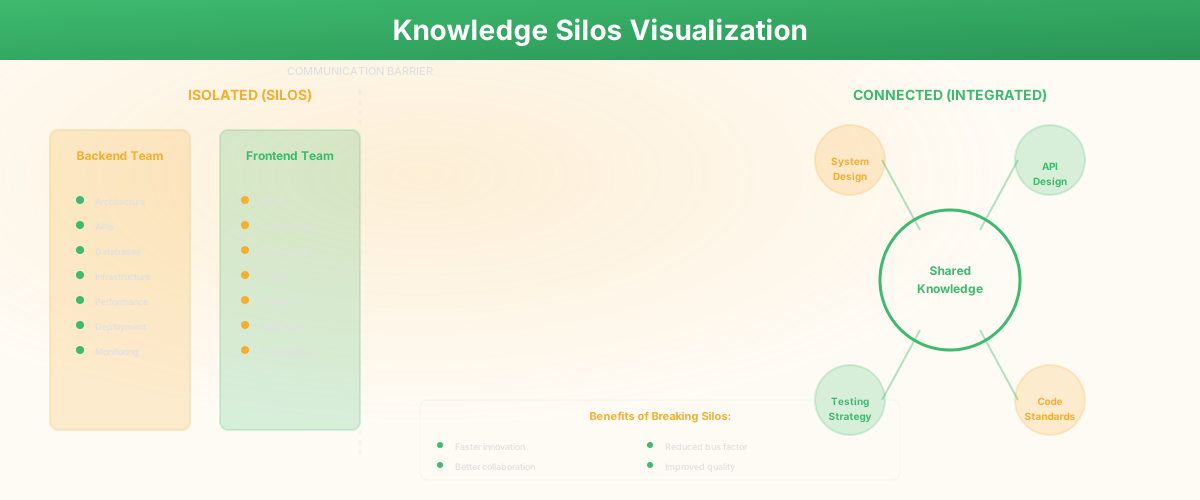
Codebase intelligence tools help break silos by making codebase knowledge accessible. Instead of asking the person who wrote the payment system "how does this work?", you can ask a tool "what's the architecture of the payment system?" The tool surfaces that information from the code.
This doesn't replace human knowledge transfer (you still want people to talk). But it makes it easier for people to become self-sufficient.
You can't fix what you can't see. Here are practical ways to measure knowledge silos in your organization:
Code ownership concentration. Look at your version control history. If 80% of commits to a module come from one person, that's a knowledge silo. Tools like git-fame or Glue's codebase intelligence can surface this automatically.
Review bottlenecks. Track who reviews pull requests. If the same person is required reviewer on most PRs for a service, knowledge is concentrated. Healthy teams have 3+ people who can review any given area.
On-call escalation patterns. When an incident occurs, who gets paged? If the same person is always escalated to for a particular system, that system has a knowledge silo. Track escalation paths over 90 days to identify patterns.
Question routing. In Slack or Teams, who gets tagged when questions arise about specific systems? If the same name keeps appearing, there's a silo. Some teams track @mentions to quantify this.
Bus factor score. For each critical system, count how many people could independently debug and fix a production issue. A bus factor of 1 is a severe silo. Aim for 3+.
| Metric | Healthy | Warning | Critical |
|---|---|---|---|
| Code ownership concentration | <50% one person | 50-70% | >70% |
| Qualified reviewers per area | 3+ | 2 | 1 |
| On-call escalation to same person | <20% | 20-50% | >50% |
| Bus factor per critical system | 3+ | 2 | 1 |
Knowledge silos look different depending on your team:
Backend engineering teams. The person who built the payment processing system is the only one who understands the edge cases around refunds, partial captures, and webhook retries. Every payment bug gets routed to them, regardless of complexity.
Frontend engineering teams. One developer built the design system and component library. Others use it but don't understand the theming architecture, responsive breakpoints, or accessibility patterns baked in. Any non-trivial UI change requires their input.
DevOps/Platform teams. The infrastructure engineer who set up the Kubernetes cluster, CI/CD pipelines, and monitoring stack holds critical knowledge about configuration choices, scaling thresholds, and disaster recovery procedures that aren't documented anywhere.
Product management teams. A senior PM who has been with the company for years knows why features were built certain ways, which customer segments drove specific decisions, and what approaches were tried and abandoned. New PMs make decisions without this context, often repeating past mistakes.
Data teams. The data engineer who built the ETL pipelines and data warehouse schema is the only person who knows which data sources are reliable, which have known quality issues, and how to troubleshoot pipeline failures. Reports get delayed whenever they're unavailable.
"Knowledge silos are just a culture problem." Partly culture, but mostly a system problem. If sharing knowledge requires extra effort and isn't valued, it won't happen. Make sharing the path of least resistance (easy to do, time allocated, recognized in reviews).
"We'll document everything." You won't. Comprehensive documentation is expensive and goes stale. Instead, document what's critical: system architecture, key decisions, known gotchas, and how to learn more.
"Only managers should care about knowledge silos." Everyone should. Knowledge silos create bottlenecks that hurt everyone. Individuals who feel bottlenecked by knowledge silos should advocate for change.
"Knowledge silos are permanent." False. Teams break them. It requires: conscious effort, measurement, incentives, and time. But it's possible.
Q: How do you balance specialization with avoiding silos? A: Specialization is fine. Silos are the problem. A specialist who's the only person learning about their specialty creates a silo. A specialist who mentors others, documents their work, and helps others learn creates expertise without a silo. The difference is knowledge transfer.
Q: If someone leaves and takes knowledge with them, is that a silo? A: Maybe. If that person was the only person who understood something critical, and there was no documentation or knowledge transfer, yes. If they mentored someone who now understands it, and there's documentation, then it's just normal turnover.
Q: How do we identify knowledge silos? A: Ask: "Who understands system X?" If the answer is one person consistently, that's a silo. Ask: "What would happen if person Y was unavailable for a month?" If the team would be blocked, that's a silo. Ask engineers: "What knowledge do you have that would be hard to replace if you left?" Their answers identify silos.
Q: What's the best way to break a knowledge silo? A: Pair the knowledge-holder with someone else on a real task. They work together. The knowledge-holder explains as they go. The other person learns. Both make progress. Everyone benefits.
Keep reading
Related resources