Use Case
Ground your competitive gap analysis in technical reality. Understand which features you can realistically build, how long they'll take, and what's already partially implemented.
At Salesken, we were in a crowded market — three direct competitors, each claiming similar features. Understanding what they actually shipped versus what they marketed was the difference between smart roadmap bets and wasted quarters.
Your competitive gap analysis looks beautiful in a spreadsheet. Eight features competitors have that you don't. Clear, visual, compelling. Leadership sees it and says: "These are our priorities." Then engineering replies: "Three of those are already partially in our codebase. Two require a full re-architecture. Two are quick wins." The entire prioritization conversation collapses because it was built on incomplete information. Competitive advantage isn't determined by which features exist on a spreadsheet - it's determined by which features you can actually build and how long it takes. A gap analysis without feasibility is just a wishlist.
Competitive gap analysis asks: What can competitors do that we can't? It's an important question. But the answer is useless without a second question: What would it cost us to build that? And answering that question requires understanding your own codebase - what's partially built, what dependencies would need to change, what's on the roadmap, what's technically possible with your current architecture.
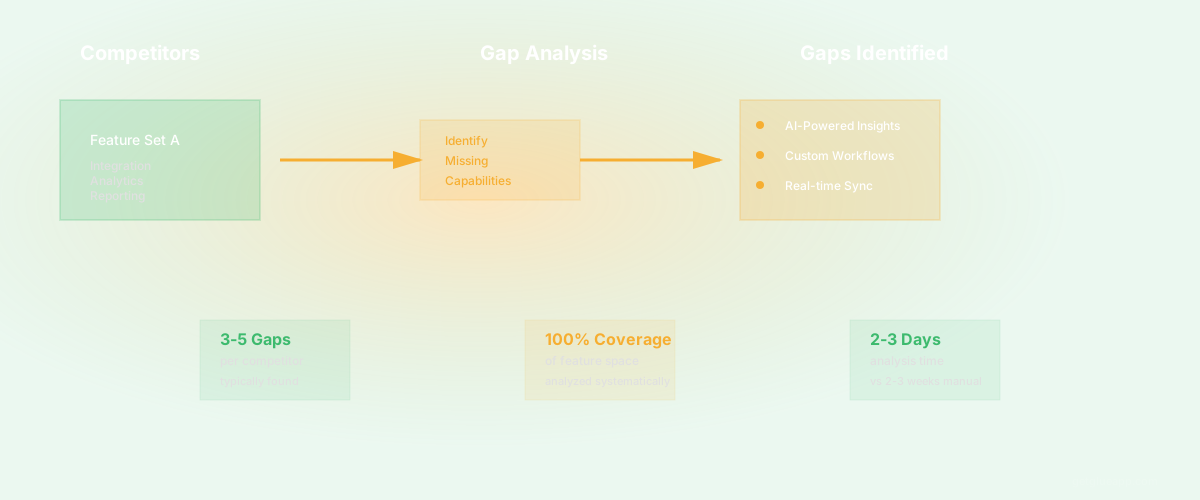
Here's what happens in most companies: a PM or analyst conducts competitive research. They create a matrix showing feature gaps. They present it confidently to leadership and engineering. Engineering responds with information that should have been included in the first place: "We actually have notifications partially built." "That would require refactoring our data model." "We don't have that infrastructure and it would take two quarters to add it." The gap analysis gets torn apart. The prioritization gets redone. Time gets wasted.
The gap analysis is also missing a critical third question: Is this feature something customers actually value? Do our competitors have better implementation of a feature we both have? Is this a gap that actually matters to our market position? Without those answers, you're treating every competitor feature as equally important. You're not prioritizing by impact - you're prioritizing by whatever analysis happened to be done. Some gap analyses lead to projects that move the needle. Others result in teams building features competitors have had for years, which customers have never asked for.
Most teams start with external competitive research tools. They compare feature lists. They conduct customer interviews. They observe what competitors are shipping. All valuable - but incomplete. A feature matrix tells you competitors have X, but it doesn't tell you whether X is a small addition to existing infrastructure or a fundamental architectural change.
Then they try to validate with engineering. They ask: "How long would it take to build this?" Engineering's answer depends on how much time they have to spend understanding the question, your codebase, and the dependencies involved. If they spend an hour on it, you get a rough estimate. If they spend a day, you get something more useful. Most teams don't allocate a day of engineering time to validate every feature gap, so they work with incomplete information.
Some teams build "spike" projects to validate feasibility - dedicated engineering time to investigate whether a feature is possible and what it would cost. Spikes reduce uncertainty, but they also consume engineering capacity that could be spent shipping. For competitive analysis to drive good prioritization, you can't afford to spike every gap. You'd never ship anything.
The deeper problem: competitive analysis happens in a vacuum. Market research team builds the gap analysis. Then it gets handed to engineering or product for validation. That's inefficient. The real work is connecting external competitive data to internal technical data. That connection isn't usually made systematically because the tools don't exist to make it fast.
Glue sits between competitive research and engineering validation. It lets you build gap analyses where the feasibility information is baked in from the start. The workflow starts with competitive research - same as usual. But before you present the gap analysis to leadership, you ask Glue questions that surface internal context.
A typical workflow: you've identified eight features competitors have that you don't. Before presenting, you ask Glue: "Does our codebase have any capabilities related to [competitor feature A]?" Glue scans your codebase and finds that you have partial infrastructure for feature A - maybe it's a library that's installed but not used, or code that was written two years ago and deprioritized. Now the gap isn't really a gap. It's a completion project. That changes your prioritization because completion projects are usually faster and lower-risk than building from scratch.
You ask Glue about feature B: "What would be affected if we built [feature B]?" Glue shows the dependency graph - which modules would need changes, which APIs would need updates, which data models would need to evolve. You now know it's a mid-tier complexity project, not a quick win and not a full re-architecture.
For feature C, you ask: "Does our current architecture support [component Y that feature C requires]?" Glue tells you no, and explains why. You now know this feature is blocked on architectural work. It's not a quick prioritization - it's a multi-quarter initiative if you want to do it.
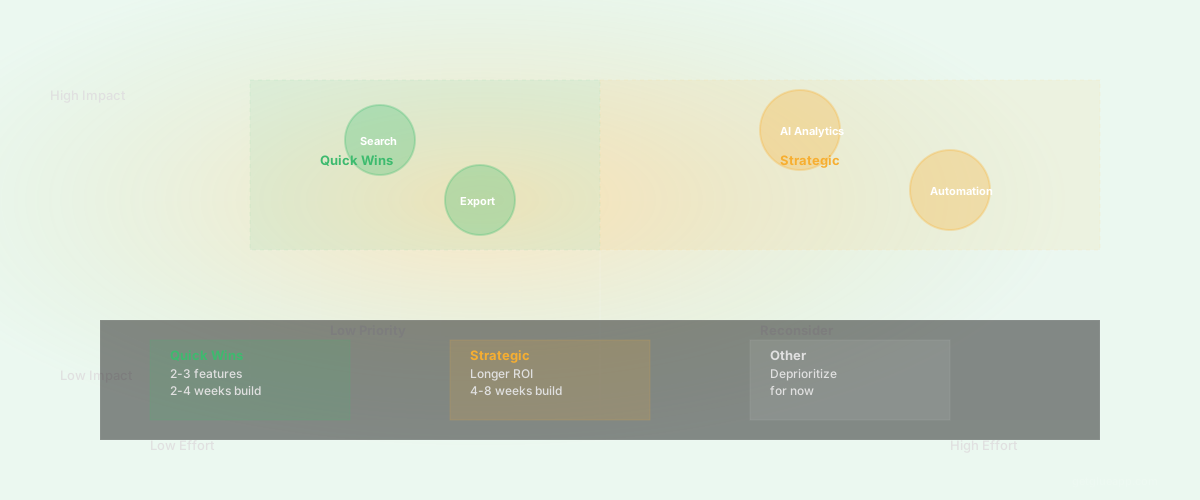
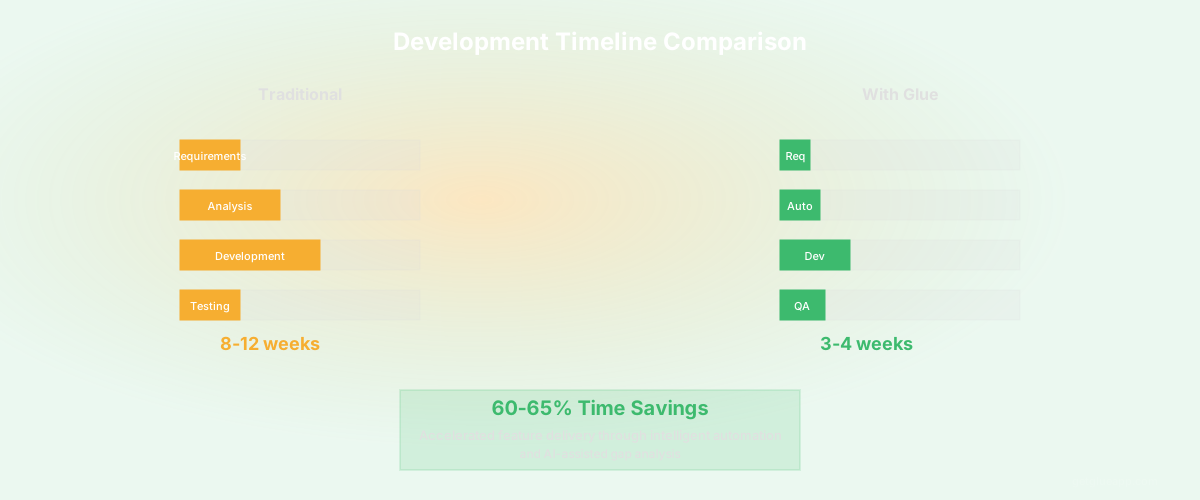
The result is a gap analysis that looks different from the original. Instead of eight equal gaps, you now have: two gaps you can close by finishing partially-built work (2-3 weeks). Three gaps that require new feature development within your current architecture (4-8 weeks each). Two gaps that would require architectural changes (quarters of work) or aren't worth the cost. One gap that isn't actually a gap - you have the capability but it's not marketed.
Now when you present to leadership, the conversation is fundamentally different. You're not saying "competitors have these eight things and we don't." You're saying "here's the competitive landscape, here's what we could realistically ship this quarter, here's what would take this year, and here's what isn't strategically worth the cost." Prioritization is grounded in reality.
The specific queries matter. You ask Glue: "What infrastructure do we have for real-time notifications?" It shows your WebSocket layer, event systems, and what's already wired up. You ask: "What would it take to add multi-tenant support?" It maps where customer isolation logic exists, where it doesn't, and what database changes would be needed. You ask: "Can our current API handle the throughput that feature would require?" Glue shows rate limiting, caching, and database query patterns that would be affected.
Your gap analysis becomes a prioritization tool instead of just a feature list. When you present it, leadership can see which gaps are quick wins, which are medium effort, and which require architectural investment. Decisions get made faster because they're grounded in technical reality. The company prioritizes features that are feasible to ship and genuinely differentiate, not features that look good on a slide.
The sales team gets better competitive positioning. Instead of saying "we can't do what competitors do," they can say "we have similar capabilities but implemented differently" or "we can deliver that in three weeks" or "that feature would require architectural changes we're not planning this year." Customer conversations shift from defensive to strategic.
Engineering's estimation becomes more accurate because they're not starting from zero. When a feature gap gets prioritized, there's already context about what's in the codebase, what dependencies matter, and what's actually required. The feature gets built faster because the planning was better.
Q: Does this mean we shouldn't build features competitors have? A: Not at all. Glue helps you prioritize which gaps to close first. Some competitor features matter for competitive parity. The point is to decide strategically - based on effort and impact - not to build everything at once.
Q: What if competitors have a feature but our customers don't care? A: Glue shows technical feasibility and effort. Customer in my experience, customer priority. Both inputs matter. Glue ensures the technical input is accurate and complete.
Q: Can Glue predict how long a feature will take to build? A: Glue can show complexity signals - code changes required, dependencies affected, related existing infrastructure. That helps engineers estimate more accurately. But estimates still require human engineering judgment.
Q: What if our codebase is so complex that even Glue can't provide clear answers? A: That's actually valuable information. Glue will surface that complexity. If a feature analysis requires weeks of investigation, that's a real cost - and should be factored into prioritization. You might decide that complexity is too high and explore different approaches.
Keep reading
Related resources