Comparison
Glue and Potpie.ai both work with AI and codebases, but solve different problems. Glue is for product managers and engineering leaders to understand features, gaps, and dependencies. Potpie powers AI agents to write and execute code for developers.
Choosing the right AI codebase tool depends on who you are and what problem you're solving. If your team needs to understand why code exists and make better product decisions, that's one problem. If you're trying to automate writing and executing code, that's a different one.
Glue and Potpie.ai both work with AI and codebases, but they approach the job from opposite directions. I've spent enough time building both types of tooling — first at Salesken where we built internal code analysis for our ML pipeline, now at Glue where codebase intelligence is the product — to know the difference is fundamental, not cosmetic.
Potpie.ai is an AI coding agent platform. It generates, writes, and executes code changes. Built for developers who want AI to handle implementation: writing functions, fixing bugs, generating boilerplate. Think of it as a more autonomous version of GitHub Copilot.
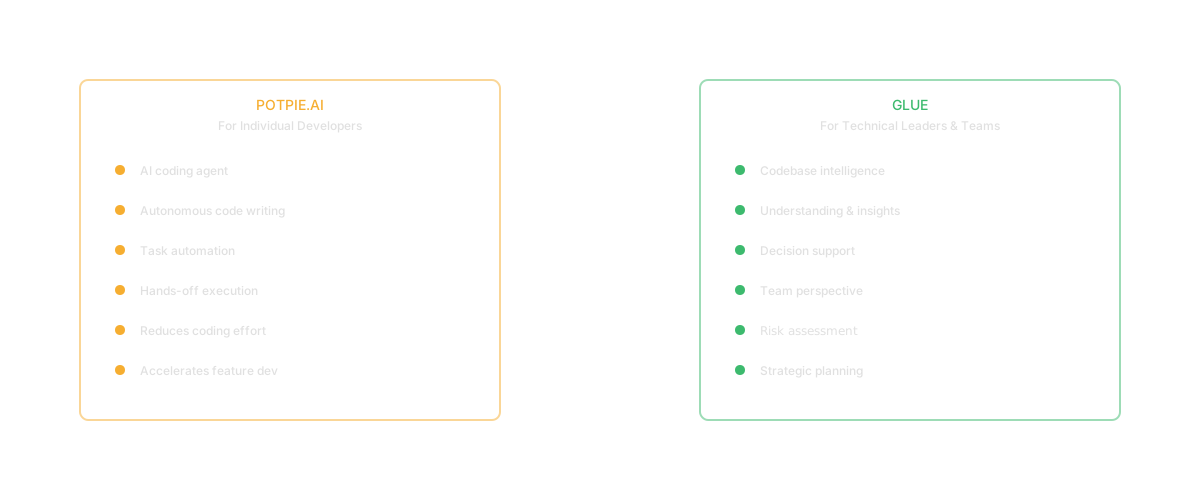
Glue is codebase intelligence for product managers and engineering leaders. It answers questions about what features exist, where the gaps are, how long changes should take, and what dependencies matter. It's a research tool for people making product decisions and managing technical complexity.
Potpie.ai focuses on the generation problem: how to get AI to write better code faster. They've raised $2.2M in pre-seed funding and are building a platform where AI agents interpret feature requests and write code in response. Changes are generated, tested, and executed. Developers specify intent rather than typing implementation.
This is genuinely useful for teams with high-churn feature work. If most of your problem is "we code too slowly," AI agents that write and deploy changes are worth investigating.
The limitation is what it doesn't do. At Salesken, we adopted Cursor heavily in 2024. Our deployment frequency tripled. But when a PM asked "what happens if we change the notification template — what else uses it?" three engineers gave three different partial answers. The coding tool didn't help because the question wasn't about writing code. It was about understanding code. The faster we wrote, the wider the understanding gap grew. I wrote about this dynamic in AI Code Assistant vs Codebase Intelligence.
Glue solves the understanding problem. It indexes your codebase and uses AI to answer questions in plain English: how features work, what competitive features you're missing, what needs modification to add new functionality, how long changes should take based on similar patterns.
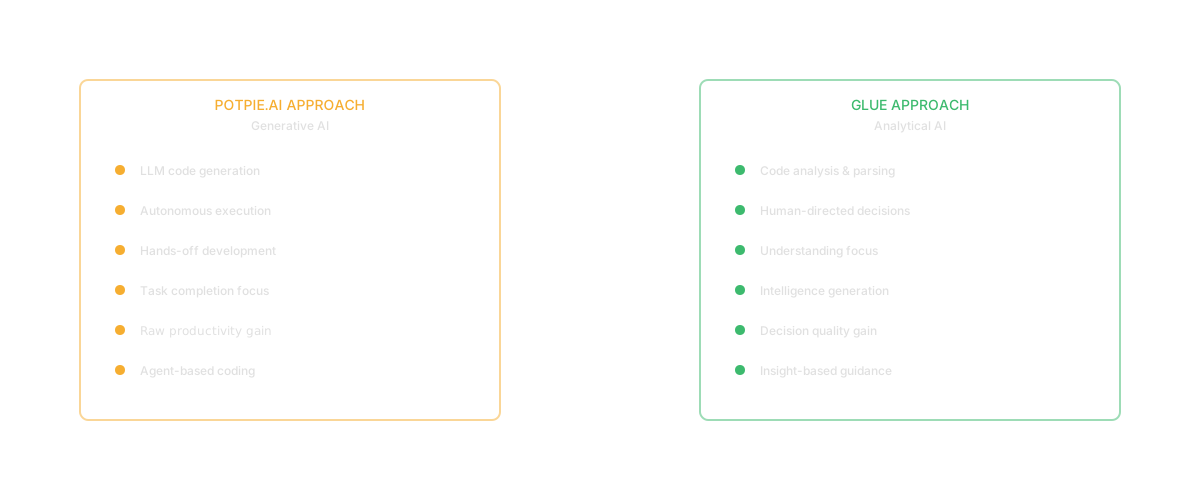
The output isn't generated code — it's generated understanding. Product managers get clarity on feature scope before anyone writes a line. Engineering leaders see dependency chains and architectural patterns. CTOs get a picture of technical risk grounded in actual code, not hearsay from the last sprint retro.
At UshaOm, where I led a team of 27 engineers building an e-commerce platform, the PMs relied on a senior engineer to explain how things worked. He was brilliant, patient, and a complete bottleneck. When he went on vacation, product planning paused. That's the problem Glue solves — making codebase knowledge accessible without requiring a human interpreter.
Potpie = Code Generation
Glue = Codebase Understanding
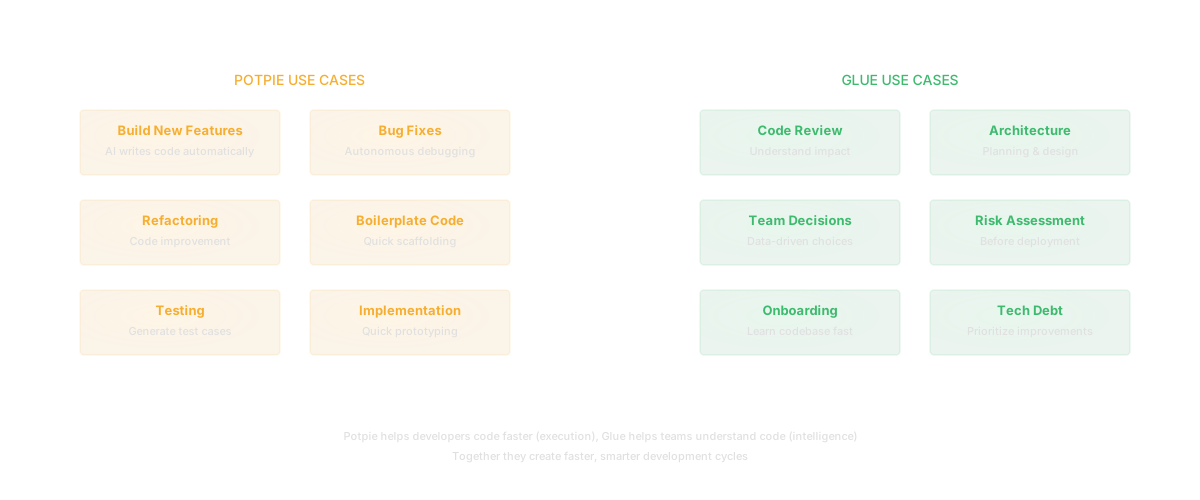
You could use both. A PM uses Glue to research what a feature requires, hands that spec to a developer who uses Potpie to implement it. That's actually a logical workflow. But they're solving different problems. Glue doesn't write code. Potpie doesn't analyze your product strategy or feature gaps.
| Feature | Potpie.ai | Glue |
|---|---|---|
| Code generation | Core feature — AI writes code | Not a code generation tool |
| Bug fixing automation | Automated fix suggestions | Not applicable |
| Boilerplate generation | Yes | Not applicable |
| Codebase Q&A | Limited to code context | Full product and architecture questions |
| Dependency mapping | Not available | Full dependency graph |
| Code ownership | Not available | Git-history-derived ownership |
| Knowledge silo detection | Not available | Identifies knowledge concentration |
| Bus factor analysis | Not available | Calculates bus factor per module |
| Feature discovery | Not available | Catalogs product features from code |
| Competitive gap analysis | Not available | Scores feature gaps against competitors |
| Architecture understanding | Limited | Full system structure mapping |
| Primary users | Developers | PMs, Engineering Managers, CTOs |
Modern engineering teams face two distinct challenges:
The building challenge. How do we write code faster? How do we reduce boilerplate? Tools like Potpie, Copilot, and Cursor address this. They make individual developers more productive at typing.
The understanding challenge. What have we actually built? What will break if we change something? Who knows how the payment system works? How long should this feature take based on our actual codebase? Glue addresses this. It makes teams more productive at deciding.
These are complementary. A team that writes code faster but doesn't understand their codebase will ship faster into more problems. A team that understands their codebase but writes slowly will make great decisions and miss deadlines.
I saw this play out firsthand at Salesken. After adopting AI coding tools, our deployment frequency tripled. But incidents also increased because nobody could trace dependencies across the new code AI had generated. Understanding hadn't kept pace with velocity. We needed both faster writing and better understanding — not one or the other.
| Role | Use Potpie for... | Use Glue for... |
|---|---|---|
| Developer | Writing code faster, fixing bugs, generating tests | Understanding unfamiliar modules, finding similar patterns |
| PM | Not applicable | Feature scoping, competitive analysis, understanding constraints |
| Engineering Manager | Not applicable | Team risk, bus factor monitoring, code health tracking |
| CTO | Not applicable | Architecture oversight, technical debt assessment, planning |
Potpie is early-stage (pre-seed). The autonomous coding agent space is evolving fast, and it's competing with well-funded tools like Devin, Cursor, and Claude Code. Whether Potpie's specific approach wins depends on execution.
Glue is also evolving. Our codebase Q&A works well for explicit dependencies — imports, function calls, database queries. Implicit dependencies (runtime config, feature flags, environment-specific behavior) are harder to detect automatically. We're honest about that gap and actively working on it.
The point isn't that one tool is better. They solve different problems for different people. If you're a developer wanting to type less, evaluate Potpie against Copilot and Cursor. If you're a PM or CTO wanting to understand your codebase without reading code, that's what Glue is built for.
What is the difference between Glue and Potpie.ai?
Potpie.ai focuses on AI coding agents that help individual developers write and debug code. Glue is a codebase intelligence platform designed for engineering leaders and product managers who need to understand codebase architecture, track technical debt, and make informed product decisions.
Is Glue or Potpie better for engineering teams?
Glue and Potpie serve different needs. Use Potpie if your primary goal is accelerating individual developer coding speed. Use Glue if you need team-level codebase visibility, technical debt tracking, competitive analysis, and product intelligence for engineering leadership and product management.
Keep reading
Related resources