Comparison
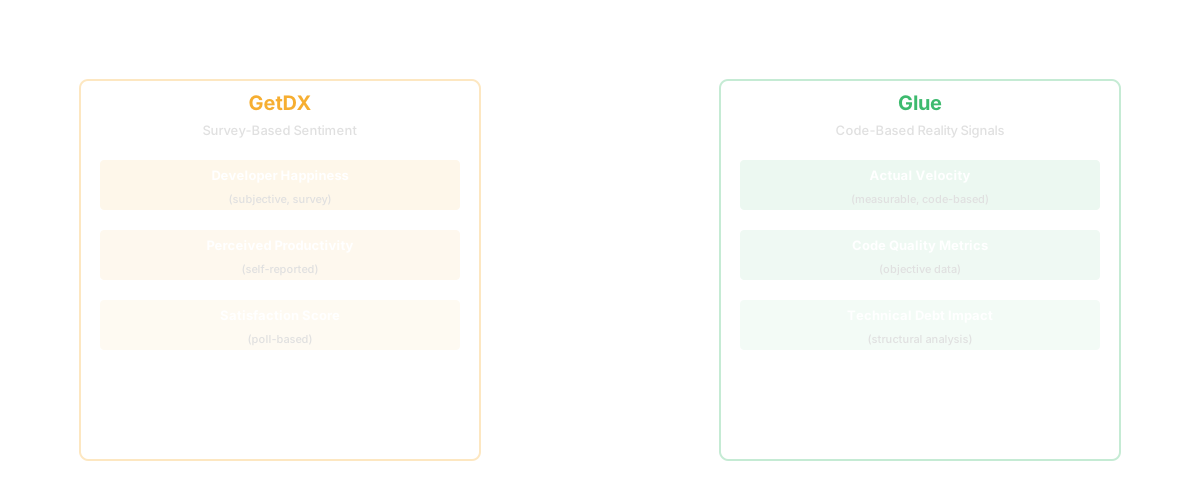
GetDX measures developer sentiment. Glue measures codebase reality. Together they reveal the structural causes of team friction.
I've evaluated dozens of engineering tools across three companies. What matters isn't the feature list — it's whether the tool actually changes how your team makes decisions.
GetDX measures how engineers feel about their work. Glue measures what's actually happening in the codebase. The best engineering teams use both - because feelings and reality don't always align, and understanding the gap is where the insight lives.
GetDX is a developer experience platform that captures what engineers say about their productivity. It runs regular surveys and engagement pulses that ask engineers: Are you blocked? Do you know what you're working on? Is the codebase easy to navigate? Do you feel confident in your deployment process? What's slowing you down?

GetDX aggregates these responses into an overall developer experience score and tracks trends. You can see which teams report lower DX, what specific pain points are most common, whether your DX is improving or declining. GetDX also connects this sentiment data to business metrics like retention and performance. The insight from GetDX is human: it captures frustration, clarity, confidence, and satisfaction. If engineers are unhappy, that's real data, even if the codebase metrics look fine.
Glue measures the codebase directly. It doesn't ask developers what's wrong. It analyzes the code structure, architectural dependencies, ownership patterns, change history, and complexity - and reveals what's actually causing friction.
When Glue says "this module is a bottleneck," it's not based on surveys. It's based on measurable facts: the module has high complexity, it's depended on by many other modules, it's owned by multiple teams, it changes frequently. These factors correlate with reduced velocity and increased frustration.
GetDX and Glue are complementary diagnostics. When both are pointing in the same direction, you know you've found the real issue. When they diverge, that gap is often where insights hide.
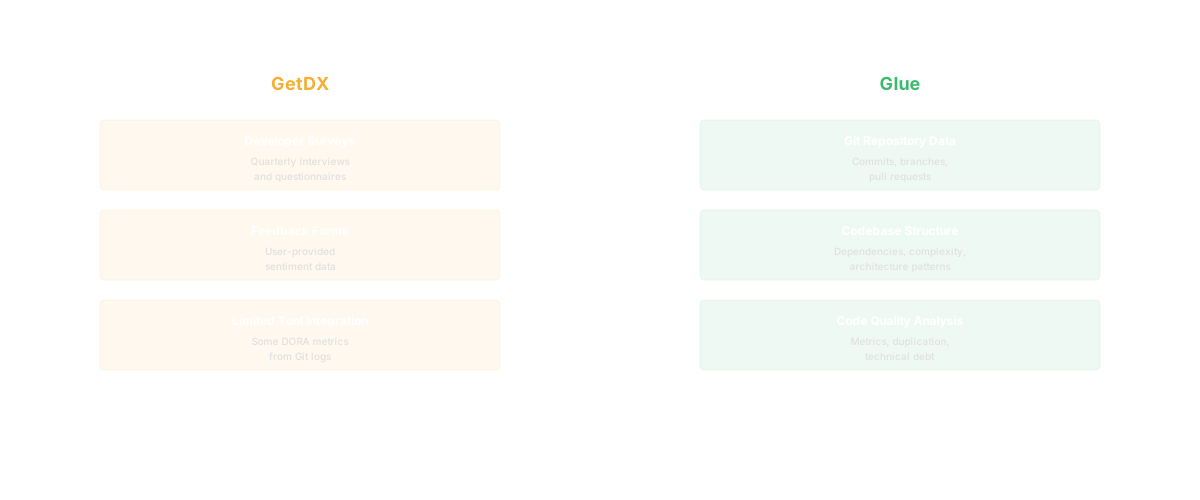
Example scenario: GetDX reports that engineers don't feel confident in the authentication module. Their NPS for that module is low. But why? GetDX can tell you the sentiment is negative, but not why. Glue shows: the authentication module is highly complex, has unclear ownership (three teams claim responsibility), is depended on by 12 other modules, and hasn't been refactored in 18 months despite constant bug fixes. That's the codebase evidence that explains the sentiment. Reverse scenario: GetDX shows generally high developer satisfaction, but Glue reveals that one critical module has structural problems that will cause slowdowns in 6 months if not addressed. GetDX would never catch this issue (engineers don't feel it yet because the impact hasn't manifested), but Glue does.
The two together are powerful: GetDX tells you what engineers perceive; Glue tells you what's actually happening. Combining them lets you say: "Yes, this feels bad to your team, AND here's the structural reason why, AND here's what we need to fix."
| Capability | GetDX | Glue |
|---|---|---|
| Developer sentiment and satisfaction | Core feature | Not applicable |
| Pain point identification | Survey-based | Not applicable |
| Retention and engagement correlation | Yes | Not applicable |
| Team-level DX scoring | Yes | Not applicable |
| Root cause of codebase friction | Not directly | Core feature |
| Architectural risk and complexity | No | Core feature |
| Ownership clarity | Surveys | Direct analysis |
| Module dependencies and coupling | No | Yes |
| Change patterns and stability | No | Yes |
| Predictive risk indicators | Limited | Yes |
| Human-centered perspective | Yes | No |
| Technical-centered perspective | No | Yes |
Choose GetDX if you want to understand how your engineering teams feel and where they're experiencing friction. If you're concerned about retention, morale, or creating a positive developer experience culture, GetDX provides the metrics and the feedback loop.
GetDX is also valuable if you're running a developer experience program and need to measure its impact on team satisfaction and productivity.
Choose Glue when you want to understand the structural, technical reasons for friction. When you want to know which specific codebase elements are creating bottlenecks. When you need to be proactive about risks before they manifest as team frustration.
Choose Glue if you're a CTO trying to decide whether a refactor is necessary. GetDX might show that engineers are fine with the current state, but Glue might reveal that the codebase structure will cause problems at your next scaling inflection. You want data on both the current sentiment and the structural risk.
| Feature | DX (getDX) | Glue |
|---|---|---|
| Developer surveys | Core feature — structured DX surveys | Not a survey tool |
| DevEx measurement | Quantitative + qualitative | Not applicable |
| Survey benchmarks | Industry comparison data | Not applicable |
| Codebase analysis | Not available | Deep code structure analysis |
| Knowledge silo detection | Survey-based (subjective) | Git-history-based (objective) |
| Bus factor analysis | Not available | Calculates bus factor per module |
| Dependency mapping | Not available | Full dependency graph |
| Feature discovery | Not available | Catalogs product features from code |
| Code ownership | Survey-based | Git-history-derived |
| Root cause of DX issues | Survey responses | Structural code analysis |
| Best for | Measuring developer experience | Understanding codebase structure |
DX (formerly getDX) is a developer experience measurement platform. It uses structured surveys to quantify how developers feel about their tools, processes, and codebase. The SPACE framework (Satisfaction, Performance, Activity, Communication, Efficiency) guides the measurement.
Glue takes a different approach: instead of asking developers how they feel, it analyzes the code itself. Knowledge silos, bus factor, code complexity, and architectural coupling are measured objectively from git history and code structure.
DX asks: "On a scale of 1-5, how easy is it to understand the codebase?" Glue measures: "The codebase has 12 modules with bus factor of 1, and 40% of architectural knowledge is concentrated in 3 engineers."
Both are valuable. Surveys capture sentiment. Code analysis captures structure. The best teams use both.
| Signal | DX Captures | Glue Captures |
|---|---|---|
| Developer frustration | Survey responses | Root structural causes |
| Onboarding difficulty | New hire satisfaction scores | Actual codebase complexity |
| Knowledge concentration | "I always have to ask Sarah" | Sarah owns 73% of commits in 4 critical modules |
| Technical debt impact | "Technical debt slows us down" | Specific modules with highest debt-to-change ratio |
Q: Should we use both GetDX and Glue?
Yes. GetDX tells you how your engineers feel. Glue tells you why they should feel that way based on codebase structure. Together they give you the complete diagnostic picture.
Q: If engineers report high satisfaction in GetDX, do I still need Glue?
Possibly. GetDX measures current sentiment. Glue identifies structural risks that haven't yet manifested as friction. A team might be satisfied today but facing a bottleneck that will slow them down next quarter. Glue provides early warning.
Q: What if GetDX and Glue point in different directions?
That's when the real insight happens. If GetDX shows low satisfaction but Glue shows the codebase is well-structured, the issue might be process, tooling, or interpersonal - not the code itself. If Glue shows codebase problems but GetDX shows high satisfaction, you might be getting lucky with team capability that's masking structural issues.
Q: Does Glue need GetDX to be useful?
No. Glue works independently. But the combination is more powerful because you're measuring both the system and the humans working with the system.
Q: Can Glue insights help improve GetDX scores?
Yes. Using Glue to address architectural bottlenecks often improves developer experience scores because engineers actually can work faster and with more clarity. The codebase improvements flow through to sentiment improvements.
Keep reading
Related resources