Comparison
OpsLevel maintains an explicit service catalog. Glue derives codebase understanding automatically. Understand the trade-offs.
I've evaluated dozens of engineering tools across three companies. What matters isn't the feature list — it's whether the tool actually changes how your team makes decisions.
OpsLevel is a developer portal and service catalog platform built on the Backstage concept (originally Spotify's open-source project). It's a strong tool for platform engineering teams that need to organize service ownership, document dependencies, and maintain scorecards. But it solves a different problem than Glue.
OpsLevel lets you build an internal developer portal where teams register and maintain information about their services: ownership, runbooks, dependencies, maturity levels (using customizable scorecards), integration with incident management and deployment systems, and visibility into service health and reliability.
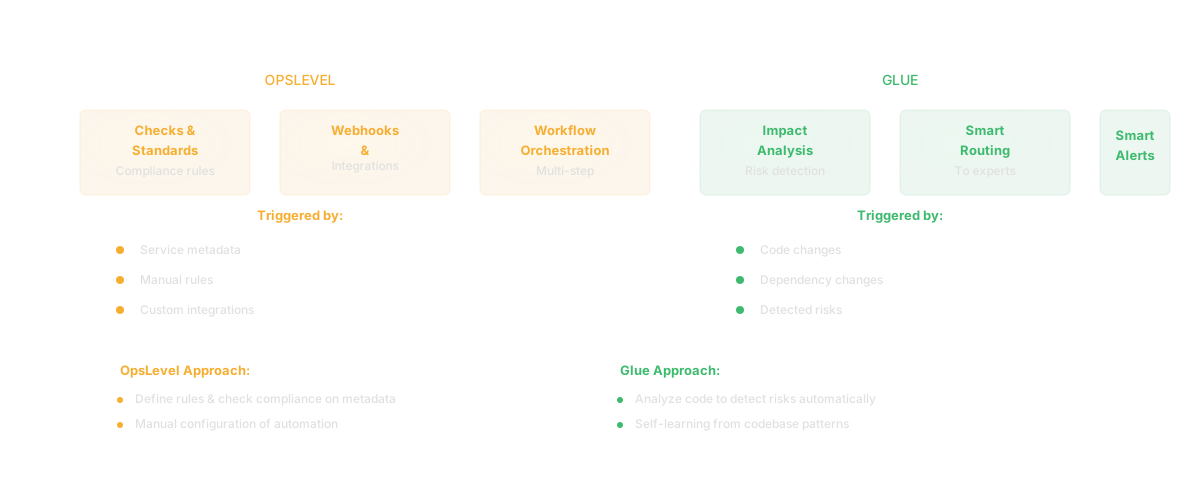
For a platform engineering team, OpsLevel is about creating a source of truth for service ownership and documentation. Teams explicitly define who owns what, and that information lives in one place that developers can reference.
The strength of OpsLevel is that it gives you a comprehensive service catalog with explicit ownership information and the ability to measure maturity across services.
Glue derives its understanding directly from your codebase - no manual registration required. You don't tell Glue what modules are important or who owns them; Glue analyzes the code and figures it out. Where OpsLevel requires teams to populate and maintain a catalog (which creates ongoing work), Glue automatically understands your codebase structure, critical dependencies, and ownership patterns by reading the source of truth: the code itself.
Glue also provides visibility into architectural change over time - how dependencies have evolved, how complexity has grown, which patterns are emerging - that a static catalog can't provide without constant maintenance.
OpsLevel is a manually-maintained service catalog. Glue is an automatically-derived codebase model.
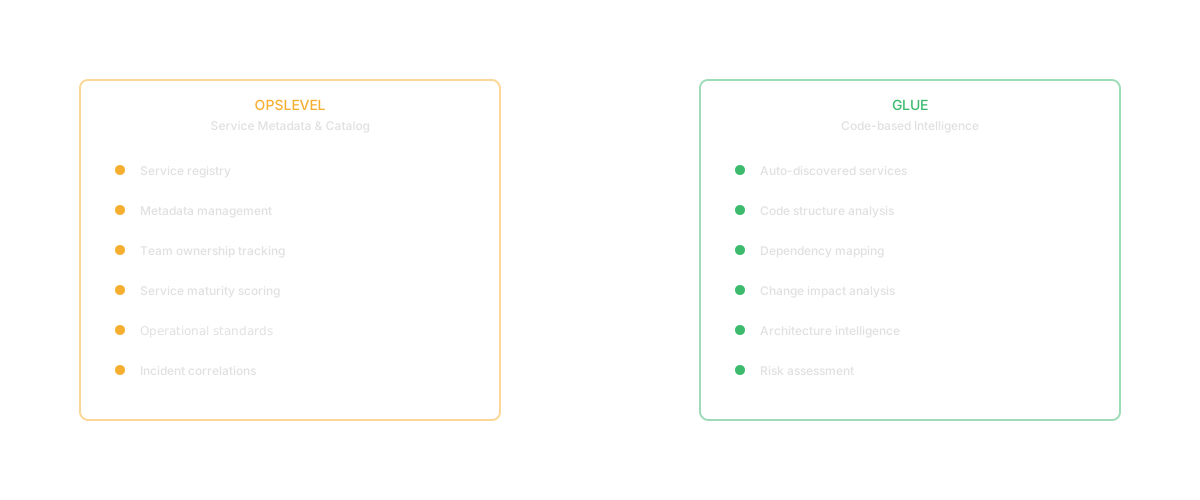
The advantage of OpsLevel is flexibility and customization. You define your maturity scorecards, you add custom metadata, you control what the portal contains. The disadvantage is maintenance burden - catalog entries get stale without active management.
The advantage of Glue is that it stays current automatically because it comes from the source of truth (your code). The disadvantage is less customization - Glue analyzes code structure as code structure exists, not as you wish it to be.
For a CTO, the question is: do you want a portal that requires active maintenance but gives you complete flexibility, or do you want something that stays current with your actual codebase at the cost of less customization?
Both have real value. Many organizations benefit from having both: OpsLevel for explicitly-managed metadata and business logic (which teams are "approved" to do certain things, what's our deployment policy), and Glue for current codebase understanding that doesn't require maintenance.
| Capability | OpsLevel | Glue |
|---|---|---|
| Service ownership directory | Yes (manual) | Yes (automatic) |
| Custom maturity scorecards | Yes | Limited |
| Incident management integration | Yes | Not applicable |
| Deployment tooling integration | Yes | Not applicable |
| Runbook and documentation | Yes | Not applicable |
| Custom service metadata | Yes | Limited |
| Architectural dependency mapping | Manual or external | Automatic analysis |
| Service criticality | Manual definition | Derived from code |
| Change history and evolution | Manual or external | Automatic analysis |
| Ownership accuracy | Depends on maintenance | Current (from code) |
| Customization | High | Lower |
| Maintenance burden | High | None (automatic) |
Choose OpsLevel if you need a comprehensive developer portal with explicit metadata management. If you have custom maturity standards or approval workflows that go beyond what code structure reveals, OpsLevel is the right tool.
Choose OpsLevel if you want to integrate service ownership with your incident management system - "who owns this service" is connected to "who gets paged when it breaks."
Choose OpsLevel if your organization prefers explicit ownership documentation and is willing to maintain it.
Choose Glue if you want current codebase understanding without the maintenance burden of a catalog. If your concern is that your OpsLevel catalog is out of date (because teams don't update it), Glue always reflects the actual codebase.
Choose Glue when the primary users asking questions about codebase structure are PMs and EMs who don't need a formal service portal - they just need to understand who owns what and why.
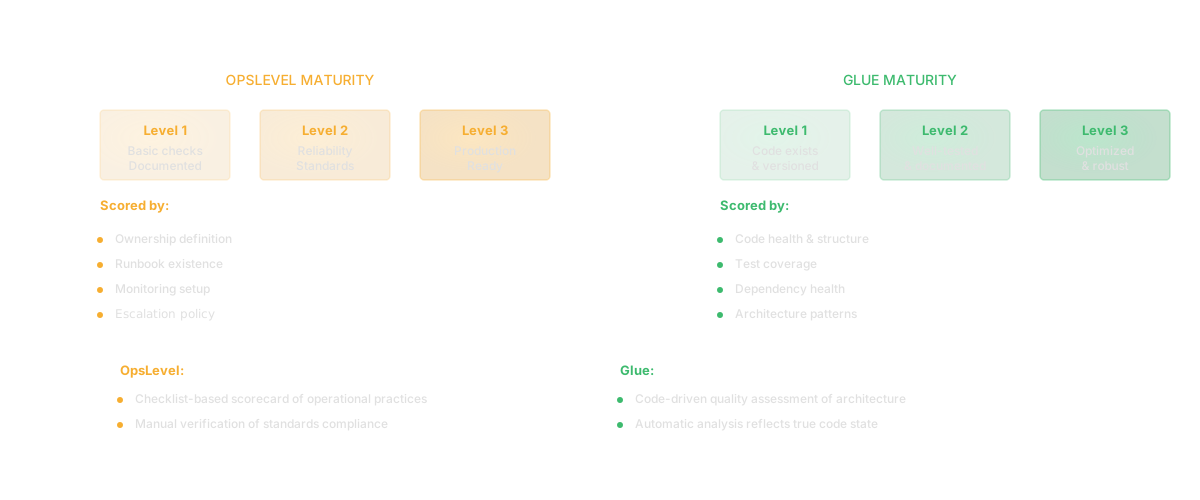
Choose Glue if you want to automatically answer questions like "what are the critical modules in our system?" without requiring teams to maintain a scoring system.
Q: Should I use both OpsLevel and Glue?
Yes, often. OpsLevel is your explicit service catalog (what we say we have). Glue is your codebase reality (what we actually have). If they diverge, that's important to know.
Q: How do I keep OpsLevel up to date?
That's the maintenance challenge. Many teams use Glue's insights to audit their OpsLevel catalog - "here's what Glue found to be critical; is that reflected in OpsLevel?"
Q: Can Glue replace OpsLevel?
For codebase structure understanding, yes. For formal service catalogs with incident management integration and custom metadata, not entirely - OpsLevel serves a broader organizational function. But for "who owns what in the codebase," Glue can be sufficient.
Q: Does OpsLevel have dependency analysis?
OpsLevel has service dependency mapping, but typically requires manual entry or external tooling to populate. Glue analyzes dependencies directly from code.
Q: If I'm using OpsLevel, what does Glue add?
Automatic codebase analysis that stays current. Current architectural risk identification. Natural language questions that don't require understanding OpsLevel's portal structure.
Q: What if my OpsLevel catalog and Glue's analysis conflict?
That's data. Maybe teams aren't following the ownership defined in OpsLevel. Maybe OpsLevel hasn't been updated to reflect a reorganization. Use both sources to get the complete picture.
Q: Does Glue integrate with OpsLevel?
Glue and OpsLevel operate independently. But insights from Glue can inform how you structure your OpsLevel catalog.
Keep reading
Related resources