
The paradox haunts every engineering leader: your team shipped 40% more commits last quarter, yet product launches took twice as long. Features that should take two weeks dragged on for six. Code reviews multiplied. Deployment windows widened. The incident rate climbed.
This is the software productivity paradox. Teams moving faster while delivering slower.
For years, I measured productivity the wrong way. At UshaOm, where I built and led a team of 27 engineers, we tracked commits per sprint and story points completed. The numbers looked great. But our e-commerce platform took longer and longer to ship new features because the codebase was getting messier with every "productive" sprint. We were optimizing activity, not impact.
It wasn't until Salesken, where we were building real-time voice AI, that I started measuring what actually mattered: deployment frequency, lead time, change failure rate, and mean time to recovery. The shift changed everything. Suddenly the team wasn't rewarded for writing more code. They were rewarded for shipping reliably. And paradoxically, they shipped more.
This guide covers what software productivity actually is, why traditional metrics fail, and how to measure and improve the dimensions that matter.
Why Traditional Productivity Metrics Fail
Lines of Code (LOC)
A developer who deletes 500 lines of dead code while simplifying a module has improved the codebase more than someone who wrote 500 new lines. LOC penalizes refactoring and rewards verbosity. I've seen engineers add unnecessary abstraction layers purely because the team tracked LOC. Perverse incentives produce perverse outcomes.
Commits Per Sprint
More commits does not mean more value. A developer who makes one thoughtful commit that ships a feature is more productive than someone who makes 20 trivial commits. At Salesken, one of our best engineers consistently had the fewest commits on the team. He also shipped the most impactful features and caused the fewest incidents. If we'd measured him by commit count, he'd have looked like our worst performer.
Story Points Completed
Story points measure estimated complexity, not value delivered. A team can complete 100 story points of low-impact work while ignoring the 8-point task that would unlock a new revenue stream. I've written about this at length in Story Points Are Useless. I don't think I was wrong about that.
The SPACE Framework
A better approach is the SPACE framework, developed by researchers at Microsoft, GitHub, and the University of Victoria:
- Satisfaction and well-being: How fulfilled are developers?
- Performance: What outcomes are developers achieving?
- Activity: What actions are developers taking?
- Communication and collaboration: How effectively do developers work together?
- Efficiency: Can developers complete tasks without unnecessary friction?
No single dimension captures productivity. You need to measure across multiple dimensions. For a deeper dive on SPACE, see our SPACE Metrics Framework guide.
The DORA Metrics Approach
The most widely adopted engineering productivity framework is DORA metrics, based on research from the DevOps Research and Assessment team:
| Metric | What It Measures | Elite Benchmark |
|---|---|---|
| Deployment Frequency | How often code ships to production | Multiple times per day |
| Lead Time for Changes | Time from commit to production | Less than 1 hour |
| Change Failure Rate | % of deployments causing failures | Less than 5% |
| Mean Time to Recovery | Time to restore service after failure | Less than 1 hour |
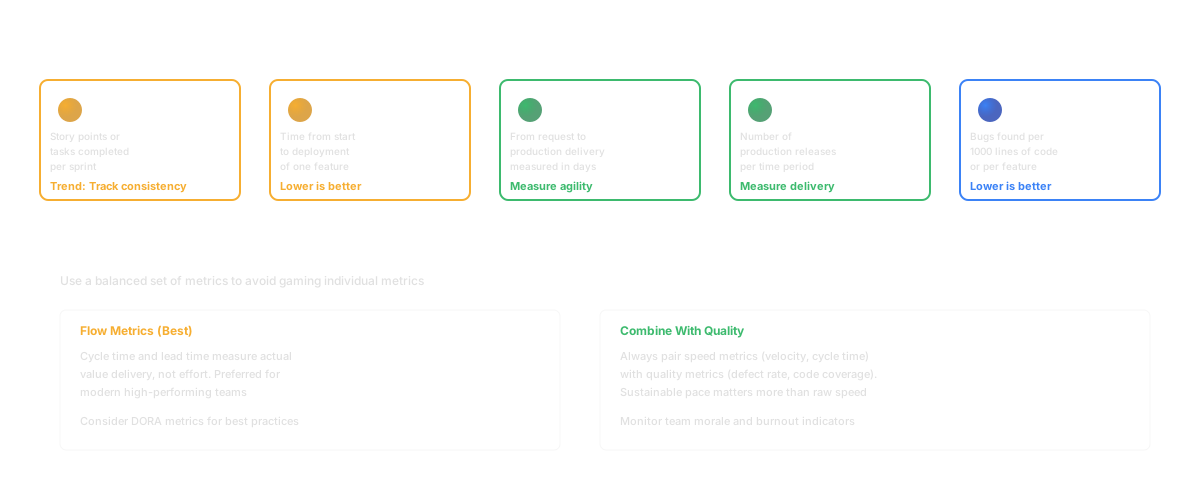
DORA metrics work because they measure outcomes, not activities. A team that deploys frequently with low failure rates IS productive, regardless of how many lines of code they wrote.
What Actually Drives Software Productivity
Codebase Health
Teams working in healthy codebases (low complexity, clear ownership, good modularity) are dramatically more productive than teams fighting unhealthy codebases. I've seen this firsthand. At UshaOm, the parts of our Magento codebase that were well-structured let new engineers contribute within days. The parts that were tangled required weeks of mentoring before anyone could touch them safely. Same engineers, same team, 5x productivity difference based on which module they were working in. Code health is the foundation.
Knowledge Distribution
When knowledge is concentrated in a few people, productivity is fragile. Those people become bottlenecks. When they're unavailable, work stops. At Salesken, our ML pipeline was initially understood by two engineers. When one went on leave and the other was pulled into an incident, the entire ML team was blocked for a week. After that, we invested in documentation and pair programming to distribute knowledge. It felt slow at the time. It was the highest-ROI investment we made that quarter. See knowledge silos for more.
Dependency Management
Tightly coupled systems require coordination across teams for every change. Loosely coupled systems let teams move independently. Dependency mapping reveals coupling that's invisible in architecture diagrams but very real in the git history.
Technical Debt Load
Teams carrying heavy technical debt spend 20-40% of their time on maintenance rather than new features. At Salesken, we tracked this informally: engineers estimated what percentage of their sprint went to maintenance versus new features. When it crossed 30%, we'd schedule a dedicated debt reduction sprint. Not perfect, but it kept the ratio manageable.
Developer Experience
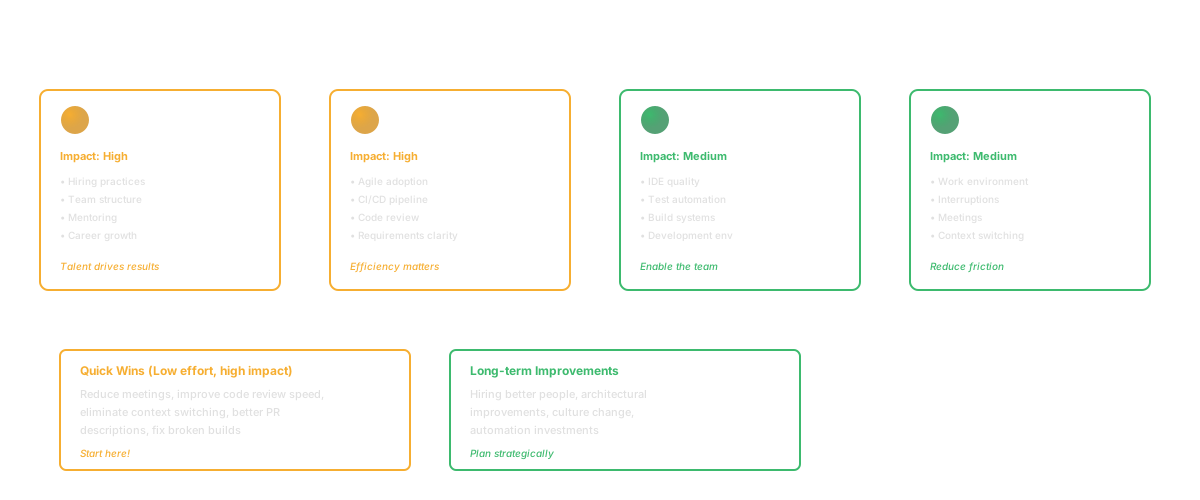
Slow CI/CD pipelines, unreliable test suites, poor local development environments, and confusing tooling all reduce productivity. In Bengaluru's competitive engineering market, developer experience is also a retention factor. Engineers with options won't tolerate a 45-minute CI pipeline and a flaky staging environment when the startup down the road has a 5-minute pipeline and one-command deploys. Invest in developer experience to remove friction.
How to Measure Software Productivity
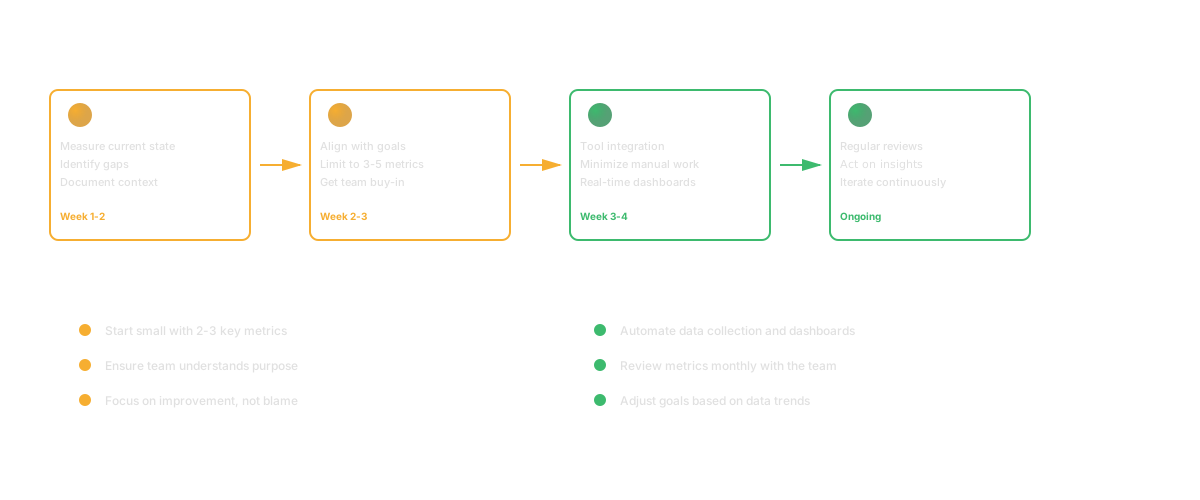
Start by establishing DORA baselines. Track your four DORA metrics for 4-6 weeks before making changes. This gives you a baseline to measure improvement against. Without a baseline, you're guessing.
Next, identify structural bottlenecks. Use codebase intelligence to find which modules have the highest complexity, lowest bus factor, and most dependencies. These are your structural productivity killers.
Survey developer experience directly. Ask developers: what slows you down? What tools are frustrating? What processes add friction without value? The answers are often surprising. At Salesken, when we surveyed the team, the top frustration wasn't our code or our tools. It was the requirement to update three different systems (Jira, Confluence, Slack standup) with the same status information every day. We automated it. Small change, big impact.
Then prioritize. Focus on the intersection of high-impact and high-frequency pain points. If 80% of your team is slowed down by the same CI pipeline, fixing that has 10x the ROI of fixing a niche tool.
After changes, track DORA metrics for another 4-6 weeks. Did deployment frequency increase? Did lead time decrease? If not, investigate why and adjust. This isn't a one-time exercise. It's a continuous loop.
Software Productivity Anti-Patterns
The Hero Developer. One developer ships most features. They're incredibly productive, and the team has a bus factor of 1. When they leave, productivity collapses. True productivity means the team is productive, not one person. I've had this hero on multiple teams. The hardest management conversation is telling your best individual contributor that they need to slow down and bring others along.
The Measurement Obsession. Teams spend more time measuring productivity than improving it. Dashboards everywhere, metrics reviews every week, but no actual changes to code or process. Measure to inform action, not to create reports nobody reads.
The Process Maximalism. Every productivity problem gets a new process: more meetings, more approvals, more documentation requirements. Each process adds overhead. Sometimes the solution is removing process, not adding it. At Salesken, we cut our deployment approval process from three sign-offs to one (the PR reviewer), and deployment frequency doubled in a month. The other two sign-offs had been adding safety theater, not actual safety.
The Tool Switching. New productivity tool every quarter. Each switch costs weeks of migration and learning. Pick good tools and commit to them. Stability in tooling is itself a productivity multiplier.
Connecting Productivity to Codebase Intelligence
The question every engineering leader asks is "where should we invest to improve productivity?" Codebase intelligence answers that by showing where the actual bottlenecks are, not where you assume they are.
At Glue, we surface the intersection of code complexity, change frequency, and ownership concentration. High complexity, high churn, low bus factor: that's your highest-leverage improvement target. We also connect this to DORA metrics: when deployment frequency drops, we can correlate it with specific code areas or infrastructure changes.
The limitation we're honest about: productivity is partly a people and culture problem, not just a code problem. Codebase intelligence can tell you the code is healthy and the pipeline is fast, but it can't tell you that the team is burned out or that the PM and the tech lead disagree on priorities. We surface the structural factors. The human factors still require human judgment.
Related Reading
- DORA Metrics: The Complete Guide for Engineering Leaders
- SPACE Metrics Framework: The Complete Guide
- Deployment Frequency: The DORA Metric That Reveals Your True Engineering Velocity
- Developer Productivity: Stop Measuring Output, Start Measuring Impact
- Code Productivity: Why Your Best Engineers Aren't Your Most Productive
- Programmer Productivity: Why Measuring Output Is the Wrong Question
Frequently Asked Questions
What is software productivity?
Software productivity measures the value delivered by software teams relative to the resources invested. Unlike manufacturing productivity, it cannot be measured by output volume alone. It requires balancing delivery speed, code quality, team sustainability, and business impact.
How do you measure software productivity without damaging culture?
Measure at the team level using outcome metrics like features shipped, customer impact, and delivery predictability. Never track individual developer activity. Use surveys to capture qualitative aspects like developer satisfaction and friction points. Make metrics transparent and team-owned.