
Codebase opacity — the condition where critical knowledge about system architecture, dependencies, and module interactions is locked inside individual engineers' heads rather than visible to the organization — compounds exponentially as teams grow. The hidden costs include extended incident resolution (50%+ of resolution time spent understanding the system rather than fixing it), slower onboarding, and cascading failures from changes made without understanding cross-module dependencies. At organizations with 50+ engineers, investing in dependency visibility tools typically delivers positive ROI from the first incident where resolution time drops from 8 hours to 3. The recommended capacity allocation for ongoing codebase health work is 15–20% of engineering time.
Across three companies, I've seen the same pattern: critical knowledge locked inside a handful of senior engineers' heads, invisible to everyone else.
By Vaibhav Verma
A 60-person fintech company spent three days debugging a critical issue where user funds appeared twice in the ledger. The root cause was a change made six months ago in a module that handled recurring payments. The engineer who made the change was trying to optimize a query. She didn't know the module was also used by a billing reconciliation process that made assumptions about idempotency.
This wasn't a single mistake. This was opacity compounding.
The invisible tax on every engineering team is the cost of a codebase that's become opaque. Not expensive. Not slow. Just opaque. When engineers don't understand the system they're working in, each change they make reduces the system's understandability further. The next engineer understands the context even less. They add code that compounds the problem. Within months, simple changes become expensive. Within quarters, your velocity just stops.
How Opacity Creates More Opacity
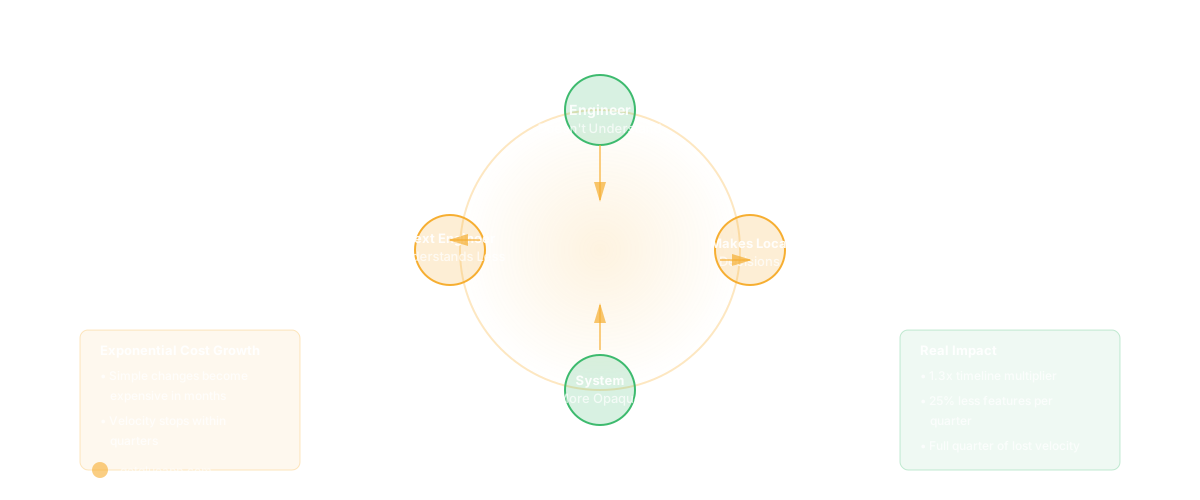
This is worth understanding mechanically because it's different from debt accumulation in other fields.
When an engineer doesn't understand the system, they make reasonable local decisions. "This variable should go here because it's close to where I'm working." "This function can do this extra thing because we're already touching this file." "This dependency is probably fine because the other module is doing something similar." Each of these is sensible from inside the engineer's limited view.
But from the global view, each one is a choice that makes the next engineer's job harder. The variable in the wrong place now confuses the next person working on that subsystem. The function doing two things means the next person who touches it has to understand the original thing and the new thing to make changes safely. The implicit dependency means the next person has to either discover it the hard way or maintain an undocumented mental map.
This is what I mean by opacity compounding. It's exponential until you break the cycle.
I watched this at a 40-person company that had grown from five people over three years. The core services still had architectural patterns from when the team was tiny. One service had 15 different modules that made sense to the original author but were barely distinguishable now. Onboarding a new engineer meant walking them through two hours of "this module is actually not separate, it talks to this one" and "this one does X but also handles Y because we added it later."
After six months of this, the company realized they had a retention problem. Not because of compensation or culture. Because experienced engineers found the codebase suffocating. New engineers took twice as long to be productive as the founders expected.
The Multiplier Effect on Estimation
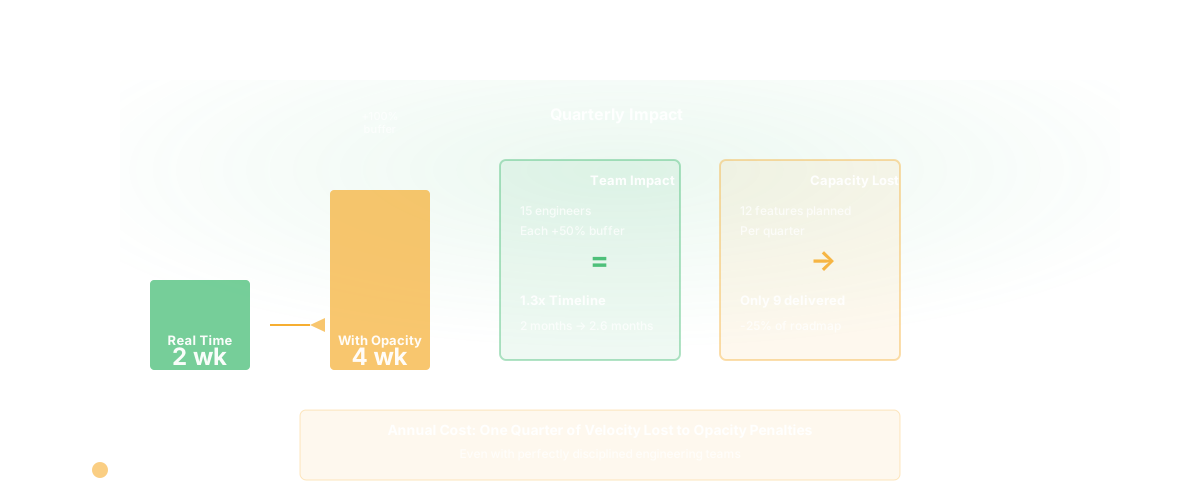
One cost of opacity that's easy to quantify: estimation becomes impossible.
When a feature involves a module that engineers don't understand, they add buffer. Not consciously, but naturally. "This should take two weeks" becomes "I'll estimate four" because the engineer knows she doesn't know what she doesn't know. That's reasonable risk management in an opaque system.
Multiply this across a team: 15 engineers, each adding 50% buffer to estimates for features in modules they don't fully understand, and you've multiplied your real feature timeline by 1.3x across the board. A feature that should take two months takes 2.6 months. A product roadmap that should fit 12 features in a quarter fits 9.
The math is that even with perfectly disciplined engineering, opacity costs you a quarter's worth of velocity every year.
Incident Recovery in Opaque Code
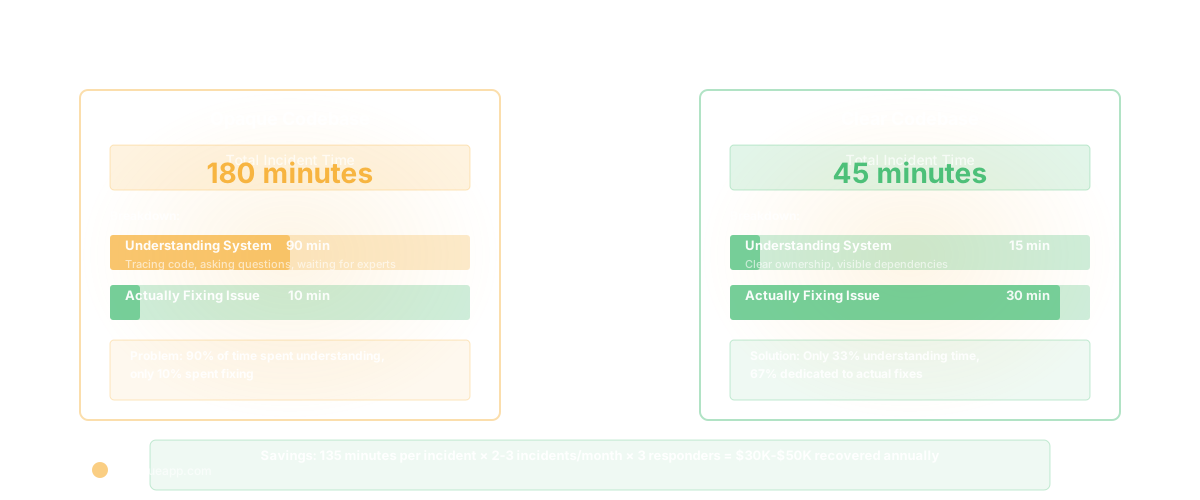
There's also the cost of incidents. When your codebase is opaque, incident resolution becomes investigation. An alert fires. The incident commander doesn't immediately know what the system does or how its parts connect. She has to trace through code. She has to ask engineers questions. She has to wait for someone who understands to get online.
A fintech startup I spoke with tracked this: incident resolution time in their payment processing system averaged 180 minutes. Time to understand the issue: 90 minutes. Time to actually fix it: 10 minutes. The system was slow not because the fixes were complex but because understanding the system was complex.
After they invested in codebase clarity ( - making ownership explicit, documenting key architectural decisions ( - incident resolution time dropped to 45 minutes. The issue understanding time became 15 minutes.
Now scale that across a team that has two ( - three production incidents a month. That's 120 ( - 180) minutes saved per month. Per incident responder. If you have three people who handle incidents, that's 360 ( - 540) minutes of engineer time freed up per month. Over a year, that's 70 ( - 100) engineer-hours. At full-loaded cost, that's $30K ( - $50K) in recovered productivity.
Multiply that by the number of systems with unclear ownership and you start seeing the real cost of opacity. Most teams that measure carefully find they're spending 10 ( - 15% of incident response time just on understanding the system, not fixing it.
The Onboarding Collapse
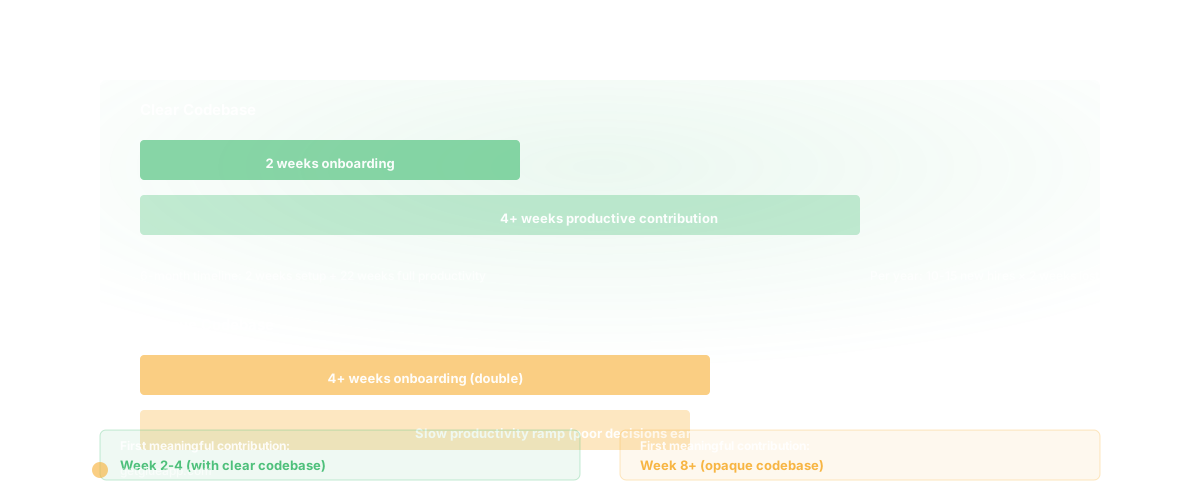
The other multiplier is onboarding. New engineers contribute less in their first six months in an opaque codebase. Not because they're weak engineers. Because they spend the first four weeks just understanding what the system does.
A 50-person engineering org hiring at a normal rate brings on 10 ( - 15) engineers a year. If each onboarding period is two weeks longer because the codebase is opaque, that's an extra month of sub-productivity per cohort. That's real capacity lost.
But there's another cost: those engineers make worse decisions early. They add code that makes local sense but damages the global system. Some of those damages compound. Some of them require expensive refactoring later. An engineer who adds a poorly-integrated feature in month three because she didn't understand the system boundaries is, in a very real sense, creating technical debt that will cost someone else months of work to repair.
The PM-Engineering Friction Symptom
Here's a signal that your codebase has become opaque: PMs and engineers are constantly negotiating about what's possible.
PM: "Can we add a feature flag to the settings page?"
Engineer: "That's complicated." (She doesn't say why because the reason requires walking through three layers of architecture that she herself is not 100% clear on.)
The PM doesn't believe it's complicated. She's seen feature flags added before. So there's friction. The engineer feels like the PM doesn't understand technical constraints. The PM feels like the engineer is being difficult.
This friction is usually a sign that the engineer genuinely doesn't know whether the feature is complicated or not. The system is opaque. She can't tell if her intuition is right. So she defaults to "yes it's complicated" to be safe.
In contrast, in teams with transparent codebases, engineers can answer questions like "what would it cost to add X?" accurately because they understand the system well enough to see the dependencies. PMs and engineers collaborate better because they're operating from shared information instead of negotiation.
Breaking the Cycle
The compounding doesn't stop itself. It stops when you decide to invest in visibility.
This isn't about rewriting the codebase. It's about making it legible. Clear ownership. Visible dependencies. Documented architectural decisions. Regular codebase health reviews where architects ask "is this module still doing one thing?" and "is this still owned by someone?"
It's also about tools. At a certain scale, you can't manually maintain visibility. A team of 50 engineers where you're asking "does anyone understand the dependency graph?" is a team where a tool that shows you the graph is ROI-positive immediately.
The cost of that tool ( - $50K, $100K, whatever ( - is less than the cost of one incident taking eight hours instead of three, multiplied across the incidents you have in a quarter.
The hard part is that opacity is invisible until it's expensive. You don't notice it at 10 people. You don't notice it at 20 people. You notice it at 50 people, when everything just feels slower, and you can't point to why. That's the compounding at work.
Frequently Asked Questions
Q: Isn't this just saying we need more documentation?
Not quite. Documentation helps, but documentation becomes stale. What matters is designing the codebase itself to be understandable: clear module boundaries, explicit ownership, and visible dependencies through dependency mapping. Good software architecture documentation supports that, but the architecture does the real work.
Q: How do we measure if our codebase is opaque?
Start with incident resolution time. If the average incident takes 120–150 minutes and 50%+ of that is "understanding the system," you're paying an opacity tax. Also track onboarding time, cycle time, and engineering efficiency metrics to quantify the cost of opacity.
Q: Can we fix this without stopping feature work?
You have to. If you stop all feature work to refactor, you'll run out of money. The move is to budget 15 ( - 20% of engineering capacity for ongoing codebase health work. That's aggressive enough to break the compounding cycle but not aggressive enough to crater your roadmap.
Related Reading
- Code Dependencies: The Complete Guide
- Dependency Mapping: A Practical Guide
- Software Architecture Documentation: A Practical Guide
- C4 Architecture Diagram: The Model That Actually Works
- Code Refactoring: The Complete Guide to Improving Your Codebase
- Knowledge Management System Software for Engineering Teams