
Knowledge management system software for engineering teams requires two complementary layers: traditional document tools (Confluence, Notion, Tettra) for static process knowledge like runbooks, onboarding guides, and team norms, plus codebase intelligence platforms that derive structural knowledge—dependencies, architecture, ownership—directly from code. Traditional KMS fails engineering teams because 80% of engineering knowledge is dynamic and embedded in code, not static and document-based, causing documentation to go stale faster than teams can maintain it.
Your engineering team has a knowledge management system. It's probably Confluence, maybe Notion, possibly both plus a Jira wiki nobody's touched in eight months. You've invested real time in it — onboarding docs, architecture overviews, runbooks, ADRs. Someone spent three days writing a "how our authentication works" document in 2022.
That document is wrong now. Everyone knows it.
This isn't a discipline problem. It's a structural one. Standard knowledge management software was built for a fundamentally different kind of knowledge than what engineering teams actually need.
At Salesken, where I was CTO building real-time voice AI, we had a Confluence space with 400+ pages. Our most-viewed page — the architecture overview — hadn't been updated in 11 months. It showed 8 services. We had 14. Three of the services it described had been merged into one. Two of the APIs it documented had been deprecated. New engineers would read it, build a mental model, and then spend weeks unlearning that model when they discovered the actual system.
I don't blame the engineers who wrote the docs. I blame the assumption that human-written documentation can keep pace with a codebase that changes multiple times per day.
What Standard KMS Tools Are Good At
Confluence, Tettra, Guru, Notion — they excel at one specific type of knowledge: explicit, relatively static information that humans write down and other humans look up. HR policies. Customer FAQs. Onboarding checklists for processes. Sales battle cards.
For that kind of knowledge, these platforms work well. Guru's browser extension lets support reps pull up answers mid-call. Tettra's Slack integration surfaces docs before someone asks.
The problem is that most engineering knowledge doesn't live in documents. It never did.
Engineering Knowledge Is Structurally Different
When a new engineer joins your team and asks "how does the payment service work?" the honest answer isn't in any document. The real answer is distributed across:
- How the service is structured (which you understand by reading code)
- Why it's structured that way (scattered across PR descriptions and a Slack thread from 2021 nobody can find)
- What it depends on and what depends on it (changes every sprint)
- Who actually owns it (one senior engineer who's been there three years)
- The three things that will break if you touch the wrong abstraction (tribal knowledge held by two people)
None of this is a document. Most of it can't become a document without going stale within weeks.
At UshaOm, where I led a 27-engineer e-commerce team, I watched a new hire spend three weeks building a mental model of our product catalog system from Confluence docs. Then she paired with the senior engineer who actually maintained it and discovered the docs described the system from before a major refactor. Three weeks of learning the wrong architecture. We didn't have a documentation problem — we had a knowledge problem that documentation couldn't solve.
Three Failure Modes

Staleness at scale. A document describing a service's architecture needs updating every time the architecture changes. In a team shipping multiple times per week, the update cadence required to keep docs current is simply unsustainable alongside actual engineering work. At Salesken, we tried mandatory doc updates as part of our PR checklist. It lasted two months. Engineers started writing one-line updates ("updated X") that passed the checklist but added no value. The process became ceremony.
The discovery problem. Traditional KMS assumes you know what to search for. But the most valuable engineering knowledge is what you don't know you need. At Salesken, a junior engineer didn't know that our caching layer had an undocumented behavior causing intermittent failures above a certain load threshold. Three services had an implicit dependency through a shared database table nobody had formally documented. The knowledge gap isn't "I need to know X and can't find it." It's "I don't know that I need to know X."
Context collapse. Code is deeply contextual. The same function means different things depending on how it's called, what data it receives, what state the system is in. A Confluence page describing a function strips away most of this context. An engineer reading that page gets a simplified map of complex territory. Simplified maps cause navigation errors.
Three Layers of Engineering Knowledge
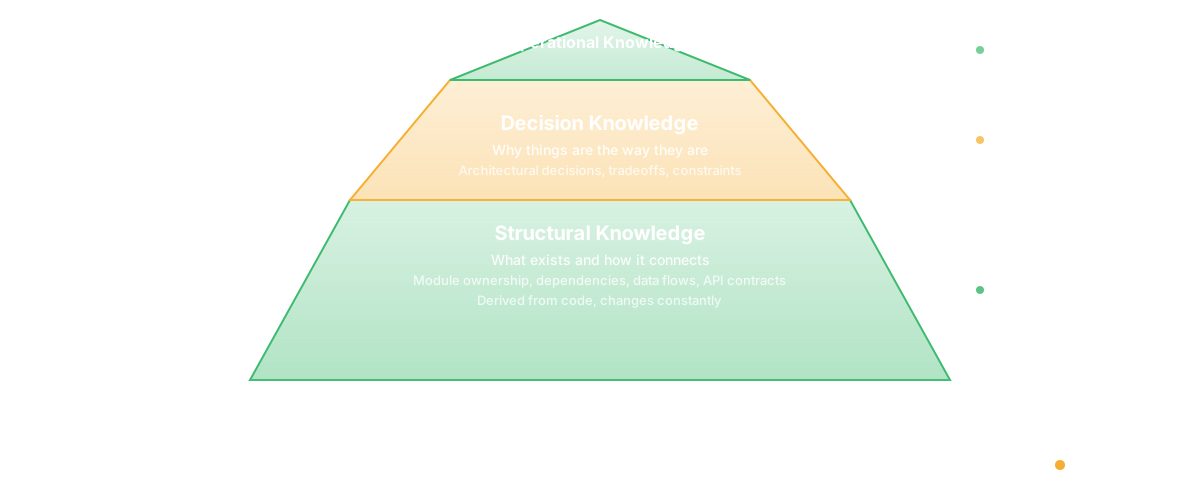
Structural knowledge — what exists and how it connects. Module ownership, service dependencies, API contracts, data flows. This is the "map of the territory." Every non-trivial codebase has a topology, and most engineers only know the parts they work in regularly. Structural knowledge needs to be derived from code itself, not written into documents, because it changes with the code.
Decision knowledge — why things are the way they are. Architectural decisions, tradeoffs, constraints. This is genuinely worth documenting — ADRs work precisely because the "why" doesn't change as fast as the "what." At Salesken, we wrote ADRs for every major architectural decision after our first year. The ADR explaining why we chose a monolithic coaching engine instead of microservices (latency requirements, <10ms per inference) saved us from relitigating that decision three separate times.
Operational knowledge — how to work safely in the codebase. What's brittle, what's changing, who to ask before touching what. This is the most valuable and hardest to capture. At UshaOm, our senior Magento engineer knew that the product import module had a race condition when processing concurrent CSV uploads. He knew because he'd debugged it twice. That knowledge lived in his head for two years before we hit it again after he went on vacation.
Generic KMS tools help with decision knowledge, barely touch operational knowledge, and are structurally unsuited for structural knowledge.
Why the Gap Is Getting Worse
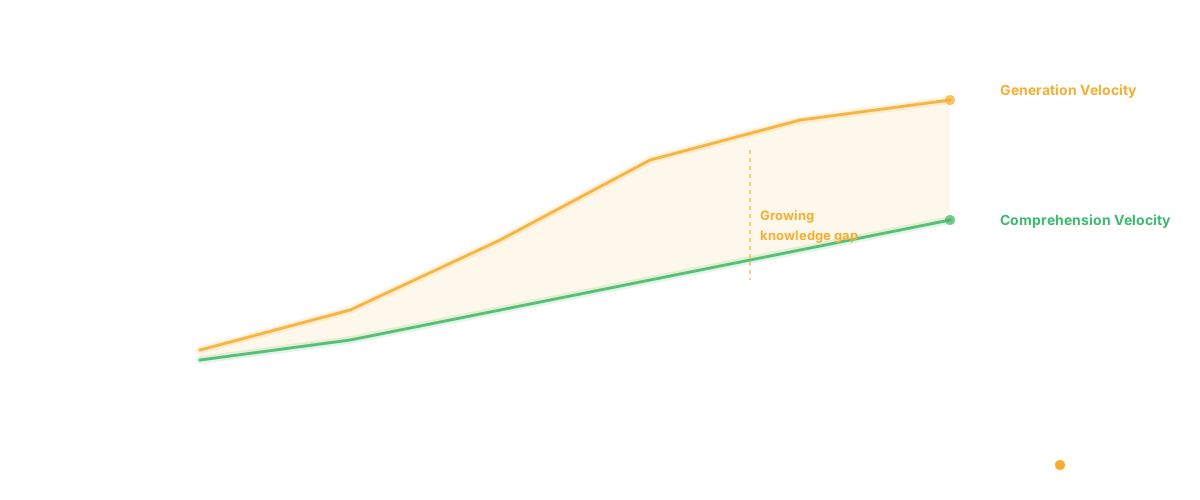
Two trends are accelerating this simultaneously.
AI coding tools. Cursor, Copilot, Claude Code let engineers generate code faster than ever. But generated code inherits context from the engineer prompting it, not from the codebase. An engineer who doesn't understand how a service's error handling works will generate code that ignores it. The code is syntactically correct. It doesn't understand local constraints. At Salesken, after adopting Cursor, our codebase grew 40% in 6 months while our documentation coverage actually decreased because engineers were generating features faster than anyone could document them.
Team growth. A five-person team can hold codebase knowledge in shared memory. At 25 engineers, that's impossible. At UshaOm, knowledge distribution was manageable at 8 engineers. By 27, our bus factor on critical modules was 1 for three different services, and nobody realized it until one engineer went on paternity leave and the team couldn't ship changes to the payment module for two weeks.
What Engineering Knowledge Management Should Look Like
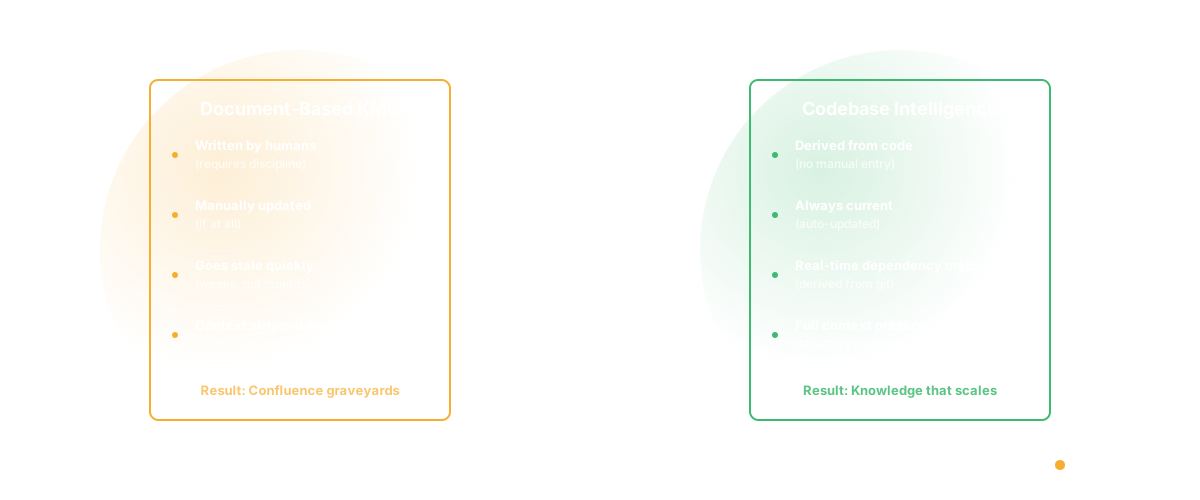
The right system starts from the codebase, not from documents. Instead of "what have humans written about this?" it asks "what does the code itself tell us?"
Codebase-indexed search. Find relevant code by describing what you're looking for in plain English, not by hoping someone documented it. At Salesken, our best "documentation" was the codebase itself. The problem was that only senior engineers could navigate it efficiently. Codebase intelligence makes that navigation accessible to everyone.
Live dependency mapping. Know what depends on what, in real time, derived from actual code. Not a diagram someone drew six months ago. At UshaOm, our architecture diagram showed 6 services. A dependency analysis revealed 14 inter-service connections that weren't on any diagram.
Ownership visibility. Who wrote what, who reviews it, who gets paged when it breaks — derived from git history and code review patterns, not from an org chart that's two reorgs out of date.
Architecture-level context. Understand how a service fits into the larger system before you start modifying it. This is what onboarding should look like — not reading stale docs, but querying the actual codebase.
The Practical Path
If you're evaluating KMS for an engineering team, here's the honest framing.
Traditional KMS (Confluence, Notion, Tettra, Guru) — worth using for knowledge that belongs in documents: runbooks, incident postmortems, team norms, process checklists. Be honest about their limits. They won't solve your codebase knowledge problem.
For structural codebase knowledge — dependencies, ownership, architecture, safe change paths — you need tooling that reads the codebase directly. Asking engineers to document this manually is the wrong approach. At Salesken, we tried it for two years. The documentation was always wrong. The code was always right.
The best engineering teams pair both: documents for stable process knowledge, codebase intelligence for dynamic structural knowledge. The failure mode is treating them as interchangeable.
Your senior engineers already know this intuitively. They don't go to Confluence to understand how a service works. They read the code. The goal of good engineering knowledge management is making that same understanding accessible without requiring six months of tenure to acquire it.
FAQ
What is the best knowledge management software for engineering teams?
It depends on the knowledge type. For process docs, runbooks, and team norms: Confluence, Notion, or Tettra. For structural codebase knowledge — dependencies, architecture, ownership: codebase intelligence tooling that derives knowledge from code itself. Most teams need both.
Why do engineering teams struggle with knowledge management?
Most engineering knowledge is dynamic and embedded in code, not static and document-based. Traditional KMS is designed for the latter. When teams force-fit code knowledge into document tools, they get docs that go stale faster than they can be maintained. This is the same root cause behind tribal knowledge silos and rising bus factor risk.
How is a knowledge management system different from a CMS?
A CMS manages content for publishing. A KMS manages internal organizational knowledge. For engineering teams, a third category matters: systems that surface knowledge embedded in the codebase itself, which neither CMS nor traditional KMS tools address.
Related Reading
- Software Architecture Documentation: The Part That Always Goes Stale
- AI Code Assistant vs Codebase Intelligence: Why Agentic Coding Changes Everything
- Code Dependencies: The Complete Guide
- Dependency Mapping: How to Know What Will Break Before You Break It
- The Product Manager's Guide to Understanding Your Codebase
- The CTO's Guide to Product Visibility
- Bus Factor in Software Engineering
- Knowledge Silos Are a Product Problem
- Tribal Knowledge Guide
- What Is Tribal Knowledge?
- What Is Codebase Documentation?
- Glue vs Swimm
- Glue vs Notion