
Software architecture documentation fails because it relies on manual maintenance of static diagrams that become stale within months. The most effective approach combines Architecture Decision Records (ADRs) for capturing design rationale, auto-generated dependency graphs derived from code for structural accuracy, and lightweight C4 context diagrams for communicating system boundaries. Good architecture documentation is sparse, current, and trusted — not comprehensive, stale, and ignored. Teams that shift from manually maintained wikis to code-derived structural docs plus decision-focused ADRs see dramatically higher usage and accuracy.
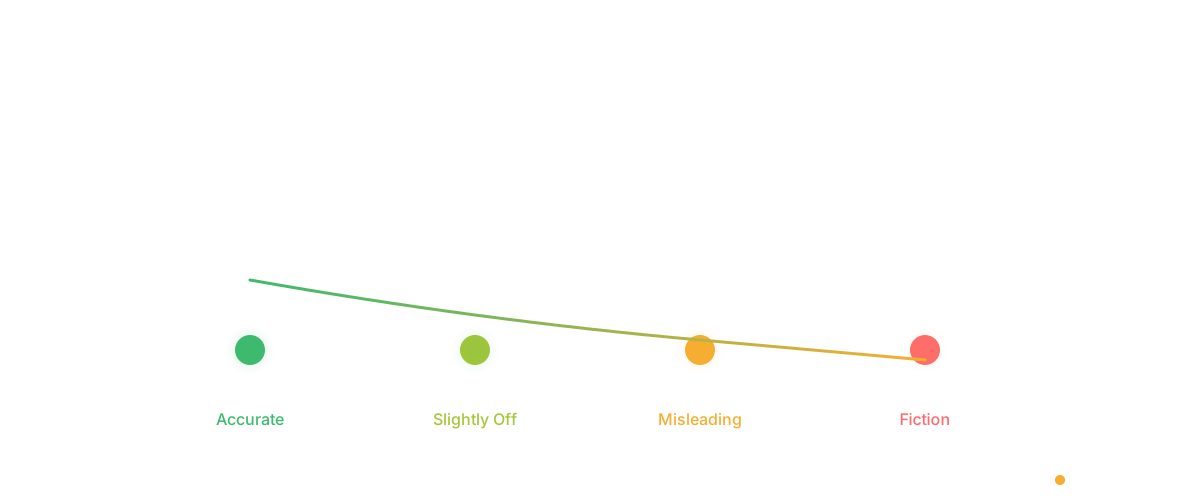
I've seen a lot of architecture documents. Neat C4 diagrams. Detailed service maps. Carefully labeled component charts. And I've watched almost all of them become fiction within six months of being drawn.
At Salesken, where I was CTO building real-time voice AI, our principal engineer spent a week creating a comprehensive system diagram in 2022. It was accurate and genuinely useful. Three months later, two new services had been added, one had been refactored into three, and a caching layer nobody documented was quietly introduced to fix a production issue. The diagram was now misleading. Updating it would take three days. Nobody had three days. The diagram stayed wrong. People stopped trusting it.
This cycle repeats until teams either stop documenting architecture entirely or convince themselves the docs are "good enough" while privately not relying on them for anything.
The problem isn't that engineers are undisciplined about updating docs. It's that the standard approach has a fundamental design flaw: it treats architecture as something you document once, rather than something you continuously surface from the code itself.
Two Purposes, Two Approaches
Before fixing the problem, be precise about what architecture documentation is actually for. There are two distinct purposes, and conflating them is the root cause of most documentation failures.
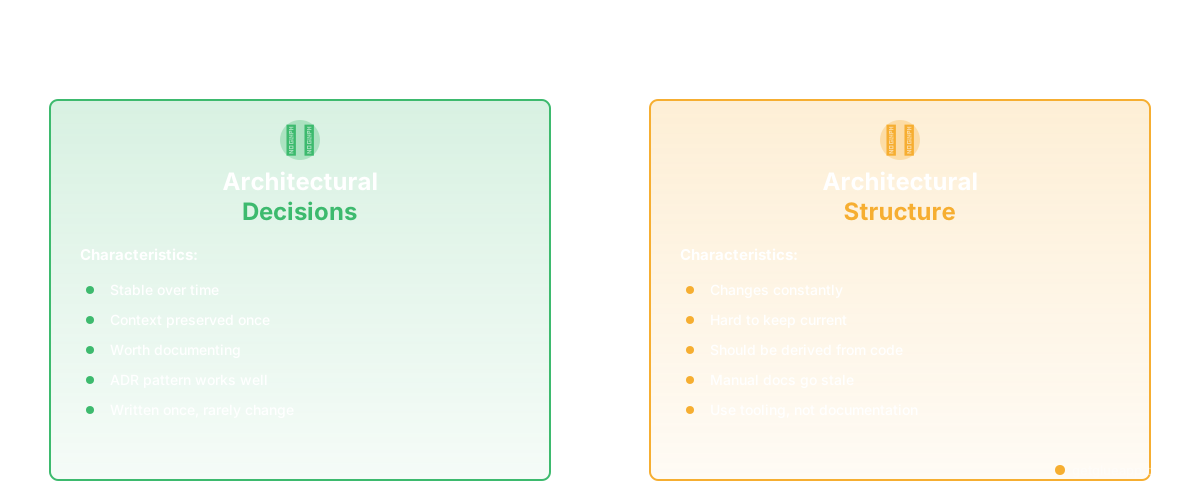
Purpose 1: Capturing architectural decisions. Why was this service split out? Why is authentication centralized? Why do we use event sourcing for the order flow but not for user profiles? These are decisions made at a point in time, with specific context. They deserve documentation because the context that produced them isn't obvious from looking at the resulting code.
At Salesken, we wrote an ADR explaining why we kept the coaching engine as a monolith instead of splitting it into microservices. The reason was latency — we needed <10ms per inference, and inter-service communication would have added 5-8ms. That ADR saved us from relitigating the decision three separate times over two years. Every time someone new proposed splitting it, we pointed them to the ADR. Five minutes of reading instead of two hours of debate.
Purpose 2: Capturing architectural structure. What exists? How does it connect? What calls what? Who owns what? This is the "map of the territory" problem.
The mistake is treating both the same way: write a document, maintain it manually. This works for Purpose 1 (decisions are relatively stable). It fails systematically for Purpose 2 (structure changes constantly).
Why Structure Documentation Always Goes Wrong
For structure to stay accurate, it has to be updated in parallel with the code. In practice, this means: every new service requires a diagram update, every dependency change requires a service map update, every refactor requires a component diagram update.
In a team shipping continuously, this is a second job. A second job with no on-call rotation, no sprint allocation, no deadline, and no visible consequence if you skip it.
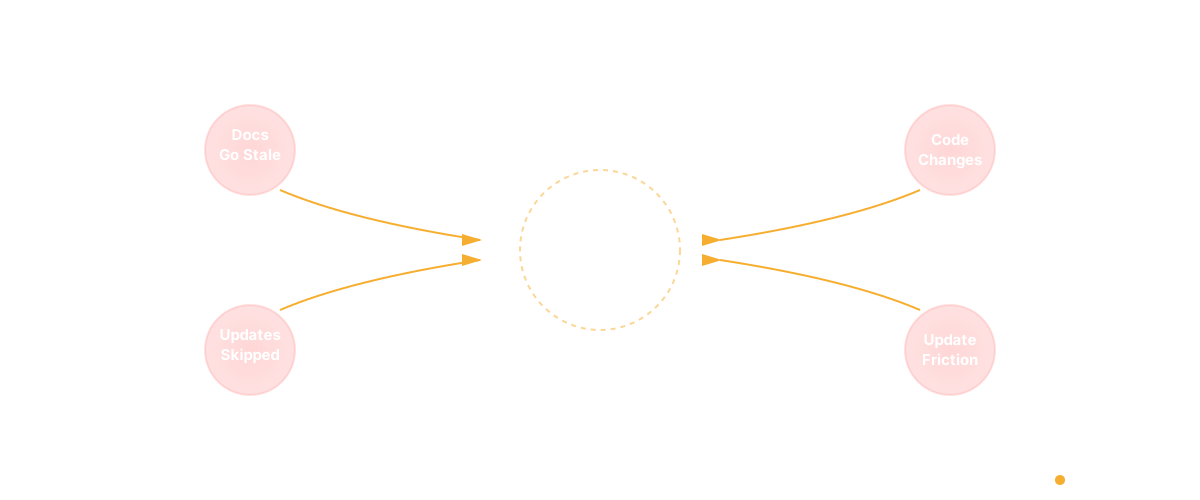
At Salesken, we tried mandating architecture doc updates in our PR checklist. It lasted two months. Engineers started writing one-line updates ("updated X") that passed the checklist but added no value. The process became ceremony — exactly the kind of process maximalism I wrote about in Software Productivity.
There's a subtler problem too. The person best qualified to update the docs is the person who made the change. But they've already written the code, the PR description, the commit message, and reviewed two other PRs today. Adding "update the architecture doc" is friction. Friction compounds.
At UshaOm, where I ran a 27-engineer e-commerce team, we went through three cycles of "let's get serious about architecture docs" over two years. Each time: initial enthusiasm, two months of updates, gradual abandonment, six months of stale docs, then the next initiative. The problem wasn't motivation. It was the structural mismatch between how fast the code changed and how much effort docs required.
The ADR Pattern: What Works for Decisions
Architecture Decision Records work because they solve a real problem (preserving decision context) in a way that resists staleness (decisions don't change as fast as structure).
A good ADR has four parts: the context (what situation prompted this), the decision (what you chose), the rationale (why, including rejected alternatives), and the consequences (what this means going forward). Written once, at decision time, essentially never updated. If the decision changes, write a new ADR referencing the old one.
The format works because cognitive load is front-loaded. You write it when context is freshest. Future engineers understand not just what the system does but why.
At Salesken, our most valuable ADRs were:
- Why we chose a monolithic coaching engine (latency requirements)
- Why we moved from synchronous to async analytics processing (cascade failure prevention — see Incident Management)
- Why we kept the STT integration as a thin wrapper (vendor flexibility)
Each was written in 30 minutes. Each saved hours of repeated discussion. That's the ROI of decision documentation.
For teams not doing ADRs yet: start small. Don't retroactively document past decisions. Pick the next significant architectural choice and write an ADR. One paragraph of context, one of decision, one of rationale. That's enough to establish the habit.
Structural Architecture: Derive, Don't Document
For structural architecture — the "map of the territory" — the answer is not better documentation practices. It's accepting that manual structural documentation is the wrong tool and switching to approaches that derive structure from the code itself.
The code already contains the structural information. Import statements encode dependency relationships. Service calls encode integration patterns. Module organization encodes architectural boundaries. API schemas encode contracts. The information exists — it's embedded in code rather than in a diagram.
At Salesken, after our third failed documentation initiative, I started using madge to generate dependency graphs from our TypeScript services automatically. The generated graph was always current because it came from the current code. It wasn't as pretty as a hand-drawn diagram. It was 10x more useful because it was accurate.
This is why codebase intelligence is a growing category. Tools that analyze import graphs to produce live dependency maps. Tools that visualize service call patterns from actual traffic. Tools that map ownership from git history rather than org charts. At Glue, this is exactly what we build — the structural layer that stays current because it's derived, not documented.
What Good Architecture Documentation Looks Like
Based on what I've seen work across the teams I've led:
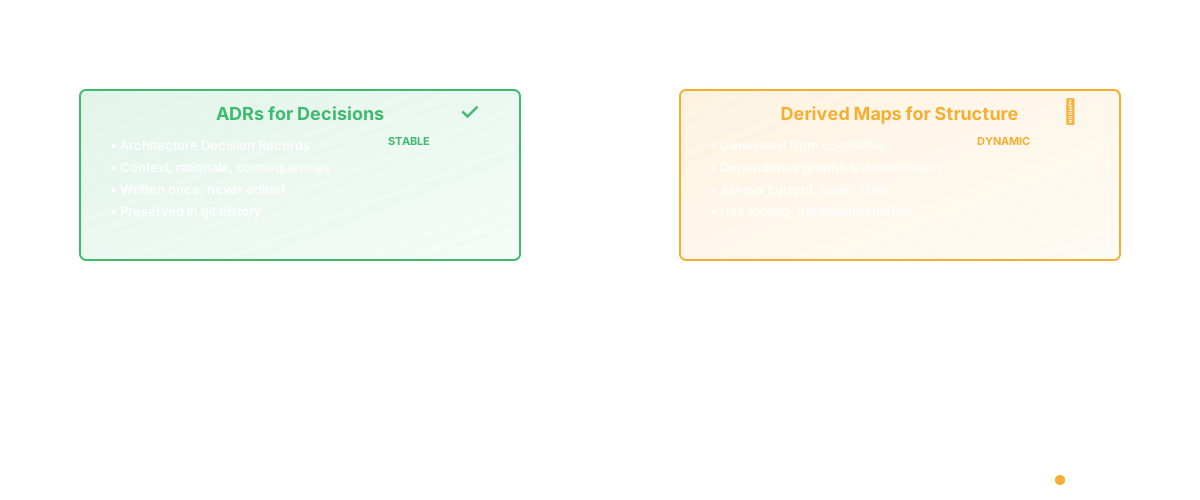
ADRs for decisions. Stored in the repo alongside code (version-controlled, change-tracked). Never edited retroactively. A well-maintained ADR log compounds in value over time.
Derived maps for structure. Architecture diagrams generated from code, not drawn by hand. Dependency visualizations from actual imports. Ownership maps from git activity. Always current because they come from current code.
Lightweight README discipline. Each service has a README explaining its purpose and main interfaces. Not the full architecture — just "what is this thing and what does it do." Small enough to maintain, useful enough to justify the effort.
Runbooks for operations. How to deploy, roll back, respond to incidents. Separate from architecture documentation but often conflated with it. Runbooks update when processes change, usually alongside an incident, which provides the forcing function.
The common thread: match the documentation approach to the stability of what you're documenting. Decisions are stable — document carefully. Structure changes constantly — derive from code. Operations change on event — update runbooks with events.
The Status Symbol Problem
There's a meta-issue worth naming. In many engineering organizations, architecture documentation functions as a signal of maturity rather than a practical tool. Teams create elaborate docs because it demonstrates seriousness, not because anyone relies on them.
When documentation is performative, the quality bar becomes "looks comprehensive in a review" rather than "helps engineers make better decisions." This produces exactly the kind that fails: beautiful when new, misleading when old, trusted by nobody.
The practical test: did an engineer use this document to make a decision last week? If the answer is consistently no, the documentation isn't serving its purpose regardless of how thorough it looks.
At Salesken, I killed our architecture wiki after discovering that the most-viewed page had 3 visits in the previous month — all from the same person, who was checking if it had been updated (it hadn't). We replaced it with ADRs in the repo and auto-generated dependency graphs. Usage went up. Maintenance burden went down. Accuracy went from "maybe 60%" to "always current."
Good architecture documentation is sparse, current, and trusted. Bad architecture documentation is comprehensive, stale, and ignored. Most teams have the latter. The fix isn't more rigor on the same approach. It's recognizing which parts of architecture belong in documents and which should be derived from code.
FAQ
What are the best C4 modeling tools for software architects?
The best C4 modeling tools include Structurizr (created by C4 inventor Simon Brown, supports diagram-as-code with DSL), IcePanel (visual C4 modeling with real-time collaboration), Mermaid.js (free, text-based diagramming that integrates with Markdown and GitHub), and draw.io/diagrams.net (free general-purpose diagramming with C4 shape libraries). For teams that want architecture diagrams derived from actual code rather than manually drawn, codebase intelligence platforms like Glue auto-generate dependency maps and component relationships from your repository, ensuring diagrams never go stale. The choice depends on whether you need collaborative visual editing (IcePanel), version-controlled diagram-as-code (Structurizr), or auto-generated accuracy (Glue).
What should a software architecture document include?
For decision documentation (ADRs): context, decision, rationale, consequences. For structural documentation, consider whether tooling that derives structure from code — like codebase intelligence platforms — serves you better. At minimum: system context (how it fits in the larger environment), component overview (major parts and responsibilities), key dependency maps, and interface definitions. Pair structural docs with code ownership data so you know who actually maintains each component.
How do you keep architecture documentation up to date?
Most teams don't — and the ones that try usually fail because manual updates are too high-friction. What works: ADRs for decisions (inherently stable), tooling that derives structural information automatically — such as dependency mapping and code dependency analysis — so diagrams stay current without manual effort, and lightweight manually-maintained docs so the burden stays manageable.
Related Reading
- Knowledge Management System Software for Engineering Teams
- C4 Architecture Diagram: How to Model Software Systems
- Code Dependencies: The Complete Guide
- Dependency Mapping: How to Know What Will Break Before You Break It
- Incident Management: From Alert to Resolution to Prevention
- The CTO's Guide to Product Visibility
- What Is Codebase Documentation?
- Glue vs Swimm
- What Is Technical Documentation?