
What is Mean Time to Recovery (MTTR)?
Mean Time to Recovery (MTTR) is a DORA metric measuring the average time from incident detection to full system restoration. Elite teams recover in under one hour; the industry average is 24 hours. Reducing MTTR requires automated detection, runbook automation, observability tooling, blast radius reduction through microservices, and automated rollback capabilities. AI-powered incident management can reduce MTTR by 40-60% through automated diagnosis and predictive alerting.
The worst production incident I've experienced was at Salesken — our real-time voice AI pipeline went down during peak hours, affecting hundreds of active sales calls. From detection to full recovery took 47 minutes. It felt like 47 hours. That incident fundamentally changed how I think about MTTR — not as an abstract metric, but as the difference between a bad day and a catastrophe.
Mean Time to Recovery (MTTR) is the average time it takes your engineering team to restore a system to full functionality after an incident occurs. It measures the duration from when an incident is detected to when users can reliably use your service again.
MTTR is a critical DevOps metric within the DORA framework—the industry standard for measuring software delivery performance. Unlike metrics that focus on prevention, MTTR measures your team's response capability. It answers the question: "When something breaks, how fast can we fix it?"
MTTR vs. Related Incident Metrics: Understanding the Acronyms
The incident lifecycle involves multiple time-based metrics. Understanding the differences is crucial:
- MTTD (Mean Time to Detect): Time from incident start to detection. Measured in minutes to hours. Automation and observability reduce this dramatically.
- MTTA (Mean Time to Acknowledge): Time from detection to first response by an engineer. Includes on-call alert delay, escalation, and context switching.
- MTTF (Mean Time to Failure): Average time between failures. Used in reliability engineering; higher is better. Not the same as MTTR.
- MTTR (Mean Time to Recovery): Time from detection to full system recovery and user-facing resolution.
Example timeline:
- System fails at 2:00 PM (incident start)
- Alert fires at 2:03 PM (MTTD = 3 minutes)
- Engineer acknowledged at 2:07 PM (MTTA = 4 minutes)
- System fully recovered at 2:47 PM (MTTR = 47 minutes)
For elite-performing teams, the entire recovery cycle—from detection to resolution—can happen in under 15 minutes. For lower-performing teams, recovery can take weeks.
Why MTTR Is the Most Important Reliability Metric
MTTR directly impacts three critical business outcomes: revenue, trust, and team health.
The Cost of Downtime
Downtime is expensive. Enterprise organizations experience an average of $5,600 in costs per minute of unplanned downtime, according to Gartner. For a SaaS company with 1,000 paying customers, a one-hour outage that affects 10% of customers could translate to:
- Direct revenue loss: Lost transactions, failed API calls, abandoned checkouts
- Incident response costs: On-call engineers, escalation, emergency staff
- Opportunity cost: Engineering time diverted from feature development
- Reputation damage: Customer churn, reduced trust, negative reviews
A company with a 4-hour MTTR losing revenue at $5,600/minute faces $13.4M in potential losses per major incident. Reducing MTTR from 4 hours to 1 hour saves $13M+ per incident over a year.
Customer Trust and Retention
Every minute of downtime erodes customer confidence. Users remember outages:
- SaaS customers expect 99.9% uptime (8.6 hours/month maximum downtime)
- Financial services customers expect 99.99% uptime (43 seconds/month)
- Healthcare and mission-critical systems require near-zero tolerance
Fast recovery (MTTR < 1 hour) demonstrates operational excellence. Slow recovery (MTTR > 1 day) leads to customer churn, particularly among enterprise accounts where SLA breaches trigger financial penalties.
Engineer Burnout and Retention
Long incident recovery cycles burn out teams:
- Engineers experience prolonged stress during incidents
- Unclear recovery processes lead to finger-pointing
- Time spent in "firefighting mode" reduces time for proactive work
- High MTTR correlates with on-call fatigue and team turnover
Teams with MTTR < 1 hour report higher job satisfaction and lower burnout rates because incidents feel manageable and contained.
DORA Benchmarks: How Does Your MTTR Compare?
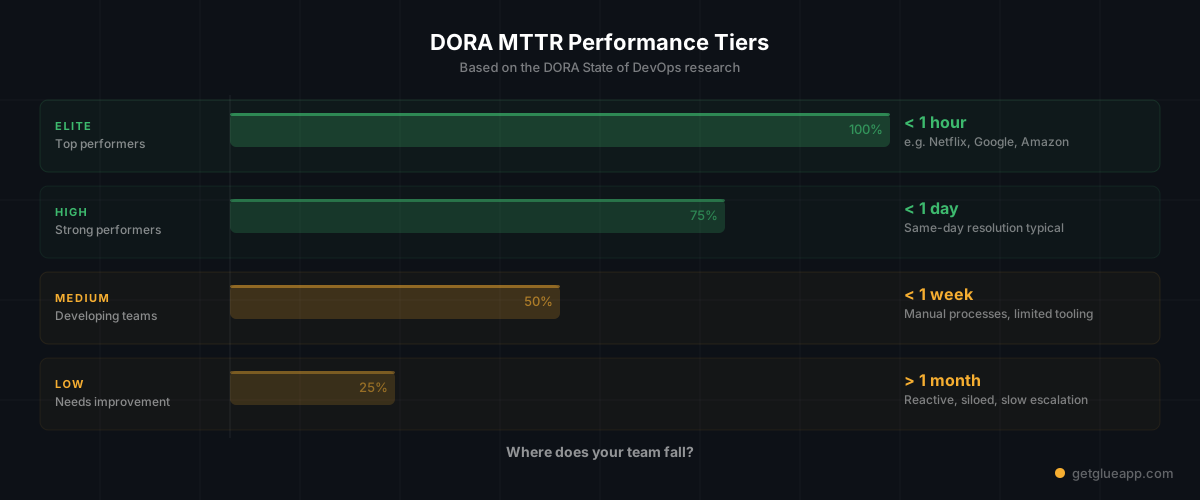
The DORA (DevOps Research and Assessment) framework defines four performance tiers based on MTTR:
| Performance Tier | MTTR | Organization Type |
|---|---|---|
| Elite | < 1 hour | Amazon, Google, Stripe, modern startups |
| High | < 1 day | Fast-growing SaaS, well-resourced teams |
| Medium | < 1 week | Mature organizations, traditional enterprises |
| Low | > 6 months | Legacy systems, limited DevOps maturity |
Elite performers recover from incidents in under an hour because they've invested in:
- Automated observability (real-time metrics, logs, traces)
- Rapid incident detection (anomaly detection, synthetic monitoring)
- Codified runbooks and automation
- Clear incident response protocols
Low performers struggle with MTTR > 6 months because:
- Manual troubleshooting processes
- Siloed teams (ops, dev, security separated)
- Limited visibility into system state
- Institutional knowledge locked in individual engineers
What tier is your organization in? If you're consistently > 1 week, you have significant opportunity to improve.
The Anatomy of Incident Recovery
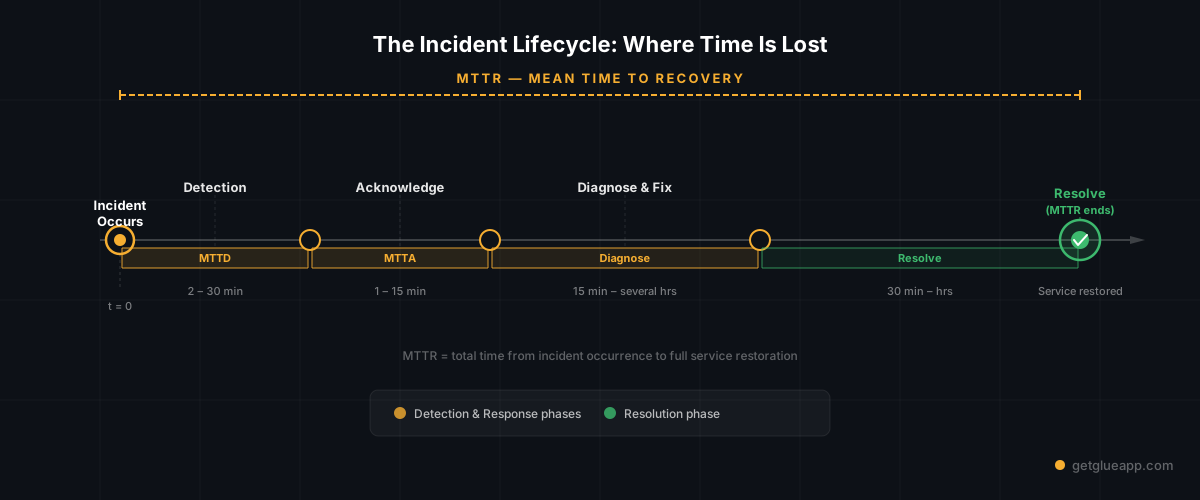
Every incident follows a predictable recovery cycle. Understanding each phase helps identify where your MTTR suffers:
1. Detection (Starts the Clock)
An anomaly is identified—either through automated alerts, monitoring systems, or user reports. Automated detection is 10-100x faster than user reports.
How to optimize: Implement comprehensive observability before incidents occur, not after.
2. Triage
The on-call engineer assesses severity and impact:
- Is this a full outage or partial degradation?
- Does it affect paying customers or internal systems?
- What's the blast radius?
How to optimize: Create incident severity definitions ahead of time. Automate classification based on error rates and customer impact.
3. Diagnosis
Engineers investigate root cause:
- Check logs and metrics
- Review recent deployments
- Examine error traces
- Correlate timing with system changes
This phase consumes the most time in traditional incident response.
How to optimize: Invest in observability. Structured logs, distributed traces, and custom metrics reduce diagnosis time from hours to minutes.
4. Remediation
Execute the fix:
- Roll back recent changes
- Deploy a hotfix
- Perform manual configuration changes
- Restart failed services
How to optimize: Automate common remediation steps. Circuit breakers, automated rollbacks, and self-healing systems resolve issues without human intervention.
5. Verification
Confirm the system is healthy:
- Automated health checks pass
- Error rates return to baseline
- User-facing services respond normally
- No cascading failures occur
How to optimize: Automated validation prevents false "all-clear" declarations. Define clear recovery criteria in runbooks.
6. Post-Mortem & Learning
After incident stabilization, document what happened and how to prevent recurrence.
How to optimize: Blameless post-mortems within 24 hours. Turn every incident into process improvement.
7 Strategies to Reduce MTTR
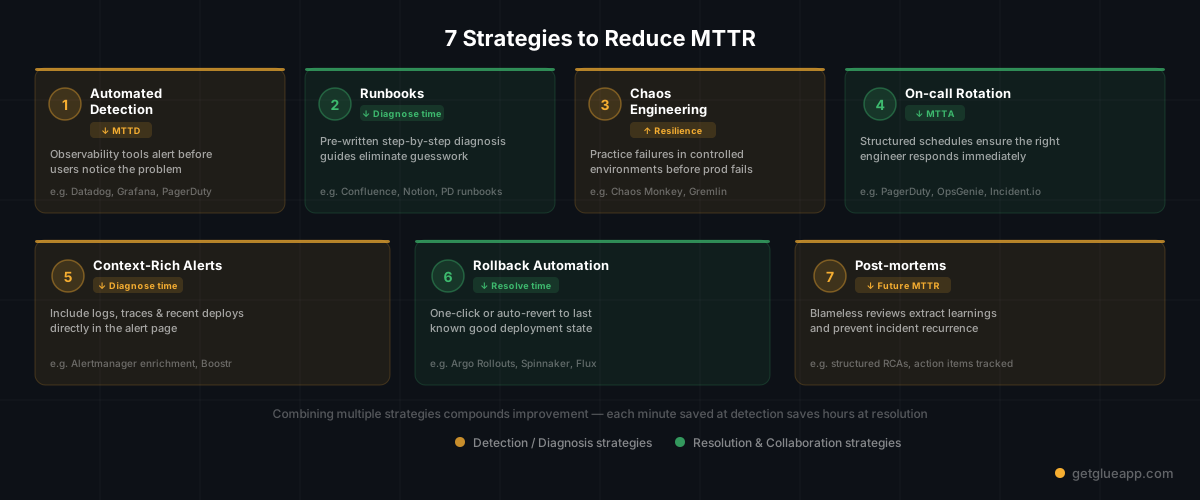
Reducing MTTR requires systematic investment across detection, diagnosis, and remediation. Here are seven proven strategies:
1. Automated Incident Detection (Reduce MTTD to Near-Zero)
Waiting for users to report outages adds 30 minutes to MTTR on average. Automated detection catches issues before customers notice.
Implementation:
- Synthetic monitoring: Simulate customer workflows every minute. Catch degradation before real users do.
- Metric anomaly detection: Use ML to identify unusual patterns in latency, error rates, and throughput.
- Distributed tracing: Detect cascading failures across microservices in real-time.
- Application performance monitoring (APM): Track request latency, database query performance, and endpoint health.
ROI: Reducing MTTD from 15 minutes to 3 minutes saves 12 minutes per incident. Over 50 incidents/year, that's 10 hours of customer-facing downtime eliminated.
2. Runbook Automation (Codify Common Responses)
Manual runbooks require engineers to read, interpret, and execute steps. Automated runbooks execute recovery actions in seconds.
Example: When CPU usage exceeds 80% for 5 minutes:
- Manual process: Engineer reads runbook → logs into server → adjusts auto-scaling settings → verifies (15 minutes)
- Automated process: Alerting system adjusts scaling parameters automatically → verifies (30 seconds)
Implementation:
- Codify incident responses in Infrastructure-as-Code
- Create automated workflows for common issues (database failover, auto-scaling, config rollback)
- Use orchestration tools (Kubernetes operators, serverless functions) to execute recovery automatically
- Build self-healing systems that resolve issues without human input
3. On-Call Best Practices (Clear Escalation, Proper Tooling)
Even with automation, humans still handle complex incidents. Effective on-call programs reduce MTTA:
- Clear escalation paths: Define who owns what and when to escalate. Ambiguity adds 10+ minutes.
- Pre-incident context: Give on-call engineers system architecture diagrams, recent deployments, and known issues.
- Incident commander role: Designate someone to coordinate communication, preventing wasted effort and re-investigation.
- On-call tooling: Use incident management platforms (PagerDuty, Opsgenie) to route alerts to the right engineer immediately.
- Regular on-call rotations: Prevent knowledge concentration. Cross-train teams so multiple engineers can respond.
4. Observability Investment (Traces, Logs, Metrics—The Three Pillars)
Poor observability is the #1 cause of long MTTR. Engineers can't fix what they can't see.
Metrics: Quantitative data about system behavior (request latency, error rate, CPU usage). Set baselines, alert on anomalies.
Logs: Event what I've seen applications and infrastructure. Structured logging enables rapid filtering and correlation.
Traces: Request flows across services. Identify which service is slow or failing in a microservices architecture.
Implementation:
- Aggregate metrics, logs, and traces in a centralized platform
- Create dashboards for common incident scenarios
- Use log correlation to connect user impact to infrastructure changes
- Implement high-cardinality logging (include user IDs, request IDs, version numbers)
Example: When latency spikes, observability lets you instantly see:
- Which service is slow (traces)
- What requests are affected (logs)
- Whether resource constraints caused it (metrics)
Without observability, engineers spend 30+ minutes investigating blind.
5. Blast Radius Reduction (Service Isolation, Circuit Breakers)
The larger the failure scope, the longer recovery takes. Architectural patterns that isolate failures reduce MTTR:
- Service isolation: One service failure doesn't cascade to dependent services. Timeouts and circuit breakers prevent propagation.
- Feature flags: Toggle problematic features off without redeployment. Recover in seconds instead of minutes.
- Database replication: Read replicas isolate database failures from readers.
- Canary deployments: Catch issues affecting 1% of traffic before rolling out to 100%, limiting blast radius.
Example: A payment service fails. Without isolation, the entire platform goes down (MTTR = 2 hours). With circuit breakers, the checkout uses a cached price and completes, limiting damage to new purchases only (MTTR = 20 minutes).
6. Automated Rollback Capabilities
Most incidents are caused by recent code changes. Rollback is often the fastest recovery path.
Implementation:
- Every deployment must be reversible. Never deploy code that can't be rolled back.
- Automated rollback on health check failures. If error rates spike after deployment, revert automatically.
- Blue-green deployments: Run two versions in parallel, switch traffic instantly if issues arise.
- Version all infrastructure and configuration changes, not just code.
Speed: Automated rollback recovers in 30-60 seconds. Manual rollback takes 10-30 minutes.
7. Post-Incident Learning Culture
Each incident is an opportunity to reduce future MTTR. Organizations that learn from incidents improve systematically:
- Blameless post-mortems: Focus on process failures, not individual mistakes. Ask "why did our process fail?" not "who failed?"
- Shared learning: Document incident patterns and responses. Turn tribal knowledge into codified processes.
- Trend analysis: Track MTTR improvements over time. Celebrate progress.
- Preventive fixes: For each incident, ask: "How do we prevent this category of failure?" and implement preventive measures.
Teams that conduct thorough post-mortems see MTTR improve 15-20% year-over-year.
Measuring MTTR Correctly
MTTR sounds simple but requires discipline to measure consistently:
Define Start and End Points
- Start: When the incident is detected by automated systems (not when users report it)
- End: When the system is verified healthy and users can reliably use it (not when symptoms stop)
Exclude Planned Maintenance
Scheduled maintenance windows don't count toward MTTR. Only unplanned incidents matter.
Handle Partial Outages
When 10% of users are affected:
- Strict definition: Count full time until 100% of users are recovered
- Practical definition: Weight MTTR by percentage of users affected
Track Metrics by Severity
Elite teams track MTTR separately for:
- Critical incidents (customer-facing, > 1% of users affected)
- Major incidents (degradation, limited user impact)
- Minor incidents (internal systems, no customer impact)
Aggregate Properly
Calculate the arithmetic mean of individual incident recovery times. If you had incidents recovering in 5 min, 30 min, 120 min, and 10 min, your MTTR is 41 minutes.
How AI Agents Reduce MTTR by 60%
AI-driven incident response is no longer theoretical—it's production-ready at leading companies. AI DevOps automation accelerates the three slowest phases of incident recovery:
Automated Diagnosis (30-40% Time Savings)
Traditional diagnosis requires engineers to manually correlate metrics, logs, and traces. AI agents do this instantly:
- Pattern recognition: "I've seen this error pattern before. It's caused by database connection exhaustion."
- Root cause hypothesis: Instead of showing raw data, AI presents the most likely root causes ranked by probability
- Cross-signal correlation: AI correlates code changes, deployment events, and infrastructure changes with incident timing
Example: When latency spikes, an AI agent generates a diagnosis in 30 seconds:
- "Latency increased 300% at 2:15 PM"
- "Correlation: New deployment v3.2.1 rolled out at 2:14 PM"
- "Root cause hypothesis: Database query N+1 in new user profile endpoint"
- "Recommended action: Rollback to v3.2.0 or apply query optimization"
Predictive Alerting (20-30% Time Savings)
AI doesn't just detect current issues—it predicts imminent failures:
- Capacity prediction: Extrapolate current trends. "At current growth, database will run out of disk space in 6 hours."
- Error rate prediction: "Error rate is increasing. At current trend, it will exceed SLA in 45 minutes."
- Anomaly scoring: Distinguish true anomalies from expected variation. Reduce alert noise by 90%.
Early prediction gives teams time to remediate proactively before customers are affected, reducing MTTR to near-zero.
Automated Remediation (20% Time Savings)
For well-understood failure modes, AI agents execute recovery automatically:
- Auto-scaling resource-constrained services
- Rolling back problematic deployments
- Circuit-breaking cascading failures
- Executing parameterized runbooks based on diagnosis
The Strategic Value of MTTR Investment
Reducing MTTR from 4 hours to 1 hour has compounding benefits:
| Benefit | Annual Impact |
|---|---|
| Averted downtime costs | $13.4M per incident (if 12 major incidents/year) |
| Prevented customer churn | $500K-$2M (for SaaS companies) |
| Engineering productivity | 200+ hours reclaimed from firefighting |
| Reduced on-call fatigue | Significantly improved retention and morale |
| Competitive advantage | Faster recovery = better reliability = market differentiation |
Organizations that invest systematically in MTTR reach elite performance (< 1 hour) within 12-18 months.
How Glue Accelerates MTTR
Glue is an Agentic Product OS for engineering teams that reduces MTTR through AI-driven incident response automation. The platform combines distributed tracing, structured logging, and AI agents to detect, diagnose, and remediate incidents with minimal human intervention.
With Glue, engineering teams see:
- Automated incident diagnosis in seconds (not hours). AI agents correlate metrics, logs, and deployment data to pinpoint root causes instantly.
- Predictive alerting that catches issues before customers notice, reducing MTTD to near-zero.
- Automated remediation workflows for common failure modes, executing recovery steps without human intervention.
- Institutional learning from every incident, turning post-mortems into actionable process improvements.
Teams using Glue report 40-60% reductions in MTTR within the first three months of implementation.
For engineering managers and CTOs aiming to reach elite performance, MTTR optimization is non-negotiable. The investment in automation, observability, and AI-driven response pays dividends in uptime, customer trust, and engineer satisfaction. Glue accelerates this journey, giving teams the tools to respond to incidents faster than ever before.
Key Takeaways
- MTTR measures recovery speed: It's the time from detection to full system recovery, directly impacting revenue and customer trust.
- DORA benchmarks define performance: Elite organizations recover in < 1 hour. Most organizations should target < 1 day.
- Seven strategies drive improvement: Automated detection, runbook automation, on-call practices, observability, blast radius reduction, automated rollback, and learning culture.
- AI accelerates recovery: Automated diagnosis, predictive alerting, and intelligent remediation reduce MTTR by 40-60%.
- MTTR is measurable and improvable: Start tracking today. Measure consistently. Improve systematically.
Reducing MTTR isn't just a technical optimization—it's a strategic investment in reliability, customer satisfaction, and team health. Organizations that prioritize MTTR reach elite performance and gain durable competitive advantages.
Related Reading
- Change Failure Rate: The DORA Metric That Reveals Your Software Quality
- Deployment Frequency: The DORA Metric That Reveals Your True Engineering Velocity
- DORA Metrics: The Complete Guide for Engineering Leaders
- Lead Time for Changes: How to Measure and Optimize
- Engineering Bottleneck Detection: Finding Constraints Before They Kill Velocity
- Cycle Time: Definition, Formula, and Why It Matters
Frequently Asked Questions
What is a good Mean Time to Recovery?
Elite-performing teams recover from incidents in under one hour. High performers typically achieve MTTR under four hours. The industry average hovers around 24 hours. Focus on reducing MTTR incrementally by improving incident detection, runbook quality, and on-call processes. Track MTTR alongside other DORA metrics like change failure rate and deployment frequency for a complete reliability picture.
How do you calculate MTTR?
MTTR is calculated by dividing the total downtime across all incidents by the number of incidents in a given period. For example, if you had 3 incidents totaling 6 hours of downtime in a month, your MTTR is 2 hours.
What is the difference between MTTR and MTTD?
MTTR (Mean Time to Recovery) measures how long it takes to restore service after an incident is detected. MTTD (Mean Time to Detect) measures how long it takes to discover that an incident has occurred. Reducing MTTD directly reduces MTTR since faster detection leads to faster resolution. Automated monitoring and engineering bottleneck detection tools can significantly reduce both metrics by surfacing anomalies before they escalate.