
Deployment frequency is a DORA metric that measures how often an engineering team ships code to production — elite teams deploy multiple times per day, high performers deploy weekly, and low performers deploy monthly or less. It is a health metric, not a performance metric: low deployment frequency reveals systemic friction such as blocked PRs, flaky CI pipelines, fear of deploying, merge conflicts, or process overload. Improving deployment frequency requires investment in automated testing, trunk-based development, feature flags, and CI/CD reliability rather than heroic individual effort.
When I was CTO at Salesken, we had a voice AI pipeline that processed thousands of sales calls daily. We shipped to production twice a week. I thought that was fine. We had good test coverage, a staging environment, careful QA. Twice a week felt responsible.
Then one quarter, we tried to increase it to daily deploys. Not because someone read a DORA report, but because our ML team was iterating on models faster than our deployment cadence could keep up. The backlog of "ready but not deployed" changes kept growing. Engineers were batching unrelated changes together just to get them into the next release window.
Within three weeks of moving to daily deployments, our change failure rate actually went down. Not because we got better at coding. Because each deploy was smaller, easier to reason about, and easier to roll back. That was the first time I really understood what deployment frequency measures. It's not speed. It's friction.
The DORA framework identifies four metrics that separate elite performing teams from struggling ones. Of these four, deployment frequency is usually the first to suffer when quality concerns emerge, process debt compounds, or team velocity plateaus. It's also the first metric that responds when you fix the underlying problems.
This post covers what deployment frequency actually measures, why it matters beyond the dashboard, and how to improve it without shipping broken code faster.
What Is Deployment Frequency and Why It Matters
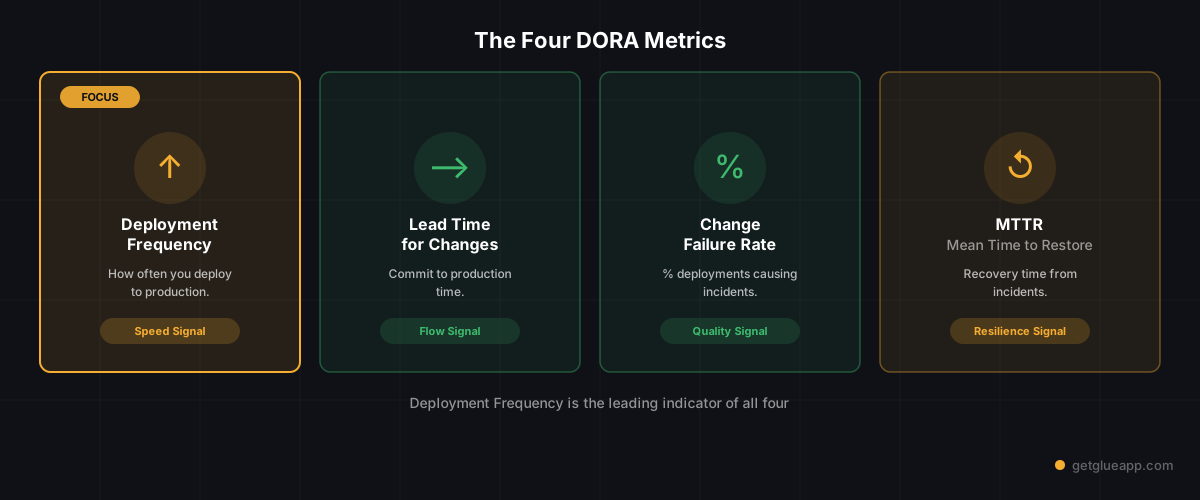
Deployment frequency measures how often your team successfully releases code to production. The DORA definition is straightforward: count the number of deployments per unit of time (typically per day, week, or month).
Most teams treat this as a vanity metric. They shouldn't.
A team deploying five times a day but doing it inconsistently, sometimes pushed by panic fixes, sometimes stalled by broken tests, learns nothing actionable from that number. A team deploying twice a week with predictable, repeatable processes learns everything.
Here's why this metric actually matters:
It isolates friction. Teams stuck in manual processes, flaky tests, or approval bottlenecks deploy less frequently. The number itself doesn't fix anything, but it tells you where to dig.
Faster deploys mean tighter feedback loops. You learn from customers sooner, catch bugs earlier, and course-correct before small problems become production incidents. This one took me a while to internalize. At Salesken, we spent weeks building features that users didn't want, partly because our deployment cadence was too slow to learn.
The correlation with stability is counterintuitive. Deploy faster, break things more? The 2023 DORA State of DevOps Report shows the opposite. Elite performers deploy on-demand, often 10+ times per day, while maintaining the lowest change failure rates. I was skeptical of this when I first read it. Now, having lived through the Salesken transition, I think the causation runs in both directions: good systems enable frequent deploys, and frequent deploys force you to build good systems.
And honestly, there's a morale component too. Teams that ship frequently feel momentum. Shipping feels tangible. I've seen the energy difference between a team that deploys daily and one stuck in biweekly release trains. It's not subtle.
Elite vs. Low Performers: What the Data Shows
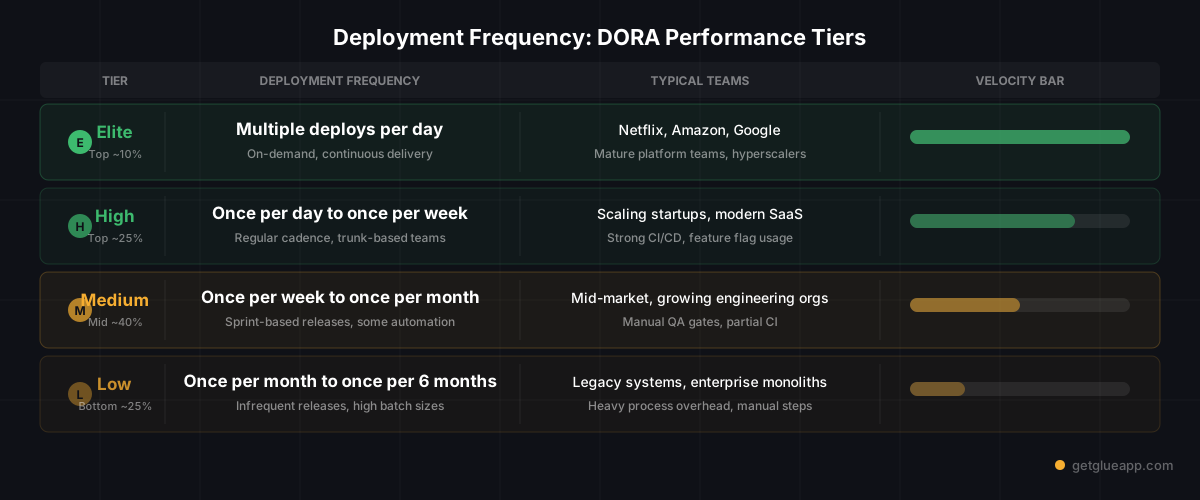
The DORA State of DevOps Report (I'm referencing the 2023 edition, which surveyed over 36,000 professionals across industries) provides clear benchmarks:
Elite performers:
- Deploy on-demand (multiple times per day, often 10+)
- Lead time for changes: under 1 hour
- Mean time to recovery: under 1 hour
- Change failure rate: 0-15%
High performers:
- Deploy weekly to monthly
- Lead time: 1 day to 1 week
- Mean time to recovery: less than 1 day
- Change failure rate: 15-45%
Medium performers:
- Deploy monthly to quarterly
- Lead time: 1 week to 1 month
- Mean time to recovery: 1 day to 1 week
- Change failure rate: 15-45%
Low performers:
- Deploy quarterly or less frequently
- Lead time: more than 6 months
- Mean time to recovery: more than 1 week (often days to weeks)
- Change failure rate: 45-100%
The gap between elite and low performers isn't 2x. An elite team shipping 10 times daily versus a low performer shipping quarterly represents something like a 100x difference in deployment cadence. That's not a performance gap. That's a fundamentally different way of organizing work.
What I find striking: low performers aren't shipping slower to be safer. They're shipping slower because they haven't solved the foundational problems that enable safe, frequent deployment. The caution is a symptom, not a strategy.
How to Measure Deployment Frequency Correctly
Before you can improve deployment frequency, you need to measure it accurately. Harder than it sounds.
What Counts as a Deployment?
Not all code merges are deployments. Not all CI/CD pipeline runs result in live changes. Define your baseline clearly first.
Narrow definition (most common):
- Count only successful deployments to production
- Exclude rollbacks
- Exclude failed pipeline runs
- One merged PR = one deployment (not multiple pipeline retries)
Practical approach:
- Query your deployment tool (Spinnaker, ArgoCD, GitHub Actions, GitLab CI) for successful prod deployments
- Group by time period (day, week, month)
- Calculate the average per team, service, or organization
- Track the trend month-over-month
Common Measurement Mistakes
Including failed deployments. A failed deploy isn't a deployment. It's process friction showing up in your metrics. Track failures separately; they tell a different story.
Counting retries as separate deployments. If a pipeline fails and someone reruns it, that's one deployment with friction, not two deployments with velocity.
Not separating automatic from manual deployments. Some teams deploy automatically on every merge to main (ideal). Others require manual approval gates. Both can show high frequency, but they represent very different risk profiles.
Measuring at the wrong granularity. This one is insidious. Org-wide deployment frequency can hide critical differences. A team deploying 20 times a day while another deploys twice a month averages to 11/day. Not actionable. Not even honest.
Measuring frequency without stability. A team deploying 10 times daily while their change failure rate is 80% isn't elite. They're in crisis mode. Always pair frequency with change failure rate and mean time to recovery.
What Deployment Frequency Drops Reveal
When deployment frequency falls, something has changed. The metric won't tell you what, but the patterns do.
Blocked Pull Requests
Frequency drops while the rate of code commits stays constant. PRs are being opened but not merged. Approvals are slow. Reviews are bottlenecked. I've seen this one destroy velocity at teams that added a second required reviewer "for safety" without increasing reviewer capacity. Check your mean review time, review queue length, and the number of open PRs.
Flaky or Slow CI
You'll hear it before you see it in the metrics. "CI is broken again." Tests fail inconsistently. Pipeline runs take 45+ minutes. Engineers avoid deploying because the feedback loop is unreliable. Track test flakiness rates, pipeline duration trends, and the number of CI failures per merge attempt. At one point at Salesken, our integration test suite took 38 minutes and had a 15% flake rate. Nobody trusted it, so everyone just re-ran the pipeline and hoped. We were deploying less because we were spending more time babysitting CI.
Fear of Deploying
This is the one that's hardest to diagnose from metrics alone. Frequency drops. When deploys do happen, they're larger and less frequent. Change failure rate spikes. Previous outages or bad deployments have made teams risk-averse. The org lacks automation, observability, or reliable rollback mechanisms. Look at change failure rates, post-incident reviews, and how much of your deployment process is actually automated versus "automated but someone has to click the button."
Merge Conflicts and Integration Pain
Frequency drops, but commit rate stays high. Time from merge to deploy increases. Teams are working on overlapping code. Integration is manual. Long-lived branches create friction. Check branch lifetimes, merge conflict rates, and the size of typical changesets. (This is almost always a sign that the team should be doing trunk-based development but isn't, usually for reasons that made sense two years ago and don't anymore.)
Process and Approval Overload
Deployment frequency declines across the organization, affecting multiple teams similarly. That's the tell. When it's systemic, it's usually process. New approval gates, compliance requirements, or process changes have been layered on without corresponding tooling. Track the steps between code merge and production deployment. Count the manual handoffs. You'll find your bottleneck.
How to Improve Deployment Frequency Without Cutting Corners
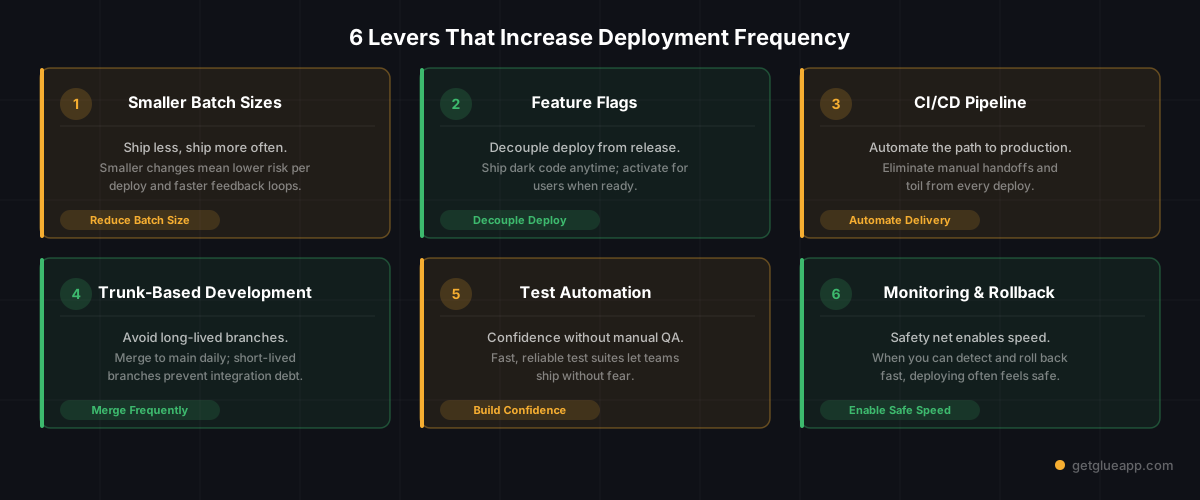
Improving deployment frequency doesn't mean deploying broken code faster. It means removing the friction that makes safe deployments feel slow.
1. Invest in Test Automation and CI/CD
Ensure your test suite runs in under 15 minutes and catches real issues. Long, flaky test suites create deployment inertia. Engineers stop trusting CI and start deploying without confidence. You'll know this is working when pipeline duration drops, flakiness decreases, and engineers stop saying "just re-run it."
2. Implement Feature Flags and Progressive Rollouts
Use feature flags to decouple deployment from release. Deploy code dark; release it to users gradually. This eliminates the "big bang deployment" risk. You can deploy multiple times daily while rolling out changes to 1% of users first. Change failure rate stays low while deployment frequency increases. We didn't adopt feature flags at Salesken until 2022. I wish we'd done it two years earlier. It would have saved us from at least three incidents that were really just "we shipped to everyone at once and couldn't contain the blast radius."
3. Automate the Path to Production
Remove manual approval gates. Move approvals to code review, where they're cheaper and faster. Manual deployments are slow, error-prone, and create single points of failure. I'm opinionated about this: if your deployment process requires someone to SSH into a box and run a script, you don't have a deployment process. You have a ritual.
4. Establish Observability Before Speed
Instrument your services with comprehensive logging, metrics, and traces before increasing deployment frequency. Frequent deployments to blind systems aren't bold. They're reckless. Observability gives you the confidence that you'll notice problems quickly, and that confidence is what enables the team to deploy more often without anxiety.
5. Standardize Your Deployment Process
Create a consistent, documented deployment pipeline that works the same way for all teams and services. In Bengaluru's startup ecosystem, I've seen this pattern repeatedly: the founding team builds a deployment process that works great for 5 engineers who all know the system intimately, then the team grows to 30 and nobody can deploy without pinging the original engineer on Slack. Inconsistency breeds caution. Standardization breeds velocity.
6. Fix the Slowest Link First
Identify the step that adds the most friction to deployment and tackle it directly. Often it's test duration. Sometimes it's approval gates. Occasionally it's infrastructure provisioning that takes 20 minutes and nobody's questioned in a year. Optimization is most effective when focused. Fixing one major bottleneck gives more ROI than optimizing 20 small things.
The Real Cost of Low Deployment Frequency
Teams that deploy rarely compound organizational risk in ways that aren't obvious until they're painful.
Feedback cycles stretch to weeks or months. You learn what customers need long after you've built the wrong thing. I've lived this. At Salesken, we once spent an entire quarter building a reporting feature based on what sales managers said they wanted. By the time it shipped, their actual workflow had shifted. If we'd been deploying incrementally, we'd have caught the drift in week two.
Context switches multiply. Engineers work on features for weeks, then spend days in deployment coordination and firefighting. Rollback becomes essentially impossible when each release contains hundreds of changes. You're committed whether you like it or not.
And then there's the morale problem. Shipping infrequently makes progress feel invisible. Engineers start to lose the connection between their work and its impact. Burnout increases. I don't have a citation for this. I've just watched it happen enough times to be certain.
Improving deployment frequency isn't about speed for its own sake. It's about distributing risk, tightening feedback, and reclaiming the ability to course-correct before small problems become expensive ones.
Autonomous Monitoring of Deployment Patterns
Once you've established a baseline for deployment frequency, the next challenge is continuous awareness. Most teams check deployment frequency monthly in a dashboard, if they check it at all. They miss the regressions happening in real-time.
Real-time pattern monitoring answers questions that static dashboards can't:
- Why did deployment frequency drop 30% last week? Was it a CI issue? A team vacation? A process change nobody announced?
- Which service is consistently the slowest to deploy? Are certain teams blocked? Is there a degraded pipeline?
- How does deployment frequency correlate with quality? When frequency increased, did change failure rate increase too, or did it stay stable?
This is the kind of problem we're working on at Glue. Autonomous agents that watch deployment patterns and correlate drops with specific changes: CI updates, new approval gates, pipeline modifications. They surface patterns humans miss in static reports and integrate deployment data with lead time, cycle time, and change failure rate to reveal causation, not just correlation.
I'll be honest about what's hard here: the correlation part. It's straightforward to detect that deployment frequency dropped. It's genuinely difficult to automatically determine why. We're making progress, but there's still a gap between "something changed" and "here's the root cause." That's an active area of work for us.
FAQ: Deployment Frequency Questions Answered
Q: Can deployment frequency be too high?
No. Elite performers deploy on-demand because their systems are instrumented, their tests are reliable, and their processes are automated. The upper bound on healthy deployment frequency is set by how fast you can safely merge code, not by some artificial ceiling. If you're deploying 50 times a day safely, keep deploying 50 times a day.
Q: Should all teams have the same deployment frequency target?
Not necessarily. A team shipping a critical payment system may need more caution than a team shipping internal tools. But the reason for differences matters. If one team deploys more slowly because of broken tests or approval bottlenecks, not by intentional design, that's a problem worth investigating. Use deployment frequency as a conversation starter, not a leaderboard.
Q: How do I measure deployment frequency for microservices?
Track it per service. A monolith deployment frequency of 5/day might represent a team shipping reliably. A microservices setup where 10 services each deploy 3 times daily is 30 deployments total, but that number tells a very different story about distributed bottlenecks. Measure at multiple levels: organization, team, and service.
Q: What if my team has zero deployments some weeks?
Investigate immediately. It means either there's nothing to deploy (rare), or something is blocking your team. Is it process changes? Team capacity? CI reliability? Feature freeze? Don't accept zero deployments as normal. It's a signal, and in my experience, the underlying cause is almost never "we just didn't have anything ready."
Key Takeaways
- Deployment frequency is a health metric, not a performance metric. It reveals friction, not competence.
- Elite performers deploy orders of magnitude more frequently than low performers, not by cutting corners, but by automating safety into their process.
- Measure deployment frequency alongside other DORA metrics (lead time, change failure rate, mean time to recovery) to get the full picture.
- Low deployment frequency usually points to one of five problems: blocked PRs, flaky CI, fear of deploying, merge conflicts, or process overload.
- Improving frequency is a systems problem, not a heroics problem. It requires investment in tooling, automation, and observability.
- Real-time monitoring of deployment patterns beats monthly dashboards for catching regressions and understanding causation.
Deployment frequency isn't the whole story of engineering velocity. But it might be the most honest metric we have. It's hard to game, hard to improve without real change, and impossible to maintain at high levels without disciplined, automated systems underneath.
Start with honest measurement. Then fix the bottleneck that hurts most. The metric will respond.
Related Reading
- Change Failure Rate: The DORA Metric That Reveals Your Software Quality
- Mean Time to Recovery: The Complete Guide to Faster Incident Resolution
- DORA Metrics: The Complete Guide for Engineering Leaders
- Lead Time: Definition, Measurement, and How to Reduce It
- Cycle Time: Definition, Formula, and Why It Matters
- Software Productivity: What It Really Means and How to Measure It
- Cycle Time in Software Development