
Code productivity is the measure of how effectively engineering work translates into business outcomes — not output metrics like commits, lines of code, or PRs merged. Truly productive engineers ship features that drive revenue, prevent incidents, unblock teammates, and improve codebase health. Cycle time (idea to production-ready code) is the most reliable proxy for code productivity because it naturally encompasses quality gates, reviews, and testing, and shorter cycle times correlate with both higher quality and better business results.
At Salesken, I once promoted an engineer based partly on commit volume. He was prolific — PRs every day, features shipped on schedule. Six months later, three services he'd built were the most incident-prone in our stack. Meanwhile, the engineer I almost overlooked had quietly refactored our payment processing pipeline, cutting deploy times in half and eliminating an entire category of production bugs.
That's when I stopped trusting activity metrics.
The Productivity Paradox That's Breaking Your Engineering Team
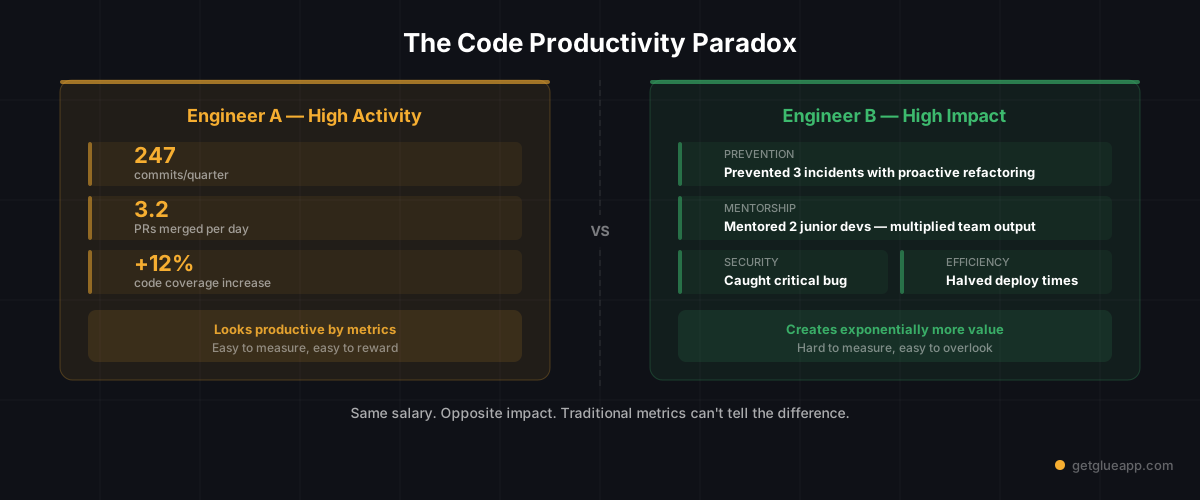
Your top performer just shipped 247 commits this quarter. They averaged 3.2 pull requests per day. Their code coverage increased by 12%. By every traditional metric, they're a productivity machine—a living embodiment of the mythical 10x engineer.
And yet, your team feels blocked more often than not.
This is the code productivity paradox that most engineering leaders never fully grasp: the engineer who ships the most code rarely creates the most value.
Consider the alternative picture. Another engineer shipped half as many commits. Their PRs took longer to write. But every PR included thoughtful refactoring that prevented three future incidents. They mentored two junior developers through complex architectural decisions. They caught a critical security vulnerability in code review—something the author hadn't spotted. They reduced tech debt in a critical service, cutting deployment times in half.
By commit count metrics, they're 50% as productive. By actual business impact, they're delivering exponentially more value.
This disconnect between traditional code productivity metrics and real-world engineering outcomes is costing your team enormous amounts of hidden opportunity cost. It's why even well-intentioned engineering managers find themselves rewarding the wrong behaviors, burning out their best people, and watching junior developers plateau.
The problem isn't measurement—it's that we're measuring the wrong things.
What Is Code Productivity? Redefining Beyond LOC and Commit Counts
For decades, the software industry has operated under a false equation: code output = productivity. Lines of code written. Commits pushed. Features merged. Pull requests closed.
These metrics are seductive because they're quantifiable. They're easy to track in your Git history. You can build dashboards around them. They feel objective.
But they measure activity, not impact.
Real code productivity is the ability to deliver business value through code while enabling others to do the same. It encompasses:
- Shipping features that solve real problems for your users or business
- Reducing friction for your team—unblocking bottlenecks, eliminating toil
- Preventing future problems through architecture decisions, refactoring, and technical debt reduction
- Sharing knowledge that multiplies team capacity, not just your individual output
- Maintaining code quality so that every engineer can move fast without breaking things
- Supporting other engineers through code review, mentoring, and pair programming
Notice what's missing: line counts, commit frequency, and hours spent coding.
The engineer who ships a 50-line PR that prevents your p99 latency from degrading is more productive than the one who shipped 2,000 lines of new features that introduced three bugs. The architect who spent two days designing a system that other engineers now move 30% faster in is more productive than the one who cranked out feature tickets at maximum velocity. The reviewer who catches a subtle race condition in 10 minutes saves the team from a 4-hour incident investigation—that's a massive productivity multiplier.
This is exactly the kind of invisible work that matters most — and that most teams have zero visibility into.
The Invisible Productivity Problem: Work That Doesn't Show Up in Metrics
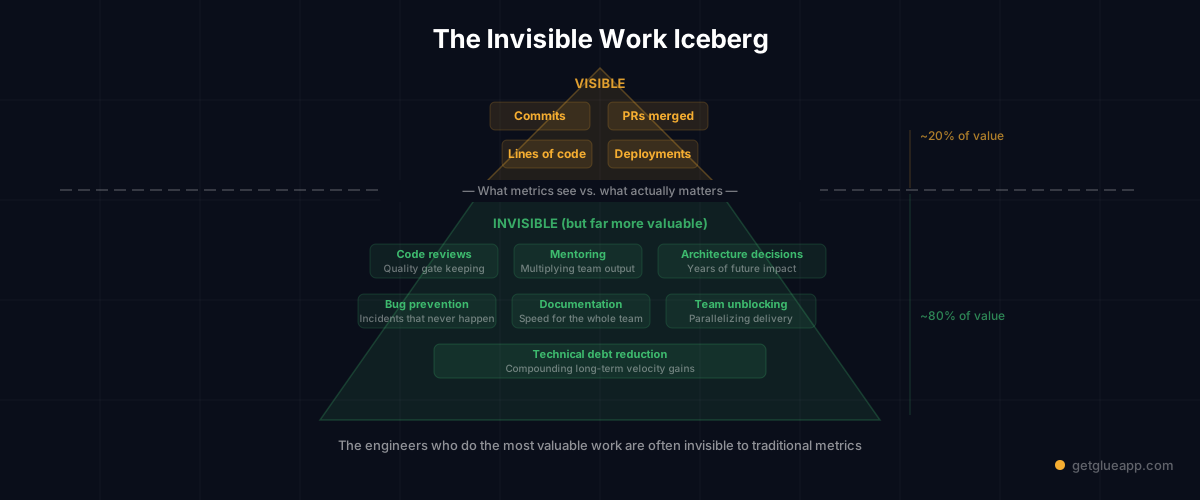
Here's a dark secret about traditional code productivity metrics: they actively punish the behaviors that make teams most productive.
Imagine an engineer in your codebase who:
- Takes time to thoroughly review every PR from junior developers (reducing their iteration time, increasing their learning)
- Spends a day refactoring a critical service to prevent technical debt from becoming a production incident
- Helps unblock three other engineers by pair programming through a complex problem
- Designs a system architecture that takes 2x longer upfront but saves the team 500 hours of friction over the next year
- Writes detailed documentation and runbooks so others don't have to figure out every problem from scratch
By commit-count metrics, this engineer looks unproductive. They shipped fewer commits because they were spending time on activities that don't produce commits. Their velocity might look flat or even declining. And yet, their actual productivity—their ability to enable the team to move faster and safer—is off the charts.
The invisible productivity problem is that most of this high-impact work is completely invisible to traditional metrics. It shows up as:
- Fewer commits (because you spent time reviewing)
- Longer cycle times (because you took time to architect properly)
- Reduced personal feature output (because you mentored junior developers)
- Lower lines of code (because you refactored existing code instead of writing new code)
And here's the compounding tragedy: when you reward engineers based on visible metrics, you systematically discourage the invisible behaviors that actually make teams productive. You create a culture where:
- Junior developers get less mentoring (because mentoring "costs" the mentor's velocity)
- Code reviews become rubber-stamp exercises (fast approval = high productivity)
- Technical debt compounds unchecked (refactoring "wastes" time that could go to new features)
- Knowledge stays siloed in people's heads (documentation is a "distraction")
- Architectural decisions get made in isolation (collaborative design takes too long)
The result: a team that looks productive on paper but feels constantly blocked in practice.
Metrics That Actually Capture Real Code Productivity
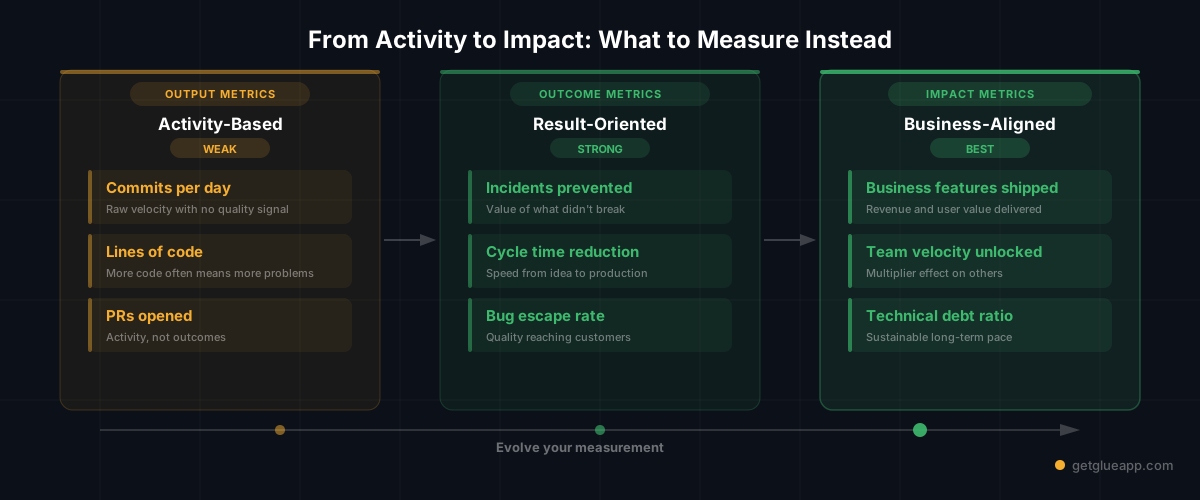
So how do you measure what actually matters? Here are the metrics that correlate with real code productivity:
1. Cycle Time and Deployment Frequency
Not how many commits you ship, but how quickly you can ship value and how frequently you do it. A team that deploys 10 times per day with a 2-hour median cycle time is more productive than a team deploying once per month, even if the second team has higher commit volume. Cycle time reveals whether your codebase, processes, and team are actually moving features from idea to production efficiently.
Learn more: Understanding Cycle Time
2. Code Quality Metrics and Incident Prevention
The number of production incidents prevented is one of the highest-leverage productivity metrics available. An engineer whose code review catches 3 critical bugs prevents cascading incidents worth thousands of hours of debugging time. Conversely, shipping features with high defect rates tanks team productivity across the entire organization—debugging and firefighting are the ultimate anti-patterns.
Track code quality through: defect escape rate, incident severity, P99 latency changes, and security findings resolved.
Learn more: Code Quality Metrics
3. Pull Request Size and Review Velocity
The size of your pull requests is a direct proxy for code review friction and team learning. Smaller, focused PRs get reviewed faster, introduce fewer bugs, and help junior developers learn through incremental feedback. Large PRs sit in review longer, concentrate risk, and create knowledge silos.
Track: median PR size, review turnaround time, and the correlation between PR size and defect escape rate.
Learn more: Why PR Size Matters
4. Knowledge Distribution and Mentoring Impact
How much of your critical knowledge is concentrated in a few people? The more distributed your expertise, the more productive your team. Measure this through:
- Contribution patterns (is code review evenly distributed or siloed?)
- Who can deploy to production without asking someone else?
- How many engineers contributed meaningfully to each service or system?
- Do junior developers have clear growth trajectories?
5. Tech Debt Reduction and System Complexity
Codebases with high technical debt become progressively slower to develop in. An engineer who spends time reducing tech debt, eliminating legacy code, simplifying architectures, or improving developer experience is doing some of the highest-leverage productivity work available—they're improving the velocity of the entire team.
Track: lines of legacy code removed, refactoring impact on cycle time, and developer satisfaction scores.
6. Team Velocity and Engagement
Real productivity shows up in team behavior: Do engineers feel unblocked? Do they have the tools and knowledge they need? Can they move fast without fear of breaking things? Teams with high psychological safety, clear ownership, and low toil are demonstrably more productive.
Track: sprint velocity trends, sprint-to-sprint consistency, deployment confidence, and engineer satisfaction surveys.
How to Improve Code Productivity Without Burning Out Your Team
Here's the trap: once you understand what real productivity looks like, it's tempting to optimize for it to death. "More code reviews! Better mentoring! Less technical debt!" becomes the new set of crushing expectations.
That's not the point. The point is to align your team's incentives with actual business outcomes and then trust your engineers to optimize accordingly.
Here's how:
1. Make Invisible Work Visible
Start tracking and celebrating the contributions that don't show up in commit counts. In your 1-on-1s and retrospectives, explicitly call out:
- "I noticed you invested significant time in architectural design for the payments system. Here's how it paid off..."
- "Your thorough code reviews caught issues that would have hit production. That's high-leverage work."
- "You mentored two junior developers through their biggest growth areas. That's multiplying team capacity."
When invisible work becomes visible, it becomes valued. When it's valued, engineers repeat it.
2. Redesign Your Performance Reviews
Stop measuring productivity by activity metrics. Instead, assess:
- Did this engineer ship features that moved business metrics?
- Did they unblock other engineers or reduce team friction?
- Did they improve code quality or prevent incidents?
- Did they develop others and strengthen team capabilities?
- Did they reduce technical debt or improve developer experience?
For each of these, the engineer's peers, managers, and the work itself should provide evidence—not their commit count.
3. Optimize for Cycle Time, Not Feature Count
Make it your team's north star to reduce cycle time—the time from idea to production. A team optimizing for cycle time naturally gravitates toward:
- Smaller PRs (easier to review and merge)
- Better code quality (fewer incidents blocking deployment)
- Clear ownership (less coordination overhead)
- Better tooling and automation (reduces manual bottlenecks)
- Strong collaboration (unblocking each other faster)
When your incentive is "move fast and safe," all the right behaviors follow.
4. Create Space for Non-Coding Work
The most productive teams explicitly allocate time for:
- Code review (not squeezed between feature work)
- Mentoring and pairing (scheduled, not opportunistic)
- Refactoring and tech debt reduction (quarterly commitments)
- Architecture design and documentation (before you code)
If you want these behaviors, you have to fund them. That means your "feature velocity" will go down—your actual productivity will go up. The only question is whether you've measured productivity correctly to see the improvement.
5. Invest in Developer Experience
An engineer stuck waiting for slow builds, flaky tests, or confusing processes is unproductive—not because they're bad at shipping code, but because the system is fighting them. The highest-leverage productivity work is often invisible to metrics but shows up immediately in engineer satisfaction:
- Faster CI/CD pipelines
- Better documentation and onboarding
- Clearer service ownership
- Fewer "tribal knowledge" bottlenecks
- Tools that reduce toil
From Measurement to Autonomous Action: How Glue Agents Surface Hidden Productivity
This is where the frontier is heading: not just measuring invisible productivity, but surfacing it in real time. Based on AI developer productivity research, we know that AI agents can significantly enhance team performance.
"Glue agents" (sometimes called "glue engineers" or agents that identify "glue work") are tools and practices that use code activity correlated with team-level outcomes to surface and amplify invisible contributions. Instead of waiting for annual reviews to notice that an engineer prevented five incidents through superior code review, you can see it happening in real time:
- A PR review that caught a critical issue and prevented an incident—surfaced immediately
- An architecture decision that reduced cycle time across the team—correlated and measured
- A refactoring that prevented technical debt from becoming a bottleneck—tracked and attributed
- Mentoring sessions that accelerated junior developer growth—visible in their contribution patterns
The future of code productivity isn't more metrics—it's the right metrics, tied to actual outcomes, and made visible to the people doing the work.
When engineers see that their invisible contributions are being measured and recognized, two things happen:
- Incentives align with outcomes. Engineers naturally spend more time on high-leverage work when they know it's being measured.
- Blockers surface faster. When you're measuring what unblocks the team, you see the blockages. Then you can remove them.
This is the shift from "how much code did you write?" to "how much did you help the team move faster?" And that shift is where code productivity finally becomes aligned with business outcomes.
FAQ: Code Productivity Questions Answered
Q: Doesn't optimizing for cycle time just mean shipping half-baked features?
A: No. Cycle time is the time from idea to production-ready code. It includes all the quality gates, reviews, and testing. It's measuring how fast you can safely ship. If you're shipping quality suffers, cycle time goes up because you're spending time on incidents and rework. Optimizing for cycle time naturally encourages quality.
Q: How do I measure productivity if my team uses different tools or languages?
A: Focus on outcomes, not activity. Whether an engineer ships commits in Go or Python doesn't matter—did they ship a feature? Did they prevent an incident? Did they unblock the team? Did they maintain code quality? These questions transcend tooling.
Q: What if my team is distributed or asynchronous? How does code review productivity work differently?
A: Asynchronous teams often have higher quality reviews because there's time for thought and fewer interruptions. The key is setting clear expectations for review turnaround time (e.g., "reviews within 24 hours") and ensuring knowledge sharing happens through documentation and recorded pairings, not just real-time interaction.
Q: How do I tell if an engineer is actually productive or just good at looking busy?
A: Look at outcomes: Did they ship? Did they ship safely? Did they unblock others? Did they improve the codebase? Did incidents decrease? Did junior developers grow? These questions cut through activity and reveal actual productivity. The DORA metrics provide a balanced framework for measuring these outcomes objectively.
Related Reading
- Programmer Productivity: Why Measuring Output Is the Wrong Question
- PR Size and Code Review: Why Smaller Is Better
- Cycle Time: Definition, Formula, and Why It Matters
- Software Productivity: What It Really Means and How to Measure It
- DORA Metrics: The Complete Guide for Engineering Leaders
- What Is a Technical Lead? More Than Just the Best Coder