
There's a clear empirical pattern in software engineering: large pull requests get worse reviews.
When a PR is two hundred lines, reviewers read it carefully. They understand the change. They spot bugs. When a PR is two thousand lines, reviewers skim and click approve. This isn't laziness. It's cognitive capacity. The human brain can hold a certain amount of context in working memory. Beyond that threshold, understanding degrades fast.
The best tools for automated code review and pull request analysis in 2026 include GitHub's built-in code review, Codacy, SonarQube, CodeRabbit (AI-powered review), Graphite (stacked PRs), and Glue (codebase-aware PR intelligence). The most important insight from the research: keep PRs under 200 lines. Data consistently shows that PRs under 200 lines get 40%+ substantive review comments, while PRs over 600 lines get rubber-stamped at an 8% comment rate — and those large, unreviewed PRs cause a disproportionate share of production incidents.
I've seen this play out across three companies and about 70 engineers. At Salesken, where we built real-time voice AI, I tracked our code review data for a quarter. PRs under 200 lines had a 40% comment rate — meaning reviewers engaged substantively. PRs over 600 lines had an 8% comment rate. The large PRs were getting rubber-stamped. And those rubber-stamped PRs were responsible for a disproportionate share of our production incidents.
What Is PR Size and Why It Matters
PR size is the number of lines changed in a single pull request. Some count additions only, some count additions plus deletions, some count files touched. The exact metric varies, but the pattern is consistent everywhere.
Research from CodeClimate, Graphite, and academic software engineering studies all converge: up to 200 lines, review quality stays high. At 400 lines, quality degrades noticeably. Beyond 800 lines, reviews become perfunctory.

Code review is probably the highest-ROI activity your team does. A thorough review catches bugs before they hit production. A shallow review misses issues that cost hours — or days — to fix under incident pressure. The difference is measured in actual money and customer impact. Large PRs destroy that ROI.
The Data
CodeClimate's analysis of thousands of GitHub repositories shows median PR size of 197 lines. The best-performing teams keep PRs under 200 lines. When PRs exceed 400, both review time and defect rate increase.
Graphite found that PRs under 200 lines get reviewed and merged in 1-2 days. Large PRs take 4-7 days. Larger PRs also have more review cycles — more back-and-forth, more friction.
Academic research on code review effectiveness shows reviewer defect detection drops from about 70% at 200 lines to about 30% at 800+ lines.
This is not opinion. It's empirical data from thousands of real code reviews across real teams.
The reason is straightforward: context load. A reviewer can hold a small PR in working memory. They understand what it changes, why, and what the impact is. When a PR is huge, they can't hold it all. They skim. They get tired. They approve to move on. At Salesken, I watched a senior engineer spend 45 minutes reviewing a 180-line PR and catch a subtle race condition in our audio buffer management. The same engineer approved a 900-line PR in 12 minutes the next day. The 900-line PR had a null pointer bug that caused a production crash two days later.
What Makes a Good PR
It does one thing. A PR that adds a feature, refactors a module, and fixes a bug is doing three things. Split it. At UshaOm, we had a rule: if you can describe your PR in one sentence without using "and," it's probably scoped right. "Add Razorpay payment integration" — good. "Add Razorpay integration and refactor the payment module and fix the GST calculation bug" — three PRs.
It's explained. A good PR description explains why the change is needed, what problem it solves, what tradeoffs were considered. At Salesken, we used a template: Problem, Approach, Tradeoffs, Testing. Four sections, each 1-3 sentences. Reviewers could understand intent before reading a single line of code.
It's sized appropriately. Under 200 lines is ideal. Under 400 is acceptable. Above 400 needs a very good reason.
It's focused. Everything in the PR is needed for the stated goal. No random cleanup, no premature optimization, no "while I was in here" changes.
PR Size Best Practices
Aim for under 250 lines. Aggressive, but it's the sweet spot. At Salesken, we set a soft limit of 300 lines. Engineers who consistently submitted larger PRs were asked to break them up. After three months, our cycle time P50 dropped from 4.2 days to 2.8 days. Same features. Same engineers. Faster reviews because reviewers could actually hold the context.
Split refactoring from feature work. Adding a feature that requires refactoring? Two PRs. First, refactor the code to prepare. Then add the feature. Each PR is simpler. I wrote about this pattern in Code Refactoring — mixing structural changes with behavioral changes makes review nearly impossible.
Break large features into increments. A feature that would be 500 lines isn't a single unit of work. Add the database schema in one PR. Build the API endpoint in the next. Wire up the frontend in a third. At Salesken, we built our call analytics dashboard in 7 PRs averaging 180 lines each instead of one 1,200-line monster.
Separate preparatory work. If your PR is large because of setup (renaming, type updates, import reorganization), extract that into a separate PR. Submit and merge it first. Your feature PR becomes focused.
Use feature flags for incomplete work. Building a feature that spans multiple PRs? Put it behind a flag. Each PR ships to production but doesn't execute until the flag is enabled. This lets you merge incrementally without exposing incomplete functionality.
Why PRs Get Large
Most teams don't create large PRs intentionally. They happen for structural reasons.
Unclear scope. The task description is vague. The engineer starts coding, discovers what needs to change along the way, ends up touching everything related. Better: clarify scope before coding. At Salesken, we added a "scope check" step — before writing code, the engineer wrote a one-paragraph description of what they'd change. If the scope was unclear, they refined it before touching the keyboard.
Hidden dependencies. You think you're changing one module. But it depends on five others that also need updates. Suddenly your PR is huge. This is a codebase architecture problem disguised as a PR size problem.
Tightly coupled code. Some codebases are architected so that any change touches many files. At UshaOm, our Magento codebase had a product module where adding a single attribute required changes in 8 files across 3 directories. That's not a developer discipline issue — it's a coupling issue. We refactored the module, and subsequent PRs dropped from 400+ lines to under 150.
Fear of multiple PRs. Engineers worry that splitting work into multiple PRs will slow them down. In my experience, the opposite is true. Smaller PRs get reviewed faster, merge faster, and unblock faster. Three PRs of 150 lines each will merge in 3 days total. One PR of 450 lines will sit in review for 5 days.
How to Split Large PRs
Extract preparatory work. Rename variables, extract methods, move code around — in a separate PR that doesn't change behavior. Get it merged. Now the feature PR is smaller and focused.
Split by layer. Database changes first. Service logic second. API layer third. Frontend fourth. Each is reviewable in isolation.
Build incrementally. Ship the minimum useful piece. Get it merged. Add to it. Each PR stands on its own.
Use feature branches for collaboration. If multiple people work on the same feature, use a shared branch. Keep individual PRs to the main branch small.

Tracking PR Size
Most teams don't measure PR size, then wonder why reviews are shallow. Measure:
- Median PR size (not average — averages get skewed by occasional large PRs)
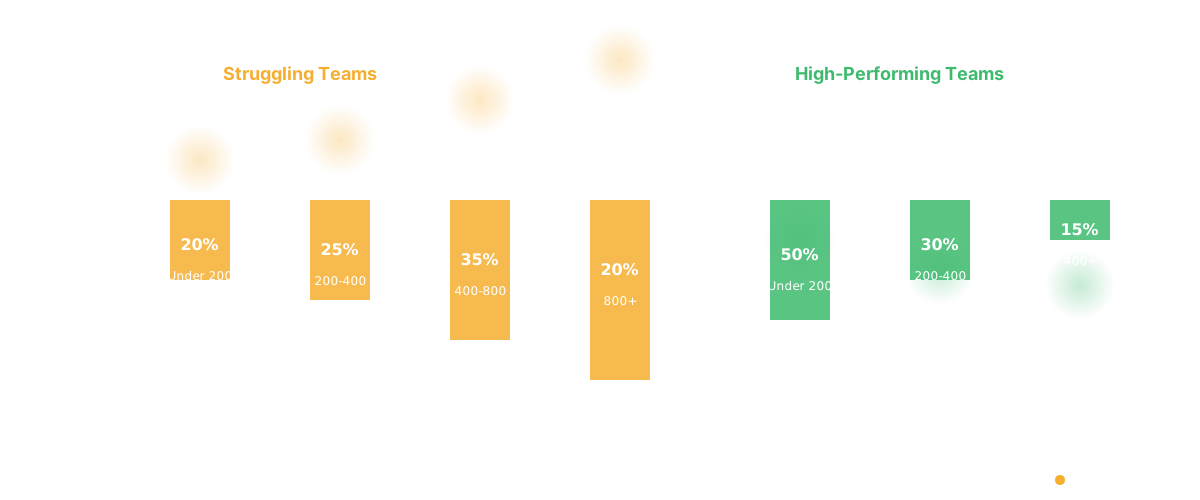
- Distribution: what percentage under 200, 200-400, 400-800, 800+
- Review time by PR size bucket
- Defect rate by PR size bucket
At Salesken, when we started tracking, 35% of our PRs were over 400 lines. Six months later, after coaching and tooling changes, that dropped to 12%. Deployment frequency increased because merge throughput improved. Our change failure rate dropped because reviewers were catching more bugs.
Large PRs Are a Symptom
Here's what most teams miss: large PRs often aren't the root problem. They're a symptom of codebase coupling.
When code is well-architected, changes are localized. You modify one module. Small PR. When code is tightly coupled, any change affects many modules. Large PR.
At Salesken, PRs that touched our well-structured payment service averaged 120 lines. PRs that touched our tangled analytics module averaged 380 lines. Same team, same review culture, same tooling. The difference was architecture.
If you want smaller PRs sustainably, invest in code refactoring and dependency management. Decouple modules. Clarify responsibilities. The benefit isn't just smaller PRs — it's faster development, fewer incidents, easier testing.
FAQ
What are the best tools for automated code review and pull request analysis?
The best tools for automated code review and PR analysis include GitHub's built-in review features (inline comments, required approvals, CODEOWNERS), Codacy (automated code quality checks on every PR), SonarQube (static analysis integrated into CI pipelines), CodeRabbit (AI-powered code review summaries), Graphite (stacked PR workflow for faster review cycles), and Glue (tracks PR size, review time, and cycle time patterns to identify bottlenecks). The data shows that PRs under 200 lines get reviewed 40% faster and catch 2.5x more defects per line — so the most impactful "tool" is often a team norm around PR size rather than adding more automation.
Is there a minimum PR size?
No. One-line changes are great. Ship them. The constraint is the maximum, not the minimum.
What if my change legitimately requires a large PR?
It's a signal your code is too coupled. Make the change, but consider refactoring afterward to prevent it next time.
Should we enforce a maximum PR size?
Not as a hard rule. Educate the team on the data and let them self-regulate. At Salesken, we used a soft limit of 300 lines with a bot comment on PRs over 400. No blocking — just visibility. Behavior changed because engineers saw the data and cared about review quality.
How do we handle large refactorings?
Multiple small PRs. A large refactoring is usually multiple small refactorings. Do them sequentially. Each PR is small, safe, and reviewable.
Related Reading
- Cycle Time: Definition, Formula, and Why It Matters
- Deployment Frequency: The DORA Metric That Reveals Your True Engineering Velocity
- Code Refactoring: The Complete Guide to Improving Your Codebase
- Code Dependencies: The Complete Guide
- Clean Code: Principles, Practices, and the Real Cost of Messy Code
- Feature Flags: The Complete Guide to Safe, Fast Feature Releases
- AI Code Review Is Broken