
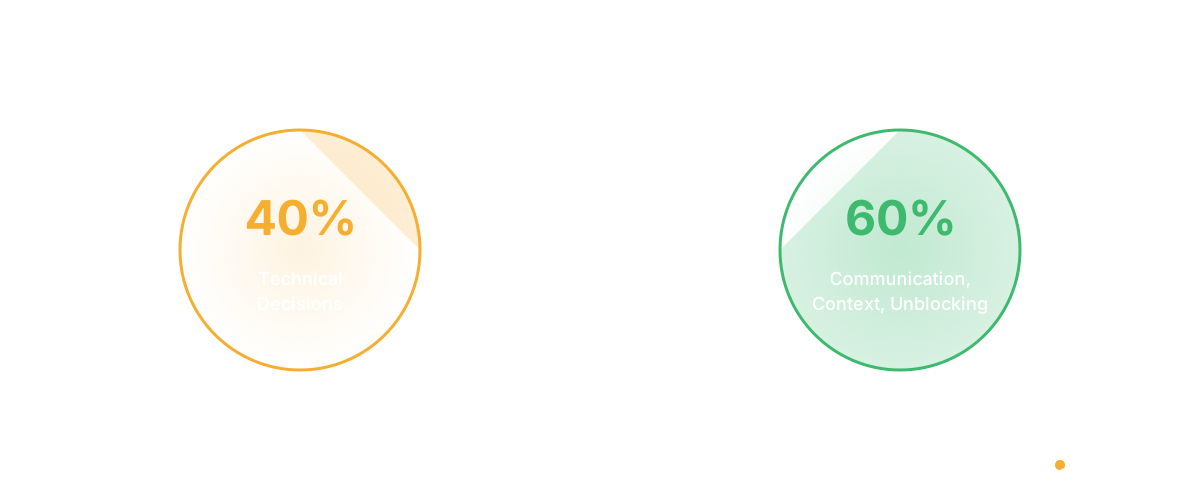
A technical lead is a hybrid role that is approximately 40% technical decision-making and 60% communication, context-sharing, and unblocking—not simply the best coder promoted into leadership. Effective tech leads multiply team output through code review mentorship, architectural decision facilitation, and cross-team coordination, while maintaining enough hands-on coding (typically 40–50% of their time) to stay technically sharp and credible.
There's a persistent misconception about technical leads: that a tech lead is the best coder on the team, promoted into a leadership role. I've been on both sides of this. I was promoted to tech lead at Shiksha Infotech because I was the strongest Java developer on the team. I was a terrible tech lead for the first six months because I kept writing code instead of enabling the team.
A technical lead is about 40% technical decisions and 60% communication, context-sharing, and unblocking. The job isn't to write the best code. It's to make sure the whole team codes well.
What Is a Technical Lead?
A technical lead is responsible for the technical direction of a team or project. They decide architecture. They ensure code quality stays high. They mentor less experienced engineers. They unblock the team when it's stuck.
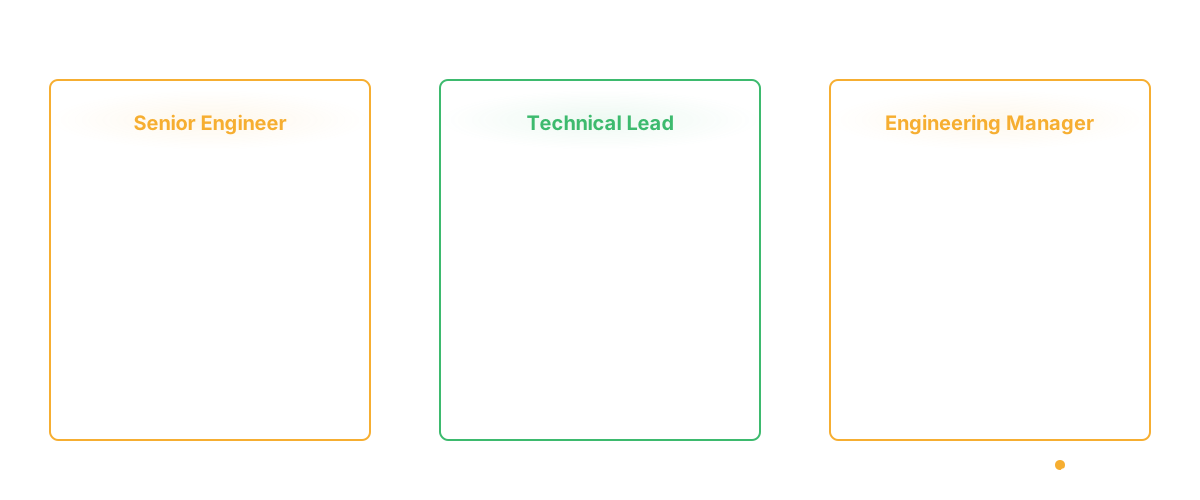
This is distinct from a senior engineer, who is typically an individual contributor. A senior engineer's scope is one or two major areas. A tech lead's scope is the whole team's output.
An engineering manager is responsible for people — hiring, feedback, career development, performance reviews. A tech lead is responsible for technology. In small teams, one person is both. At Salesken, I was CTO, which meant both roles. At UshaOm, where the team grew to 27 engineers, I split the roles: two tech leads handled architecture and code quality while I focused on people management and product strategy. The split happened when I realized I couldn't do code reviews in the morning and performance reviews in the afternoon without doing both badly.
The tech lead doesn't have to be the best coder. They should be very good, but their value comes from making the team good, not being individually brilliant. At Salesken, one of our best tech leads was our third-strongest engineer. But she had the best judgment about tradeoffs, the clearest communication, and the most patience for mentoring. The team shipped better code under her leadership than under the engineer who could write the most elegant algorithms.
Technical Lead Responsibilities
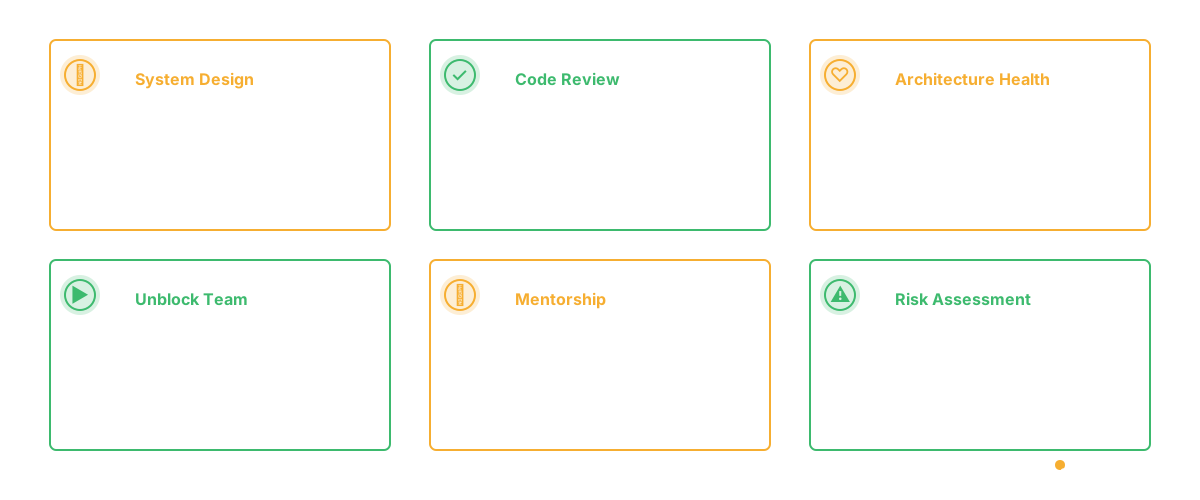
System design decisions. When the team debates whether to refactor a module, build a new service, or extend the existing system, the tech lead owns that decision. They gather input. They consider tradeoffs. They decide. At Salesken, our tech lead for the ML pipeline decided to keep our real-time inference as a monolith instead of splitting into microservices. Half the team disagreed. She was right — the latency requirements (<10ms per inference) would have been impossible to meet with inter-service communication overhead.
Code review standards. What does good code look like? What patterns do we follow? What do we avoid? At UshaOm, our tech lead defined a code review checklist: no PR over 400 lines, no new circular dependencies, every public function has a test. Simple rules. Enforced consistently. Code quality improved within a month.
Architecture health. Is the system getting more complex or staying stable? Are dependencies proliferating? Can the team add features at the same speed as six months ago? At Salesken, our tech lead tracked cycle time per module. When the analytics module's cycle time crept from 2 days to 5, she flagged it before it became a crisis.
Unblocking the team. Someone is stuck. They don't understand how something works. The code is too tangled for the feature they need. The tech lead helps — not by writing the code, but by finding the context the person is missing. Sometimes that means pairing for an hour. Sometimes it means deciding that a refactoring is necessary before the feature work can proceed.
Technical mentorship. Junior engineers don't know how to approach problems. The tech lead teaches approach, not just answers. At Shiksha, when I finally learned to be a decent tech lead, the shift was from "here's how to fix this" to "here's how to figure out how to fix this." The first makes them dependent. The second makes them capable.
Risk assessment. New dependency? Risk. Technology decision that's hard to reverse? Risk. At Salesken, our tech lead vetoed adopting a new real-time database because, despite the performance benefits, it had a small community and the vendor was pre-Series A. Six months later, that vendor pivoted. Good call.
Skills a Technical Lead Needs
System thinking. Seeing how parts fit together. Understanding that optimizing one function while making another 10x slower is a bad tradeoff. At Salesken, our audio processing pipeline ran every frame in <10ms. A junior engineer optimized the silence detection algorithm to run in 2ms instead of 5ms. But his optimization introduced a memory allocation pattern that slowed the downstream buffer manager to 15ms. Net result: the pipeline got slower. A tech lead with system thinking would have caught this in design review.
Communication. Writing clear design documents. Explaining decisions so the team understands the why. Listening to concerns. A tech lead spends more time writing and talking than coding. At UshaOm, our best tech lead spent about 4 hours per day in conversations — code reviews, design discussions, mentoring sessions, PM alignment meetings. The code she wrote in the remaining 4 hours was high-leverage because it was informed by all those conversations.
Context building. Knowing what the business is trying to do. Understanding constraints. Translating between business and engineering. When a PM at Salesken asked "can we add multi-language support?" the tech lead who said "that's a 6-month project" wasn't wrong technically. The one who said "we can support Hindi and Tamil in 3 weeks by leveraging our existing STT provider's language models, then evaluate whether to build custom models" was more useful because she understood the business context: we needed it for a specific customer, not for every language on earth.
Judgment. Knowing when to enforce a standard and when to make an exception. When to refactor and when to ship. When to go deep and when to delegate. This is the hardest skill to teach because it comes from experience, not study.
Humility. Knowing you don't know everything. Being willing to learn from someone with three years of experience when they know a specific domain better. Changing your mind when presented with better data. The worst tech leads I've worked with were brilliant engineers who couldn't accept being wrong.

Technical Lead vs Engineering Manager
These roles require different skills and have different responsibilities. A tech lead is responsible for the quality of code and architecture. An EM is responsible for people, delivery, and career development.
A tech lead might decide not to refactor something because it would slip a deadline. An EM might push for the refactor because it's a learning opportunity for a junior engineer. A tech lead says "use technology X because it scales better." An EM says "our team knows technology Y and we'd ship faster."
At Salesken, I played both roles as CTO. The conflict was constant. Should I prioritize the architecture improvement that would help long-term, or the quick fix that would unblock the team today? When one person holds both roles, these tradeoffs are internal. When roles are split, they become productive tension between two people with different priorities.
In Bengaluru's tech scene, I see more companies splitting these roles as teams grow past 15 engineers. The sweet spot for a combined role is teams of 5-12. Beyond that, neither role gets enough attention.
You Can't Lead What You Don't Understand
The core constraint on the tech lead role: you can't make good technical decisions without understanding your codebase. If you don't know how the system is structured, you can't judge whether a proposal is sound. If you don't know which code is brittle and which is stable, you can't assess risk.
At Salesken, when we grew from 15 to 40 engineers, I lost the ability to hold the whole system in my head. I'd approve architecture proposals that introduced circular dependencies because I didn't see the existing dependency graph. I'd assess changes as "low risk" that actually affected three downstream services I'd forgotten about.
This is where codebase intelligence becomes essential. Not as a replacement for understanding — a tech lead still needs to think deeply — but as a way to see the system at a scale that exceeds any individual's memory. Dependency mapping, bus factor analysis, complexity hotspots — these are the inputs a tech lead needs to make good decisions as systems grow.
Common Mistakes
Not getting feedback from the team. A tech lead who makes decisions in isolation builds resentment and misses important context. The team knows things you don't. At UshaOm, our best architectural decisions came from group design sessions where the tech lead facilitated instead of dictated.
Not spending enough time on code. A tech lead who stops coding entirely loses understanding of what the team faces. Stay current. I'd recommend at least 30% of your time writing or reviewing code. Below that, you lose touch.
Changing decisions too often. Decisiveness matters. At Salesken, I watched a tech lead reverse a database choice three times in two months. The team stopped trusting his decisions and started implementing whatever they thought was right, regardless of what he said.
Making architecture decisions without data. "This feels complex" isn't actionable. "This module has cyclomatic complexity of 47, changes 3x per sprint, and has a bus factor of 1" is actionable. Measure before deciding.
Over-engineering. Tech leads who love architecture sometimes build systems for scale they'll never reach. At UshaOm, we built a message queue system designed for 100x our actual throughput. The infrastructure cost exceeded its value for two years before we grew into it. I should have pushed back harder.
How to Become a Technical Lead
It's a progression, not a title change.
Start by having stronger opinions in code review. Don't just approve — explain why you'd do something differently. Share design thinking. Be the person who considers tradeoffs.
Take ownership of a specific system. Make it the best-designed, best-tested, cleanest code in the codebase. Show what good looks like.
Mentor people. Help junior engineers with detailed code review feedback. Help them think through problems, not just solve them.
Write design documents. Show that you think systematically. Document tradeoffs, not just decisions.
And ask for the role. Most teams won't create a tech lead position automatically. Make the case that the team needs one and that you've already been doing the work.
FAQ
Can you be a tech lead while still coding heavily?
Yes, but balance matters. 50% coding and 50% leadership works. 70% coding and 30% leadership usually means leadership gets neglected. At Salesken, our most effective tech lead coded about 40% of the time — enough to stay sharp, not so much that she couldn't mentor and review. Effective tech leads focus their coding time on high-leverage work like code refactoring and foundational libraries.
What happens to your coding skills?
They atrophy if you're not careful. The best tech leads stay current by choosing high-leverage coding work: foundational libraries, critical path features, prototype code. Not ticket-driven feature work that any engineer could do.
Should a tech lead make all architectural decisions?
No. Big decisions should involve the team. The tech lead facilitates, gathers input, considers tradeoffs, and decides when consensus isn't reachable. The worst tech leads dictate. The best ones synthesize.
Is tech lead the same as staff engineer?
Different roles. A staff engineer is typically an IC with deep expertise and broad influence. A tech lead leads a specific team. Some organizations use the terms interchangeably. They shouldn't.
How do you measure a good tech lead?
Team velocity steady or increasing. Code health stable or improving. Engineers feel unblocked and understand the system. Fewer incidents over time. Good technical decisions that hold up six months later. DORA metrics — especially deployment frequency and change failure rate — provide objective signals of team health under a tech lead's stewardship.
Related Reading
- Software Productivity: What It Really Means and How to Measure It
- Clean Code: Principles, Practices, and the Real Cost of Messy Code
- Code Refactoring: The Complete Guide to Improving Your Codebase
- DORA Metrics: The Complete Guide for Engineering Leaders
- Incident Management: From Alert to Resolution to Prevention
- The Product Manager's Guide to Understanding Your Codebase