
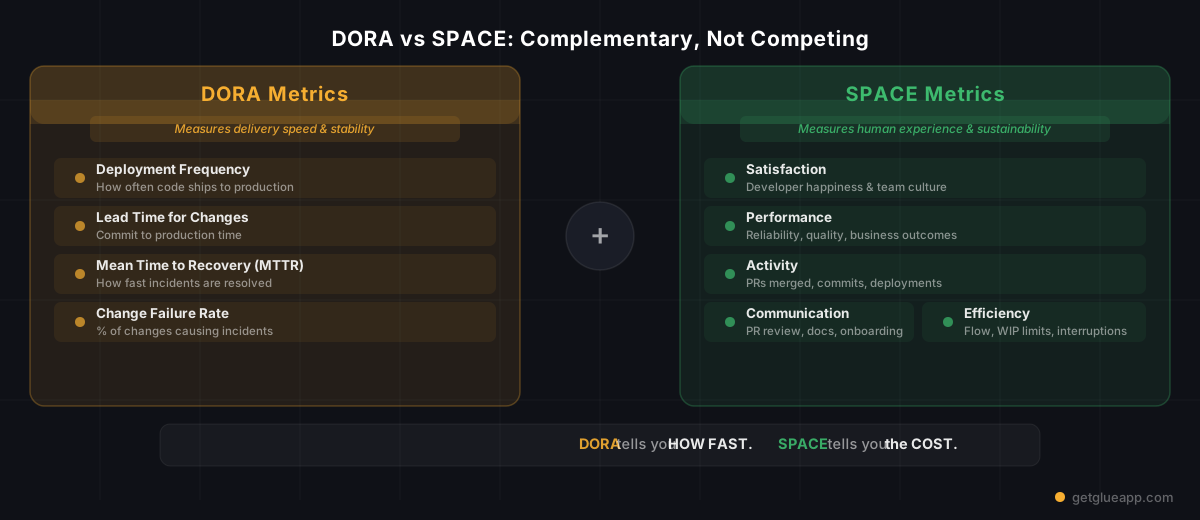
At Salesken, our DORA metrics looked great for two quarters straight — deployment frequency up, cycle time down, CFR stable. Then three senior engineers quit in the same month. Our metrics said we were elite performers. Our retention said otherwise. That disconnect is exactly why SPACE exists: it measures the human side of engineering that DORA deliberately doesn't cover.
The SPACE metrics framework measures five dimensions of developer productivity: Satisfaction and well-being, Performance, Activity, Communication and collaboration, and Efficiency and flow. Unlike DORA metrics which focus on delivery pipeline speed, SPACE captures the human factors - developer experience, cognitive load, and team collaboration patterns - that determine whether high output is sustainable. Engineering leaders should track at least one metric from three of the five SPACE dimensions to avoid over-optimizing any single factor.
Most engineering leaders have heard of DORA metrics. They've seen the charts tracking deployment frequency, lead time for changes, and mean time to recovery. They've celebrated when cycle time drops. But here's what nobody talks about at the quarterly business review: your team is burning out.
The developer at your company who shipped 40% of critical features this quarter might be miserable. The team hitting every sprint goal might be churning through people. Velocity charts don't measure the cost of context-switching, Slack interruptions, or the creeping sense that nobody actually understands what they're building anymore.
That's the gap SPACE metrics fill.
SPACE doesn't replace DORA. It sits beside it, measuring what DORA can't: the human experience of building software. It answers questions that velocity never could: Are your developers satisfied with their tools? Can they actually focus? Is communication creating clarity or chaos?
This guide explains what SPACE is, why it matters, and how to implement it effectively in your organization—including why traditional tracking methods fail, and why the future belongs to teams using AI agents to monitor SPACE automatically.
What is the SPACE Framework?
SPACE is a five-dimensional framework for measuring software engineering productivity, developed by researchers at UC Berkeley and Microsoft in 2021. The acronym stands for:
- Satisfaction & well-being
- Performance
- Activity
- Communication & collaboration
- Efficiency & flow
The framework emerged from frustration with purely quantitative productivity metrics. DORA metrics had become the industry standard, but they were incomplete. They measured the output of engineering teams without understanding the conditions that made good output possible. A team could hit DORA targets while operating in chaos. Developers could be productive while miserable.
The researchers behind SPACE, led by Margaret-Anne Storey and colleagues, spent months interviewing engineering leaders at companies like Google, Microsoft, and Stripe. The pattern was consistent: teams relying on single metrics (lines of code, pull requests merged, commits) were missing critical signals about team health, sustainability, and real productivity.
SPACE acknowledges a fundamental truth: engineering productivity is multidimensional. A developer might have high activity (lots of commits) but low satisfaction (forced overtime). A team might have excellent communication while shipping slower. Another might be extremely efficient in focused bursts but burning out in the process.
The framework isn't meant to be a ranking system where you optimize one dimension at the expense of others. It's a diagnostic tool—a way to see the full picture of what's happening in your engineering organization.
The Five Dimensions of SPACE
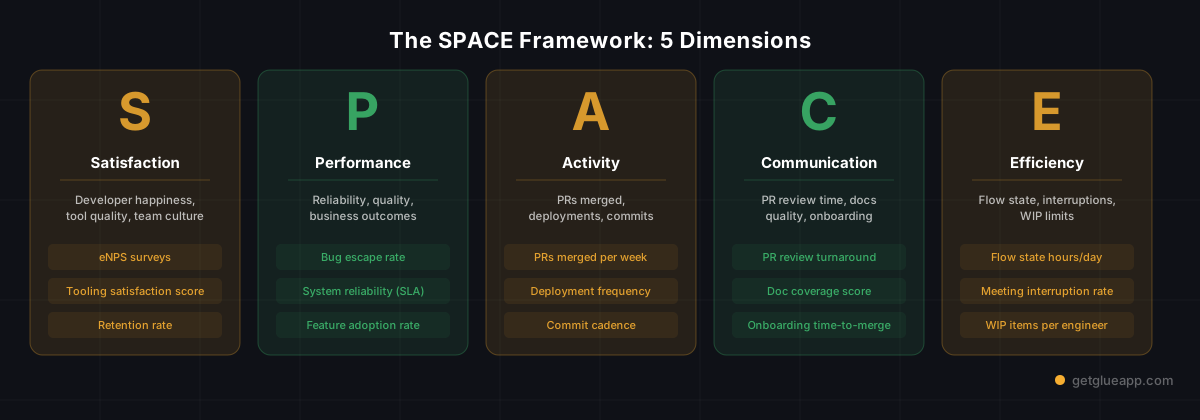
Each dimension captures a different aspect of engineering health. Understanding what each measures, how to track it, and what good looks like is essential to implementing SPACE effectively.
Satisfaction & Well-being
Satisfaction measures how happy and fulfilled developers feel in their roles. This includes job satisfaction, work environment quality, and overall well-being.
What it includes:
- General job satisfaction (do developers feel valued?)
- Work environment quality (are tools, processes, and infrastructure adequate?)
- Psychological safety (can developers speak up about problems?)
- Work-life balance (are people working sustainable hours?)
- Career growth perception (do developers see a path forward?)
Why it matters: Satisfied developers stay longer, mentor effectively, and produce higher-quality code. Teams with poor satisfaction metrics are fragile—one departure triggers others. At Netflix, Morgan Stanley, and Stripe, satisfaction is treated as a leading indicator of team stability.
How to measure it:
- Pulse surveys asking simple questions: "On a scale of 1-10, how satisfied are you in your role?"
- Exit interview data (if developers are leaving, why?)
- Retention rate (is your team stable or churning?)
- Psychological safety assessments (can people fail safely?)
- Tool satisfaction surveys (are developers happy with their tech stack?)
Red flags:
- More than 20% of your team considering leaving within a year
- Satisfaction scores below 6/10 on average
- Rising unplanned departures, especially senior engineers
- Developers describing work as "demotivating" or "frustrating"
Improving satisfaction: In 2024, a here's what I've seen: Harvard found that engineering satisfaction increased 34% when teams reduced meeting load by just 20%. Removing process friction, improving tool quality, and protecting focus time are more effective than surveys alone.
Performance
Performance measures the quality and effectiveness of work produced. Unlike activity metrics (which just count output), performance looks at impact: Are you shipping features that matter? Is the code quality high? Are deployments stable?
What it includes:
- Impact of shipped features (are releases solving real problems?)
- Code quality metrics (bugs per release, test coverage)
- System reliability (uptime, incident frequency, MTTR)
- Customer-facing quality (support tickets, bug reports)
- Strategic alignment (is work moving the business forward?)
Why it matters: A developer shipping 100 commits a week is worthless if the code is buggy or features don't address customer needs. Performance separates actual productivity from the appearance of productivity.
How to measure it:
- Feature adoption rates (are people actually using what you built?)
- Production incident frequency and severity
- Test coverage and automated test pass rates
- Code review feedback (are reviews catching issues early?)
- Customer metrics (support tickets, feature satisfaction)
- Velocity toward roadmap goals (are you making planned progress?)
The performance-activity relationship: This is where SPACE gets useful. You might see high activity (lots of commits) but declining performance (more bugs slipping through). This signals a problem: either developers are rushing, or your code review process is broken. DORA metrics alone wouldn't catch this.
Red flags:
- Increasing production incidents despite stable or increasing deployment frequency
- Test coverage dropping below 60%
- Features shipped but not adopted by users
- Code review cycles extending beyond 24 hours
Activity
Activity measures tangible output: pull requests, code commits, deployments, tickets closed. It's the dimension closest to traditional metrics.
What it includes:
- Commits and pull requests
- Deployments and releases
- Issues and tickets closed
- Code additions/deletions
- Test coverage changes
Why it matters: Activity data is objective and easy to track. It provides a baseline. However, activity alone is dangerous—it can reward the wrong behaviors. A developer who closes 50 low-value tickets appears more productive than one who closes 5 critical ones.
Why activity metrics fail alone: The research behind SPACE found that teams relying primarily on activity metrics were optimizing for the wrong outcomes. Developers would:
- Split work into smaller tickets to inflate closure numbers
- Prioritize easy tasks over critical ones
- Avoid tackling complex problems that take longer
- Focus on visible work rather than valuable work (refactoring, technical debt)
At one major tech company, tracking "pull requests per week" led developers to split single features into 20 tiny PRs to hit quotas. It looked productive on paper. In reality, it created review bottlenecks and fragmented the codebase.
How to measure it:
- PR frequency and merge rate
- Commit distribution (by person, team, project)
- Deployment frequency
- Work-in-progress metrics (are PRs sitting open too long?)
- Issue closure rate
Combining activity with other dimensions: Activity shines when combined with other metrics. High activity + high performance = healthy output. High activity + low satisfaction = burnout risk. This is why SPACE is five dimensions, not one.
Red flags:
- Activity metrics rising while performance declines
- Developers logging work but not shipping
- PRs sitting open for a week or longer
- Tickets marked closed but customers still reporting the issue
Communication & Collaboration
Communication measures how well information flows across the engineering team and between teams. It includes synchronous communication (meetings, pair programming), asynchronous communication (documentation, Slack threads), and cross-team coordination.
What it includes:
- Meeting load and effectiveness
- Documentation quality and accessibility
- Cross-team collaboration patterns
- Knowledge distribution (is knowledge siloed or shared?)
- Communication tools effectiveness (is Slack enabling or drowning you?)
Why it matters: Poor communication is one of the strongest predictors of failed projects. A 2023 McKinsey study found that organizations with effective internal communication were 3.5x more likely to deliver projects on time.
Communication also affects every other dimension:
- Poor communication → lower satisfaction (confusion, misalignment)
- Poor communication → lower performance (rework, misaligned features)
- Poor communication → lower efficiency (duplicated work, blocked dependencies)
How to measure it:
- Meeting load: hours spent in meetings per week (Google's in my experience, > 25 hours is counterproductive)
- Documentation coverage: % of features/systems with current documentation
- Cross-team PRs: how often do developers from different teams collaborate?
- Slack patterns: are conversations happening in threads or creating chaos?
- Onboarding efficiency: how long until new developers are productive?
- Dependency tracking: are handoffs between teams smooth or painful?
The meeting metric: Burson-Marsteller's 2024 research found that when engineering teams reduced meeting load below 20% of the week, communication effectiveness actually increased. Fewer, better meetings beat more talking.
Asynchronous communication as a proxy: The best teams aren't the ones with the most meetings. They're the ones that document decisions, record video walkthroughs, and answer questions in writing. Track your asynchronous communication quality—can someone answer a question without five Slack exchanges?
Red flags:
- Developers spending > 30% of time in meetings
- Documentation aging (last updated > 3 months ago)
- New hires take > 4 weeks to make first committed PR
- Recurring all-hands standups despite having a status dashboard
Efficiency & Flow
Efficiency measures how uninterrupted developers can focus on deep work. Flow state—deep, uninterrupted focus—is where complex problem-solving happens. Every interruption costs 23 minutes in context-switching time, In my experience.
What it includes:
- Uninterrupted focus time (blocks of time without meetings/interruptions)
- Context-switching load (how often are people task-switching?)
- Tool friction (time spent on overhead vs. creation)
- Deployment friction (how easy is it to ship code?)
- Process overhead (meetings, approvals, waiting on reviews)
Why it matters: Efficiency is where many teams sabotage themselves silently. A 10-person engineering team spending 2 hours per week in process overhead is "wasting" 20 engineer-hours monthly on friction. Scale that to 100 people, and you're losing a full engineer's output to bureaucracy.
How to measure it:
- Focus time: blocks of 2+ hours without calendar events (most engineers want > 15 hours/week)
- Review cycle time: how long between PR creation and approval?
- Deployment cycle time: from merged code to production in minutes
- Process wait time: time spent waiting for approvals, reviews, or environment access
- Tool satisfaction: do developers feel their tools add or remove friction?
Real examples of efficiency problems:
- A 20-person team requiring manager sign-off on all deployments. Result: deployments once per week instead of multiple times per day
- Code review taking 3 days average. Result: developers context-switching to other work while waiting
- Manual infrastructure setup taking 2 hours per new environment. Result: developers avoiding creating staging branches
- Calendar blocked with meetings, leaving only 3-hour chunks for focus work. Result: complex problems take 3x longer
Flow state and complexity: Interestingly, efficiency becomes more critical as work becomes more complex. A developer maintaining simple CRUD APIs might be unaffected by frequent interruptions. A developer implementing a complex algorithm desperately needs 4-hour focus blocks. Track efficiency by team and work type.
Red flags:
- Developers reporting they can't find 4-hour blocks for focused work
- Average code review cycle time > 24 hours
- Frequent "context switch" complaints in retros
- Deployment process taking > 30 minutes from merge to production
SPACE vs DORA Metrics: How They Complement Each Other
The industry sometimes treats DORA and SPACE as competitors. They're not. They're complementary frameworks that measure different things.
DORA focuses on:
- Deployment frequency
- Lead time for changes
- Mean time to recovery
- Change failure rate
DORA tells you how fast your team ships and how reliable releases are.
SPACE focuses on:
- Developer satisfaction
- Code quality and strategic impact
- Work activity and output
- Communication effectiveness
- Team efficiency and focus
SPACE tells you why your team can (or can't) ship reliably and sustainably.
A real example: Imagine two teams with identical DORA metrics:
Team A:
- 3 deployments per day
- 4-hour lead time for changes
- 30-minute MTTR
- 2% change failure rate
Team B:
- 3 deployments per day
- 4-hour lead time for changes
- 30-minute MTTR
- 2% change failure rate
On paper, they're equivalent. But their SPACE metrics tell a different story:
Team A's SPACE:
- Satisfaction: 8/10 (people want to stay)
- Performance: High (features are adopted, customers are happy)
- Activity: Balanced (sustainable pace)
- Communication: Clear (onboarding new people is smooth)
- Efficiency: Excellent (developers have 18 hours/week of focus time)
Team B's SPACE:
- Satisfaction: 4/10 (two people just left, others interviewing)
- Performance: Declining (defects increasing)
- Activity: High but unsustainable (overtime to hit deployment targets)
- Communication: Poor (documentation lags, tribal knowledge)
- Efficiency: Terrible (developers in meetings 40% of the time, interrupted constantly)
Team A is sustainable. Team B will collapse in 6 months.
Why both matter:
- DORA tells you if you're shipping. SPACE tells you if you can keep shipping.
- DORA catches deployment problems. SPACE catches team problems.
- DORA is a lagging indicator (you know about problems after they happen). SPACE is a leading indicator (you see problems forming).
The best engineering organizations track both. They monitor DORA to ensure delivery velocity. They monitor SPACE to ensure that velocity is sustainable and that developers are actually fulfilled by the work.
How to Implement SPACE Metrics in Your Team
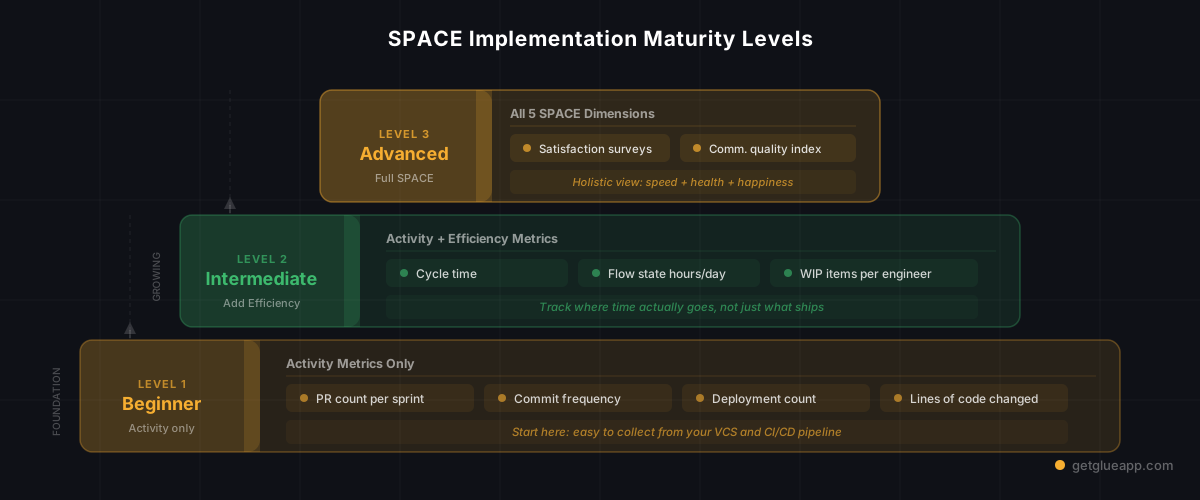
Implementation is where most teams fail. They read about SPACE, decide it's important, and then... nothing happens. Or they run a survey once and never follow up. Or they collect data without understanding what to do with it.
Here's a practical implementation roadmap:
Phase 1: Baseline & Buy-in (Weeks 1-2)
Step 1: Run a SPACE survey. Use a simple, anonymous survey covering all five dimensions. Keep it short (8-12 questions max):
- Satisfaction: "How satisfied are you in your current role?" (1-10 scale)
- Performance: "Do you feel your work is impactful?" (Yes/Somewhat/No)
- Activity: "Do you have clarity on what you're building?" (Yes/Somewhat/No)
- Communication: "Can you get answers to technical questions quickly?" (Yes/Somewhat/No)
- Efficiency: "Do you have uninterrupted focus time for deep work?" (Yes/Somewhat/No)
Step 2: Share results with leadership and team. Don't hide the data. If satisfaction is 5/10, say so. This creates urgency and buy-in. Discuss as a team: which dimension is hurting most? Why?
Step 3: Set baseline targets. Don't aim for 10/10 on everything. A realistic healthy team targets:
- Satisfaction: 7/10 or higher
- Performance: 80%+ saying their work is impactful
- Activity: Clear, aligned workload (not overflowing)
- Communication: 80%+ can get answers quickly
- Efficiency: 60%+ have 4+ hours/week of uninterrupted focus
Phase 2: Implement Continuous Tracking (Weeks 3-8)
Satisfaction: Monthly pulse surveys. Ask one question: "Overall, how satisfied are you in your role?" (1-10). Track trend.
Performance: Pull directly from your systems:
- Feature adoption: check analytics for what people use
- Incident metrics: track production issues from your on-call system
- Code quality: pull from your code scanning tool (SonarQube, etc.)
- Customer satisfaction: NPS or support ticket trends
Activity: Connect to your development tools:
- GitHub/GitLab APIs for commits, PRs, deployments
- Jira for tickets closed
- Don't obsess over this—it's just a baseline
Communication: This requires a bit more work:
- Calendar data: pull from your calendar system to measure meeting load
- Documentation: audit how much of your wiki/confluence is current
- Onboarding time: track how long new hires take to make first PR
Efficiency:
- Calendar analysis: % of time in uninterrupted blocks of 2+ hours
- Deployment metrics: time from PR merge to production
- Review cycle time: median time from PR creation to approval
Phase 3: Make It Visible & Actionable (Weeks 9+)
Create a dashboard (Grafana, Looker, or even a simple Google Sheet) showing all five dimensions. Update monthly. Share with the team.
The critical step: make one dimension your focus each month. If satisfaction is low, focus there. If efficiency is broken, fix that. Don't try to improve everything at once—you'll fail.
Example quarterly focus areas:
- Q1: Fix efficiency (reduce meeting load, speed up reviews)
- Q2: Improve communication (document everything, cut meetings by 30%)
- Q3: Celebrate performance (feature adoption and impact)
- Q4: Focus on satisfaction (career growth conversations, wellbeing)
Why Manual SPACE Tracking Fails
Here's the uncomfortable truth that neither Glue nor Swarmia will tell you: manual SPACE tracking doesn't work at scale.
The theory is sound. The implementation fails.
Problem 1: Survey fatigue. You ask engineers to fill out a survey once a quarter. Response rates drop from 80% to 40% by Q3. By next year, people ignore it. The data becomes useless.
Problem 2: Measurement lag. You run a survey in January. You analyze it in February. You discuss changes in March. By the time you act on the findings, the problem has changed. You're always one step behind.
Problem 3: Data fragmentation. Performance metrics live in your incident tracking system. Activity metrics live in GitHub. Communication metrics require manual calendar audits. Efficiency data requires surveys (because nobody exports calendar data). You're stitching together what I've seen five places, with different latencies and formats.
Problem 4: The honesty problem. Even anonymous surveys have bias. A developer worried about layoffs reports higher satisfaction than they feel. Someone angry at the CTO reports lower satisfaction. Survey data reflects emotional state, not truth.
Problem 5: No visibility into why. You see that satisfaction dropped from 7 to 5, but you don't know why. Is it a specific person? A specific project? Process changes? You start guessing and making changes that don't fix the real problem.
Problem 6: Requires dedicated people. Implementing SPACE well requires someone to own it: running surveys, pulling data, analyzing trends, presenting findings. At most companies, that person doesn't exist, so SPACE tracking dies after the first enthusiastic month.
The honest assessment: most companies tracking SPACE manually are doing it poorly. They have survey data that's three months out of date, activity metrics that incentivize the wrong behavior, and no real-time visibility into team health.
That's not the framework's fault. That's a tooling problem.
The Agent-First Approach to SPACE Metrics
There's a better way: autonomous monitoring.
Instead of manual surveys and fragmented data, imagine if AI agents continuously tracked SPACE metrics from the systems your team already uses.
Here's what that looks like:
Your agents monitor:
- Satisfaction signals from your communication patterns (are people happy or stressed in Slack? Are people protecting focus time or burning out on calls?)
- Performance data from your deployment systems and incident tracking (are features stable? Are we hitting our reliability targets?)
- Activity data from GitHub, pulling real-time metrics on PR frequency, review cycles, and deployments
- Communication patterns from your calendar and collaboration tools (meeting load trends, focus time availability)
- Efficiency data from your tools—deployments per day, review cycle times, process friction
And crucially: agents can see the why behind the metrics. When satisfaction drops, an agent can correlate it with a spike in meeting load, a delayed feature launch, or a sudden increase in production incidents. It's not just a number—it's connected to root causes.
Continuous vs. periodic: Agents update SPACE metrics daily or weekly, not quarterly. You see trends forming in real-time, not months after they've already caused damage. An agent can alert you: "Meeting load increased 40% this week—developers are flagging focus time as a concern." You fix it before people start leaving.
Autonomous triage: Agents don't just measure SPACE—they diagnose problems. An agent that sees low efficiency + high activity might identify that your code review process is broken. It suggests: "Average review cycle time is 36 hours. If we target 12 hours, this would free 8 hours/week of focus time per engineer."
Integration with the rest of your systems: A good AI agent for SPACE monitoring doesn't exist in isolation. It connects to your product metrics (is what you're shipping actually being used?), your incident tracking (is reliability suffering?), and your roadmap (are people working on what matters?).
This is fundamentally different from the Glue / Swarmia approach, which is: collect data, run analytics, show dashboards. Agents don't just show you the problem—they help you understand it and suggest solutions.
The Glue difference: Glue is an Agentic Product OS for engineering teams. It deploys agents that autonomously monitor your product, triage tickets, write specs, and answer questions about your codebase. One of those agents can continuously track SPACE metrics across all five dimensions, surfacing insights you'd miss with manual tracking.
You get:
- Real-time SPACE visibility, not quarterly snapshots
- Automatic root-cause analysis (agent sees the correlations you'd miss)
- Actionable recommendations (agents suggest specific changes, not just "improve communication")
- Integration with your other systems (SPACE data informs triage decisions, prioritization, planning)
Manual SPACE tracking will always be incomplete and dated. AI agents make it continuous, intelligent, and actually useful.
FAQ
Q: What SPACE metrics should engineering leaders track?
A: Engineering leaders should track all five SPACE dimensions: Satisfaction (developer happiness and fulfillment surveys), Performance (code quality, reliability, and customer impact), Activity (commit frequency, PR volume, deployment count), Communication (documentation quality, knowledge sharing, review responsiveness), and Efficiency (flow state time, context switching burden, tool friction). The key is measuring at least one metric from each dimension to avoid optimizing one area at the expense of others. Combine SPACE with DORA metrics for delivery velocity and use developer experience platforms to automate continuous measurement.
Q: Should we use SPACE instead of DORA?
A: No. Use both. DORA metrics (deployment frequency, lead time, MTTR, change failure rate) measure delivery velocity and stability. SPACE metrics measure team health and sustainability. They're complementary. You need both to understand your engineering organization.
A team with excellent DORA metrics but poor SPACE metrics is burning out and won't sustain performance. A team with excellent SPACE metrics but poor DORA metrics is happy but not delivering. You need both to be healthy.
Q: How often should we measure SPACE?
A: Satisfaction: monthly (pulse surveys). The other dimensions: continuously (pull from your systems). Traditional advice is quarterly surveys, but that's too slow. By the time you see a problem in quarterly data, it's already been a problem for weeks.
If you're using automated agents, you can update all five dimensions weekly or daily and spot trends as they form.
Q: What if SPACE metrics conflict? (e.g., high performance but low satisfaction)
A: That's a signal to investigate, not a reason to ignore one metric. High performance + low satisfaction often means you're driving people too hard. It's unsustainable—people will leave, and performance will collapse.
The point of SPACE is to balance all five dimensions. Optimize for the combination, not individual metrics.
Q: Can we game SPACE metrics?
A: Yes, and traditional implementations are vulnerable to gaming. Examples:
- Satisfaction surveys: people lie if they're worried about layoffs
- Activity metrics: developers split work into tiny PRs to inflate numbers
- Communication metrics: teams optimize for meeting attendance rather than effectiveness
This is why agent-based tracking is better—it's harder to game automated data collection. An agent sees your real calendar patterns, your actual PR review times, your genuine communication flow. There's no survey bias, no artificial inflation.
Q: How do we balance SPACE metrics with business goals?
A: SPACE metrics enable business goals. High satisfaction = lower turnover = faster onboarding = faster shipping. High efficiency = more capacity without hiring. High communication = fewer failed projects.
SPACE isn't separate from business success. It's the foundation for sustainable delivery.
Next Steps
SPACE metrics give you a complete picture of engineering health. But measurement alone doesn't improve anything. What matters is:
-
Establish baselines. Run one survey this month. See where you stand across all five dimensions.
-
Focus on one dimension. Pick the weakest area and make it your Q1 priority. If efficiency is broken, fix review cycle times and meeting load. If communication is poor, invest in documentation and async processes.
-
Make it visible. Build a simple dashboard showing all five dimensions. Update monthly. Talk about it in retros.
-
Automate it. Manual tracking is a temporary solution. Move toward continuous measurement using agents and automated data collection. You'll see real trends, not quarterly snapshots.
-
Connect SPACE to decisions. Use SPACE data to inform hiring decisions (are we under-resourced?), process changes (should we cut meetings?), and roadmap planning (is our current work sustainable?).
SPACE metrics won't solve problems by themselves. But they'll surface the real problems so you can fix them.
The teams that will win are the ones that measure SPACE continuously, act on the data quickly, and protect developer satisfaction and efficiency as fiercely as they protect delivery velocity.
Related Resources
- DORA Metrics: Not Enough
- Developer Experience Platform Glossary
- DORA Metrics Explained
- Measuring Programmer Productivity
Related Reading
- DORA vs SPACE Metrics: Which Framework Should You Use?
- DORA Metrics: The Complete Guide for Engineering Leaders
- DX Core 4: The Developer Experience Framework That Actually Works
- Developer Experience: The Ultimate Guide to Building a World-Class DevEx Program
- Developer Productivity: Stop Measuring Output, Start Measuring Impact
- How to Measure Developer Experience: Frameworks, Metrics & Measurement Stacks