
Software capitalization is the accounting practice of recording qualifying software development costs as intangible assets on the balance sheet rather than expensing them immediately. Under GAAP (ASC 350-40 for internal-use software), costs incurred during the application development stage — coding, testing, and configuration — are capitalizable, while preliminary project and post-implementation costs are expensed. The best tools for tracking capitalizable engineering work include Glue, Anrok, Apptio, and Productiv, which map engineering activity to GAAP-compliant cost categories automatically.
At Salesken, this question came up every quarter like clockwork. Our CFO would ask how much engineering work was capitalizable, and our engineering managers would stare blankly. Finance would estimate based on project names. Engineering would argue that "refactoring" was really "new functionality." Neither side was wrong — they just didn't have a shared framework for classifying work. Building that framework saved us from both over-capitalizing (which inflates assets) and under-capitalizing (which tanks EBITDA).
Your CFO walks into the quarterly business review and asks: "How much of our engineering effort this quarter should we capitalize versus expense?"
Your VP Engineering looks at the finance lead blankly. Nobody has a definitive answer. Engineering has been shipping features, patching bugs, and refactoring code. Finance has been guessing. Somewhere between their desks, tens of thousands of dollars in misclassified engineering costs slip through.
This is the CFO-CTO disconnect that plays out in tech companies every quarter. Finance needs accurate capitalization data to allocate costs correctly on the balance sheet. Engineering has no process to provide it. The gap between what accounting standards require (ASC 350-40) and what engineering teams can actually track is massive—and it's costing you money in both audit risk and financial misclassification.
This guide walks you through software capitalization from first principles: what it is, when it applies, how to classify work in practice, and how modern engineering teams are automating the entire process to turn a quarterly guessing game into reliable data.
What is Software Capitalization? (ASC 350-40 Basics)
Software capitalization is the accounting process of treating certain software development costs as capital assets rather than immediate expenses. Instead of writing off all engineering costs to P&L in the period they're incurred, capitalization allows you to defer those costs to the balance sheet and amortize them over the software's useful life (typically 3-5 years).
From an accounting perspective, this follows the principle of matching costs to the periods in which they generate revenue. A feature built today will drive revenue for years. It makes sense to spread its cost across those years rather than hit profits entirely in month one.
Why This Matters
The difference between expensing and capitalizing engineering work directly impacts:
- Net Income: Capitalizing increases reported profits (spreading costs over time)
- Balance Sheet: Capitalized costs appear as intangible assets
- Cash Flow: No impact (both are non-cash decisions)
- Tax Treatment: Can create timing differences between book and tax accounting
For a $2M annual engineering budget, the difference between 40% and 60% capitalization can swing your reported net income by hundreds of thousands of dollars. Auditors care deeply about getting this right.
When to Capitalize vs. Expense Software Development Costs
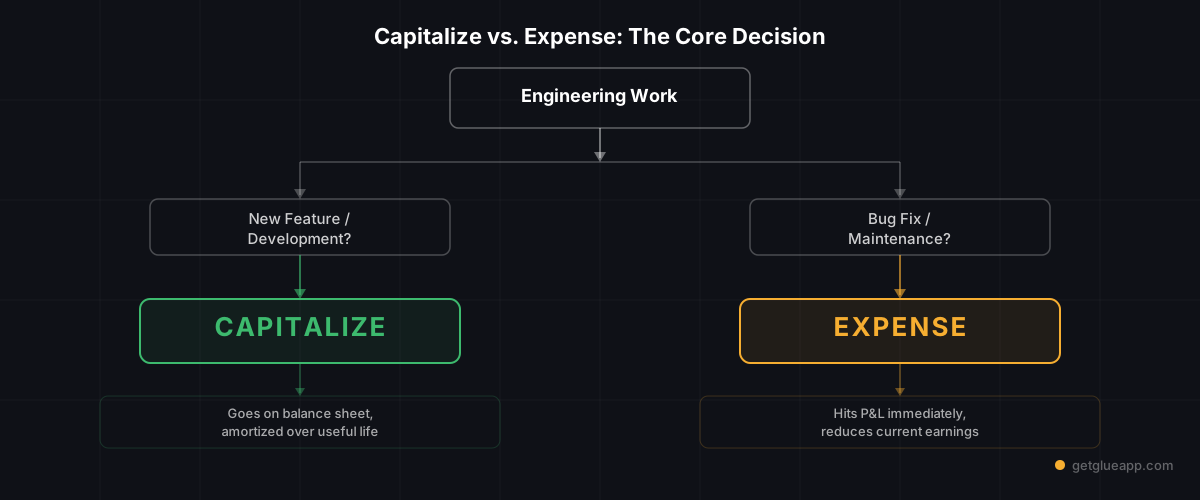
The core principle is simple: Capitalize work that creates or enhances a software asset. Expense work that maintains the status quo or fixes problems.
Capitalizable Work (Defer to Balance Sheet)
- New product features that expand functionality
- Significant enhancements to existing features
- Architectural improvements that add new capabilities
- Infrastructure work that directly supports a specific revenue-generating product
- Custom integrations built for specific customer implementations
- Machine learning model development (with caveats—see below)
Expensable Work (Hit P&L Immediately)
- Bug fixes and defect corrections
- Routine maintenance and security patches
- Technical debt reduction
- Code refactoring (unless it enables new functionality)
- Performance optimization (unless it's transformational)
- DevOps, CI/CD pipeline improvements
- Routine testing and QA
- Training, documentation, and administrative work
The line is blurry. A "performance optimization" that reduces database query time by 10% is maintenance. A "performance optimization" that allows the product to handle 100x more concurrent users—enabling a new pricing tier—might be capitalizable.
This ambiguity is exactly why engineering and finance teams clash.
The Three Phases of Software Development (Preliminary, Application Development, Post-Implementation)
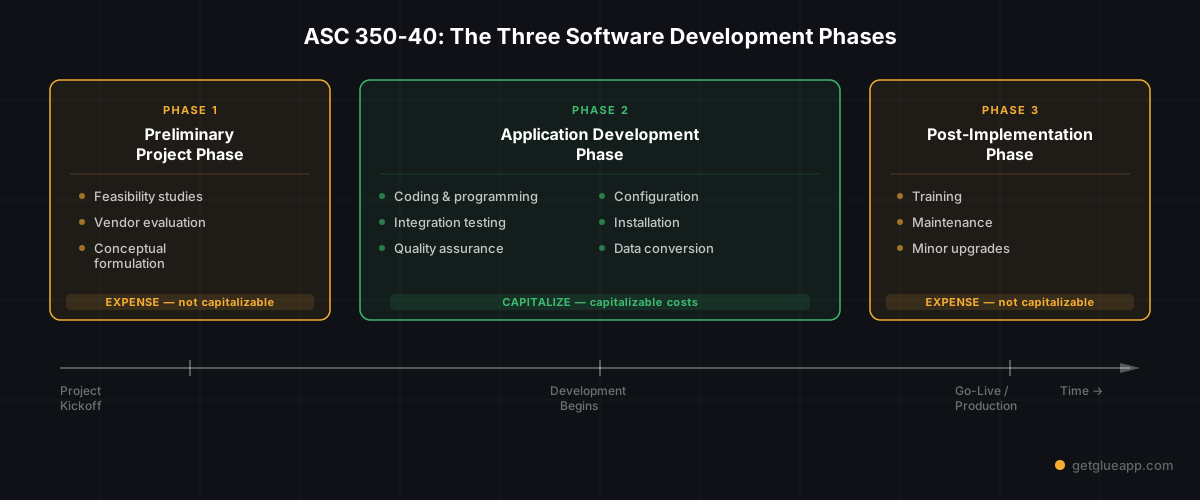
ASC 350-40 divides software development into three distinct phases, each with different capitalization treatment:
Phase 1: Preliminary Stage (100% Expensable)
This is the "exploration and planning" phase before development begins.
- Concept planning and market research
- Requirements gathering and feasibility studies
- Technology and vendor selection
- Architecture design discussions (before commitment to build)
- Proof-of-concept development
Why it's expensable: You haven't committed to building yet. These costs help you decide whether to build.
Real example: Your product team spends 3 weeks researching whether to rebuild the dashboard in React or Vue. That's preliminary-stage expense.
Phase 2: Application Development Stage (Conditional Capitalization)
Once you've committed to building a specific software feature or product, development costs can be capitalized—but only after you've cleared specific technical and commercial hurdles.
Capitalizable conditions (all must be true):
- The organization has committed to funding and completing the project
- The technical feasibility of completing the software has been established
- The company intends to use or sell the software (not experimental)
- The software will generate probable future economic benefits
Real example: Your product team decides to build a new reporting module. Once engineering has signed off on technical feasibility and the project is approved with budget, development work to build the core reporting engine qualifies for capitalization.
Not capitalizable within Application Development:
- Learning new tools or technologies for this project
- Technical debt discovered during implementation
- Architecture refactoring needed because initial design had flaws
- Bug fixes found in testing
Phase 3: Post-Implementation (Mostly Expensable)
Once the software is live and generating revenue, additional costs are generally expensed:
- Ongoing maintenance
- Bug fixes (unless they qualify as new features)
- Minor enhancements
- Hosting and infrastructure (operational costs)
Exception: Significant enhancements or new major features added post-launch can be capitalized if they meet Phase 2 criteria.
Real example: Six months after launch, your reporting module is generating revenue. A request comes in to add drill-down capabilities. If this is substantial enough to warrant a separate development project with clear scope and technical feasibility, it can be capitalized. If it's a quick add-on by one engineer, it's maintenance and gets expensed.
What Counts as Capitalizable? (New Features, Significant Enhancements — YES. Bug Fixes, Maintenance, Minor Updates — NO)
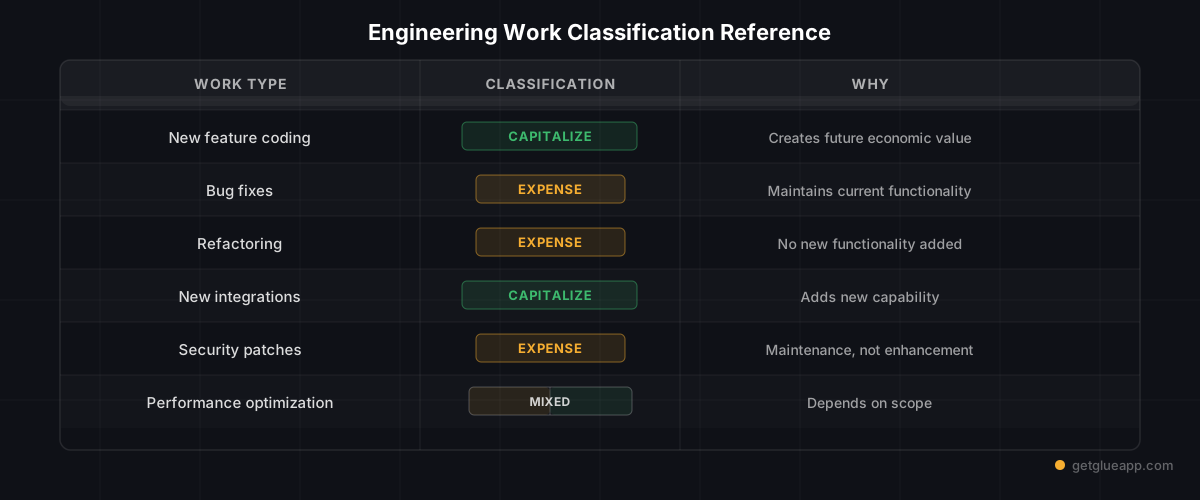
Let's make this concrete with real-world scenarios:
YES — Capitalize These
Scenario 1: Building a new product feature
- Your analytics product currently shows basic metrics. You build a completely new "custom dashboard" feature with drag-and-drop widgets, real-time updates, and export functionality.
- Classification: Capitalizable. This is new functionality that will drive future revenue.
- Treatment: Capitalize all engineering costs from Phase 2 approval through launch.
Scenario 2: Significant platform upgrade
- Your mobile app runs on legacy code. You undertake a major rewrite to switch from an old framework to a modern stack that will enable future AI features and faster performance.
- Classification: This is borderline, but if the rewrite is motivated by creating future capability (not just "our code smells"), and enables new feature development that wouldn't be possible otherwise, portions can be capitalized.
- Reality check: If you're doing it because "engineers complained about the legacy codebase," that's maintenance. If you're doing it because "without this rewrite, we can't ship the AI feature our customers are demanding," that's capitalizable.
Scenario 3: Custom integration for enterprise customer
- A Fortune 500 customer is willing to sign a $500K annual contract—but only if you build custom integration with their ERP system. Your team builds the integration specifically for this customer's use case.
- Classification: Capitalizable (or possibly billed to the customer as a professional services fee). This creates a tangible software asset that generates revenue.
NO — Expense These
Scenario 1: Security patches
- Your backend has a known vulnerability in one of its dependencies. Your team upgrades the library and patches the code.
- Classification: Expensable. This is maintenance to keep the existing product safe and secure—not new functionality.
Scenario 2: Bug fix after launch
- Users report that the custom dashboard's export feature doesn't work correctly with certain data types. Engineering fixes the bug.
- Classification: Expensable. You're fixing a defect in existing functionality, not adding new capability.
Scenario 3: Technical debt reduction
- Your engineering team spends two sprints refactoring the authentication service because it's become hard to test and maintain.
- Classification: Expensable (all of it). Refactoring improves code quality but doesn't create new functionality. The service works the same way from the user's perspective.
- Note: If refactoring enables new features (e.g., "refactoring auth lets us implement single sign-on"), only the refactoring work necessary for the new feature counts as capitalizable, and the rest is maintenance.
Scenario 4: Performance optimization
- Engineers optimize database queries and reduce page load time from 3 seconds to 1 second.
- Classification: Expensable. Performance improvement is maintenance—unless the optimization enables new functionality.
- Exception: If performance improvement enables you to serve 10x more concurrent users without infrastructure cost, making a previously infeasible feature now viable, discuss with accounting.
The Gray Zone: Tech Debt and Refactoring
Tech debt is the worst. Finance wants a clear yes or no. Engineering knows it's complicated.
General rule: Tech debt is expensable because it represents the cost of fixing mistakes from the past. It doesn't create new functionality.
Rare exception: If tech debt elimination is a prerequisite to developing a new, capitalizable feature (and the refactoring wouldn't happen otherwise), discuss allocating a portion to capitalization with your controller.
Safe approach: Err on the side of expensing tech debt. If your CFO pushes back, you have documentation that it was intentionally conservative.
The Practical Problem: How Do You Actually Track This?
Here's where theory meets reality.
Your engineering team uses Jira. They're organized into agile sprints. They commit code with messages like "fix: crash on export" and "feat: dashboard v2." Sometimes they write good PR descriptions. Sometimes they write "stuff."
Your finance team doesn't have access to Jira. They see a bill from your PEO or salary tool showing 15 engineers at $150K each. They don't know which of those engineers worked on capitalizable features vs. bug fixes.
So they guess. Or they ask engineering to fill out timesheets. And engineers hate timesheets.
The result: Either capitalization is systematically too high (inflating profits, creating audit risk), or it's systematically too low (overstating expenses, understating the value of engineering investment).
The Manual Approach (What Most Companies Do)
Finance creates a spreadsheet. They ask engineering to estimate "what percentage of work this quarter was capitalizable?"
Reality: Engineers round. They guess. They might overstate capitalization because it makes engineering look more productive. They might understate it because they don't want the scrutiny.
The number you get—"60% capitalizable"—is an educated guess at best.
The Spreadsheet Approach (What Mature Companies Do)
Finance creates detailed project tracking. They define "capitalizable projects" vs. "maintenance buckets." Managers allocate engineering effort to projects.
Reality: This works better, but:
- It requires overhead from engineering managers
- It's still allocation-based, not actual-based
- People get the classifications wrong anyway
- It requires constant reconciliation
Manual Tracking vs. Automated Work Classification (Glue Angle — Agents that Classify Work Automatically)
The fundamental problem is that engineering and finance speak different languages.
Engineers think in terms of: commits, pull requests, tickets, sprints, and code changes.
Finance thinks in terms of: projects, cost centers, asset classifications, and accounting codes.
Someone has to translate. Today, that someone is usually a finance manager with a spreadsheet—and they're guessing.
Enter automated work classification.
A modern approach is to use AI agents that can read the engineering activity that's already happening—commit messages, PR descriptions, ticket types, sprint goals, story points, code changes—and automatically classify whether each piece of work is capitalizable or expensable.
How It Works
Step 1: Collect Data The system has read access to your Jira workspace, Git history, and related systems. It sees:
- Ticket titles and descriptions
- Sprint goals and milestones
- Git commit messages and PR descriptions
- Linked dependencies between tickets
- Story point estimates
- Which team members worked on which items
Step 2: Classify Automatically An AI agent reads this data and applies the ASC 350-40 framework:
- Is this work creating new functionality or enhancing existing capability? → Likely capitalizable
- Is this work fixing bugs, addressing security issues, or reducing tech debt? → Likely expensable
- Does the ticket description indicate this is "maintenance" work? → Expensable
- Does it reference a "new feature" or "product launch"? → Likely capitalizable
The agent also flags ambiguous cases for manual review.
Step 3: Provide Finance Visibility The system generates a dashboard showing:
- Engineering effort by classification (capitalizable vs. expensable)
- Drill-down by project, team, sprint, and individual ticket
- Confidence scores (high-confidence vs. manual review needed)
- Audit trail showing why each classification was made
Step 4: Feed the General Ledger The classification feeds directly into your accounting system or is available for export to your controller's spreadsheet. Instead of "engineering is 60% capitalizable," you have:
- Q1 capitalizable engineering effort: $487K (based on actual work analysis)
- Q1 expensable engineering effort: $213K (maintenance, bug fixes, tech debt)
Why This Matters
For Finance:
- Accurate capitalization data instead of guesses
- Audit-ready documentation showing how classifications were made
- Compliance with ASC 350-40 requirements
- Ability to track trends (is capitalization % trending up or down?)
For Engineering:
- No timesheets required
- No need to interrupt work to fill out forms
- Transparency into how work is valued
- Data that supports budget requests ("we're creating $2.1M in assets quarterly")
For Auditors:
- Clear methodology and consistent application
- Automated logging of classifications and the reasoning behind them
- Reduced audit risk because the system is deterministic
The Tool: Glue Agents
Glue agents are designed specifically to solve the finance-engineering gap. They:
- Read your existing engineering systems (Jira, GitHub, GitLab, linear, etc.) without modification
- Apply consistent classification rules across all work
- Flag gray-zone items for finance-engineering review
- Provide dashboards, API access, and GL integration
- Are customizable—you can adjust classification rules to match your specific business model and accounting practices
The net effect: What used to require quarterly guesswork or manual spreadsheet reconciliation becomes an automated, auditable, and accurate process.
Software Capitalization Best Practices for Startups
If you're a scaling startup, here's how to handle software capitalization effectively without hiring a full-time finance controller:
1. Define Your Capitalizable Categories Early
Don't wait until your first audit to clarify what counts as capitalizable in your business.
Ask yourself:
- What software products or modules are we building that will have long-term revenue impact?
- Are we a SaaS platform (capitalization is critical), a services company (most work is expensable), or a mix?
- Do we build custom software for specific customers? (Likely capitalizable if properly scoped)
Action: Write a one-page document defining your capitalization policy with 3-5 concrete examples from your own product. Share it with your CPA and controller.
2. Organize Jira (or Your Ticket System) for Classification
You don't need separate projects, but you do need consistent tagging.
Use one of these approaches:
- By project type: Create "Product Features" vs. "Maintenance" buckets. Route all technical debt, bug fixes, and infrastructure work to a separate project code.
- By ticket type: Use Jira issue types to distinguish. Create a new issue type "Capitalizable Feature" vs. "Bug" vs. "Maintenance."
- By label: Add a label to each ticket:
capitalizable,expensable,review.
Action: Spend one sprint creating and tagging your backlog correctly. Use this as a baseline for ongoing classification.
3. Use Milestones and Epics for Clarity
Link all capitalizable work to a specific product or milestone.
When finance asks "what's the $500K in Q2 engineering capitalized against?"—you want a clear answer: "The Analytics Dashboard Epic ($300K), the Customer API Phase 2 ($150K), and the AI Recommendations Research ($50K, expensable because still in preliminary stage)."
Action: Ensure every capitalizable feature is tied to an Epic or Milestone with clear start and end dates.
4. Implement a Simple Capitalization Review Process
You don't need formal approval workflows, but you do need visibility.
Monthly:
- Finance or your controller does a spot check of Jira
- Reviews the top 5-10 tickets in the "capitalizable" category
- Asks engineering: "Are we sure this is still capitalizable?" or "Did scope change?"
- Notes any reclassifications
This catches errors early instead of discovering them in audit.
Action: Schedule 30 minutes on the first Friday of every month. Have one finance person and one engineering lead quickly review the prior month's capitalizable work.
5. Track Software Capitalization Separately from Hardware and Other Assets
Use a separate cost center or account code for "Capitalized Software Development." This makes reporting clean and makes auditor questions easier to answer.
Action: If you use QuickBooks, create a balance sheet account called "Capitalized Software" (asset) and a corresponding amortization expense account. Map your engineering time to these accounts.
6. Plan for Amortization from Day One
If you capitalize $500K in engineering this year, you'll be expensing ~$100K+ annually in amortization going forward (depending on useful life assumption).
Build this into your long-term financial model. It affects your path to profitability.
Action: Review your amortization schedule quarterly. Make sure it's realistic given your product lifecycle.
7. Get Professional Advice Early
If capitalization is material (more than 10% of your engineering budget), have your CPA or controller weigh in on your policy before you've already capitalized $1M+.
A one-hour conversation up front saves months of rework during an audit.
Action: Invite your external CPA to a "technical accounting alignment" call. Walk through your capitalizable projects and get agreement on methodology.
FAQ: Common Software Capitalization Questions
1. Can You Capitalize Agile Development Work?
Short answer: Yes, but it's harder to track than waterfall.
Explanation: ASC 350-40 doesn't care whether you're agile or waterfall. What matters is whether the work is building new capability or maintaining existing functionality.
The challenge: Agile sprints mix capitalizable and expensable work. A sprint might include:
- Story 1: Build new dashboard feature (capitalizable)
- Story 2: Fix export bug (expensable)
- Story 3: Refactor auth service (expensable)
- Story 4: Add SSO integration for enterprise tier (capitalizable)
You can't just capitalize the whole sprint.
Best practice: Track at the story level, not the sprint level. Classify each story as you commit to it. Use automation (like Glue agents) to apply consistent logic.
2. What About Tech Debt Work? Can Any of It Be Capitalized?
Short answer: Almost never. Tech debt is expensable.
Explanation: Tech debt represents the cost of fixing engineering mistakes and decisions made in the past. By definition, it doesn't create new functionality—it just makes existing functionality maintainable.
Exception: If tech debt elimination is a prerequisite to building a new, capitalizable feature, and the refactoring wouldn't happen otherwise, you might allocate a portion of the refactoring to the capitalizable project.
Example: Your legacy codebase can't support multi-tenancy. To launch your enterprise product tier (capitalizable), you must refactor the architecture. The refactoring work that's directly required for multi-tenancy could be capitalized as part of the enterprise product development.
Reality check: Avoid this if possible. It's audit bait. Finance and auditors will question whether the refactoring was truly prerequisite or just a convenient way to capitalize more engineering spend.
3. Can You Capitalize Machine Learning and AI Model Development?
Short answer: Sometimes, but tread carefully. This is a hot topic in audits right now.
Explanation: Machine learning model development can be capitalizable if:
- The ML model is part of a new revenue-generating product or feature
- The model will be used or sold by the company
- Development has reached a stage of technical feasibility
- The project has commitment and approved funding
What's expensable:
- Exploratory ML research ("we're exploring whether LLMs could improve our product")
- Model training and fine-tuning (usually considered ongoing operational costs)
- Data labeling and data pipeline work (operational infrastructure)
What might be capitalizable:
- Building a completely new AI-powered feature (e.g., "AI Copilot for [your product]")
- Developing a proprietary ML model that provides competitive advantage
Audit risk: Auditors are scrutinizing AI capitalization heavily right now because companies are often too aggressive. Be conservative.
Best practice: If ML development is material in your business, have a conversation with your auditors early about what's capitalizable and what's not. Get guidance in writing.
4. What If We Build Software for a Customer to Use (Not Us)?
Classification depends on intent:
If you're building custom software as a service to that customer: It's a professional service engagement. Costs are typically expensed as COGS or recorded as revenue once delivered (if billed separately). Don't capitalize it.
If you're building software that the customer will use, but you retain IP and can resell it to others: Capitalize it like any other product development.
If you're building software that you'll use internally or resell, but there's a customer partnership: It's a gray zone. Consult your controller.
5. What's the Difference Between Capitalizing vs. Capitalizing-Then-Immediately-Expensing?
No difference financially, but there is an audit difference.
Some companies capitalize software development (on the balance sheet as an asset) but then immediately run it through amortization expense.
Example:
- Capitalize $100K in Q1 engineering → appears on balance sheet
- Amortize it over 3 years → $33K hits P&L as expense annually
vs.
- Expense $100K in Q1 engineering → appears on P&L immediately
Net income result: Both approaches result in $100K hitting P&L eventually. But the timing and balance sheet presentation differ.
Why companies do this: It can create a cleaner audit trail if there's documentation that the work was deliberately capitalized (even if amortized quickly).
Reality: Most startups skip this and just expense aggressively to simplify accounting. Capitalize only when it's clearly material and supportable.
Automate Away the Guesswork
Software capitalization is a necessary evil of modern accounting. But it doesn't have to be a guessing game.
The finance-engineering disconnect exists because the two teams lack shared language and real-time visibility into work. Manual processes—spreadsheets, timesheets, post-hoc reconciliation—introduce delays, errors, and audit risk.
Automated work classification using AI agents changes this. Instead of engineering estimating what percentage of work is capitalizable, the system analyzes actual work using the same framework auditors apply. The result is accurate, auditable, defensible capitalization data that neither finance nor engineering has to fight over.
For engineering leaders tired of capitalization questions from finance, this is how you finally answer them with confidence.
For finance leaders trying to get accurate balance sheet data without slowing down engineering, this is how you replace guesswork with signals.
Start with clear policies. Move to systematic tracking. End with automation.
Related Resources
- The Dollar Cost of Technical Debt
- Technical Debt Glossary
- Measuring Programmer Productivity: Beyond Lines of Code
Related Reading
- GAAP Rules for Capitalization of Software: Complete Scenario Guide
- Capitalizing Software Development Costs: A CFO's Complete Guide
- Capitalizing Software Implementation Costs Under GAAP
- Capitalized Software GAAP: ASC 350-40 vs ASC 985-20 Compliance
- Engineering ROI: How to Measure and Communicate Business Value
- Software Productivity: What It Really Means and How to Measure It