Glossary
Code intelligence uses automated analysis to extract actionable information from codebases. Learn why it matters for PM-engineering alignment.
Building Glue taught me that the biggest problem in engineering isn't writing code — it's understanding the code you already have.
Code intelligence is the use of automated analysis ( - ) increasingly AI-powered ( - ) to extract meaningful, actionable information from a codebase. Distinguish this from related concepts: code search finds specific files or functions by name. Static analysis finds bugs, security issues, and style violations. Code completion writes code for engineers. Code intelligence does something different: it understands the codebase at a structural level and answers questions that no individual engineer could hold completely in their head. What systems own which capabilities? What depends on what? How complex is this module? How does a change in one place affect another? What's the change history of this subsystem? What does this system actually do?
Code intelligence is fundamentally about making codebase knowledge accessible to people beyond engineers. In traditional setups, a codebase is opaque to product managers, designers, and other stakeholders. They ask engineers questions about what's possible. Engineers answer based on what they remember about the architecture and what they can quickly look up. The knowledge remains in engineers' heads.
When code intelligence outputs are accessible to product teams ( - ) not just engineers ( - ) the entire product-engineering communication improves. A PM can ask: "What would it take to support a new payment method?" If the answer requires understanding the payment system architecture, its dependencies, and what changes would propagate to other systems, code intelligence can show this. The PM doesn't need to ask an engineer. The codebase itself answers the question.
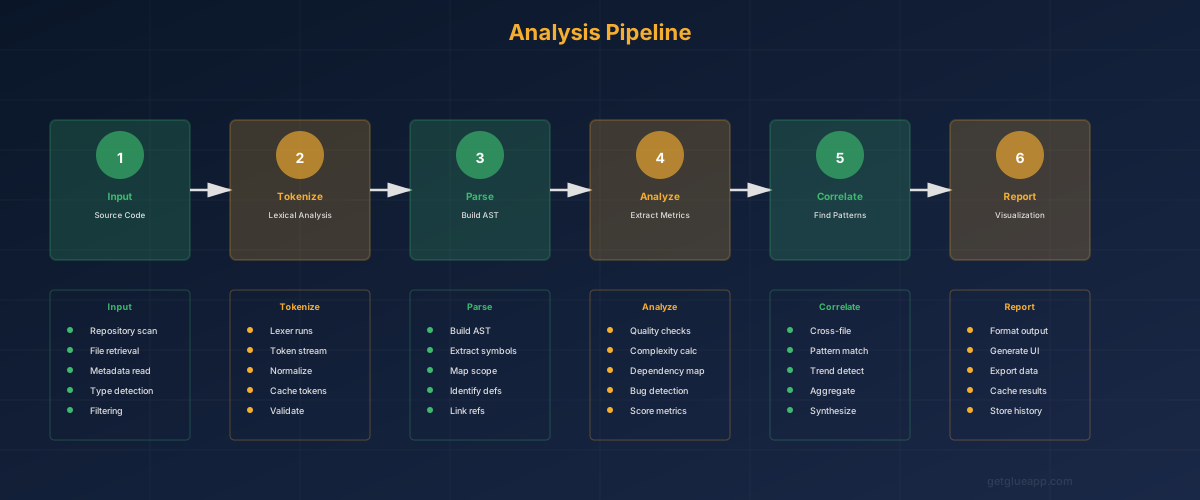
This changes planning and estimation. When PMs have visibility into the actual system architecture and can understand technical constraints directly, they make better design decisions. They know which features are easy because the architecture already supports them, and which features are hard because they require architectural changes. Estimates become more reliable because they're based on visible system properties, not on an engineer's recollection.
Code intelligence also improves incident response. When something breaks in production, the team needs to understand what systems are affected, what changed recently, what systems depend on the broken component, and what the impact likely is. Code intelligence can answer these questions immediately. Teams spend less time reconstructing context and more time fixing problems.
Most importantly, code intelligence democratizes understanding. Without it, product understanding depends on senior engineers who've been around long enough to hold the codebase in their head. With code intelligence, that understanding is available to newer engineers, product managers, and technical leaders who need the information without needing to remember everything.
Consider a product team planning a redesign of their onboarding flow. The current onboarding system integrates with multiple backend services: user service, email service, analytics service, feature flags service, and authentication service. To estimate the redesign work, the PM needs to understand: what's in scope for onboarding in the codebase, what dependencies the onboarding system has, what else depends on onboarding behavior, and what would break if they changed how onboarding works.
Without code intelligence, the PM schedules a meeting with a senior engineer who worked on onboarding three years ago. That engineer spends an hour explaining the system. The PM takes notes. Later, when the engineer quits, the PM has outdated notes. The next PM has to have a similar meeting with someone else.
With code intelligence, the PM opens a system and asks: "Show me all the systems that depend on the onboarding service." The intelligence system immediately shows them the dependency graph. The PM can see that the analytics service depends on onboarding events, the feature flags service depends on user setup during onboarding, the email service depends on onboarding confirmation status. The PM can then estimate: changing onboarding requires careful coordination with four other services. They can ask: "What's the change history of onboarding in the past year?" Code intelligence shows them that onboarding has been stable, which means redesigning it carries less risk of introducing bugs than redesigning something that changes constantly.
During incident response, the value becomes clearer. An engineer receives a page: onboarding flow is timing out. Without code intelligence, they log into production, check logs, and discover something about feature flag evaluation is slow. But they need to understand whether this is an onboarding problem or a feature flags problem. Is onboarding calling feature flags in a loop? Is feature flags calling onboarding? Are they independent? These questions take time to answer through code inspection.
With code intelligence, the engineer asks: "Show me the call chain from onboarding to feature flags." Code intelligence reveals the relationship. If onboarding calls feature flags for every step of the flow, the engineer immediately knows that optimizing feature flag evaluation will fix the onboarding timeout. They can prioritize their debugging effort.
Over time, code intelligence changes how engineering managers allocate work. Instead of asking senior engineers to mentor new engineers on specific systems, managers can point them to code intelligence tools. New engineers can ask the codebase questions and get answers immediately. This doesn't replace mentorship, but it makes mentorship more productive because it's answering questions that require human context, not questions that the codebase itself can answer.
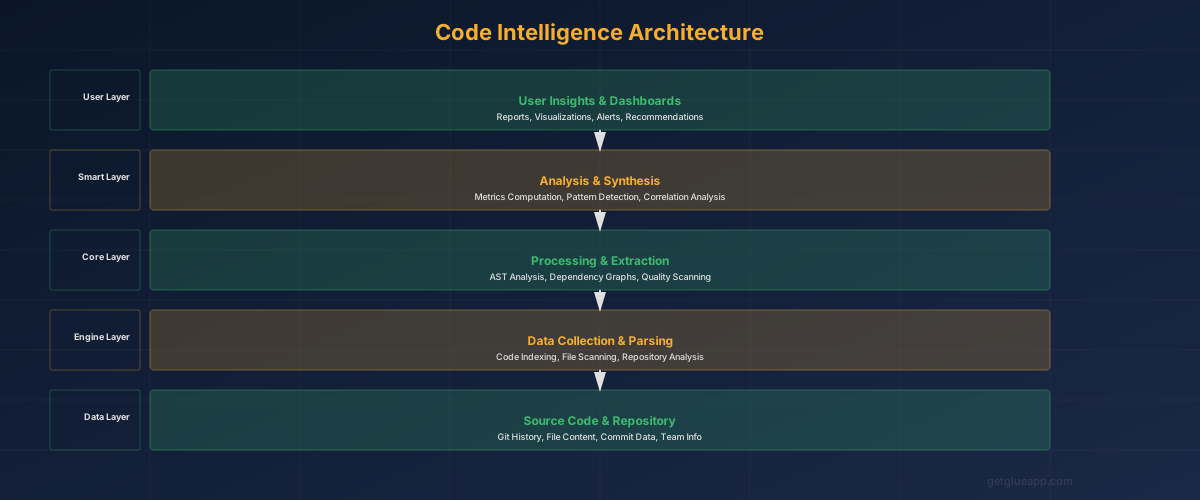
Code intelligence tools vary in sophistication and scope. Basic code intelligence answers structural questions: which files depend on which other files, how complex is each module, what's the churn rate of each system (how often does it change). More sophisticated intelligence uses AI to understand what systems do, to find similar patterns across the codebase, to predict the impact of changes, and to generate documentation.
The most useful code intelligence outputs for product teams are: architectural dependency graphs (what depends on what), system ownership maps (who understands each system and how much), complexity heat maps (which parts of the codebase are hardest to understand and most likely to have bugs), and change impact analysis (what changes break other systems).
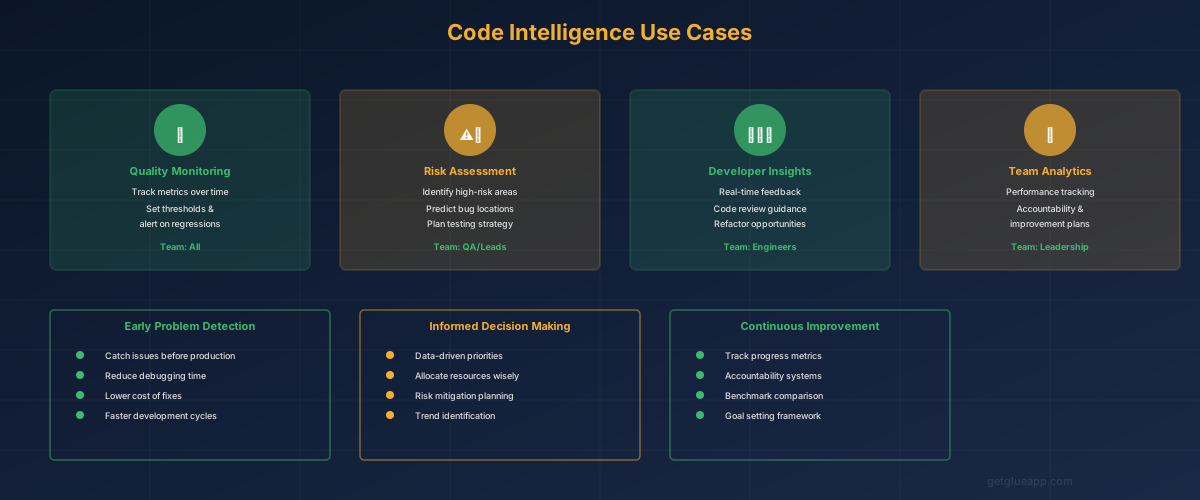
Measuring the value of code intelligence is indirect. Track whether it changes decision quality: do PMs make better design decisions when they have codebase visibility? Track whether it accelerates incident response: does knowing the dependency graph help teams debug faster? Track whether it improves onboarding: do new engineers become productive faster when they can ask the codebase questions?
Implementing code intelligence usually requires investment in tooling and data pipelines. At minimum, organizations should have visibility into code dependencies and complexity. More sophisticated implementations add AI-powered understanding of what code does, automatic documentation generation, and impact analysis. The investment is worthwhile when codebase opacity creates real friction in planning, estimation, or incident response.
Misconception 1: Code intelligence is only useful for engineers. This misses the entire point. Code intelligence's highest value is making codebase understanding accessible to non-engineers. Engineers learn the codebase through experience and code reading ( - ) they don't necessarily need code intelligence. Product managers, technical leads, and engineering managers need code intelligence because they need to understand systems they're not maintaining daily. The accessibility audience for code intelligence should be everyone making decisions about systems, not just the people who wrote them.
Misconception 2: AI-powered code intelligence is the only kind that matters. While AI can make code intelligence more powerful, even basic automated analysis ( - ) dependency graphs, complexity metrics, ownership maps ( - ) provides value. Start with the analysis you can do reliably. AI adds sophistication, but basic code intelligence is better than no intelligence.
Misconception 3: Code intelligence can replace knowing how to read code. Code intelligence is a tool that helps engineers understand codebases, not a replacement for code reading skill. Code intelligence tells you what dependencies exist, but understanding whether those dependencies are well-designed requires reading code. Code intelligence tells you a function is complex, but understanding what it actually does requires reading the code. Code intelligence amplifies reading skills; it doesn't replace them.
Q: What information should code intelligence make visible to product teams?
A: The most useful outputs are: what capabilities exist in the codebase (searchable, documented product features), what systems own those capabilities, what other systems depend on each system, estimated complexity of changes (what's easy, what's hard), and change history (how stable is this system). This gives PMs visibility into whether features are feasible, whether features can be shipped independently or require coordination, and whether systems are stable enough to redesign or need stabilization first.
Q: How is code intelligence different from architecture documentation?
A: Architecture documentation is static ( - ) someone writes it once. Code intelligence is dynamic ( - ) it reflects the actual current codebase. Architecture documentation tells you what the system was supposed to be. Code intelligence tells you what it actually is. Ideally, they align. When they diverge, code intelligence reveals the reality, and documentation should be updated. For product teams, code intelligence is more reliable than documentation because it can't become stale.
Q: Can code intelligence help product teams understand whether a competitor's feature would be hard to build?
A: Partially. Code intelligence can tell you whether you have related capabilities in your own codebase that you could build on, or whether you'd need to build from scratch. It can tell you the complexity of changes. But estimating whether a specific competitor feature is hard requires understanding both your architecture and what the competitor actually did, which code intelligence alone can't provide. Code intelligence is useful for competitive gap analysis on the internal side ( - ) what you have, what constraints you have ( - ) but not for reverse-engineering competitor implementations.
Keep reading
Related resources