
Competitive analysis fails when product teams don't understand their own product's technical capabilities — comparing competitor features against an incomplete or inaccurate view of your own codebase leads to misguided roadmap decisions, redundant feature builds, and missed positioning opportunities. Effective competitive analysis requires architecture-level visibility into your own system: knowing what's built, what's stable, what's fragile, and what's feasible to build next. Codebase intelligence closes this gap by giving PMs the internal product understanding needed to make competitive assessments that reflect engineering reality.
At Salesken, we were in a crowded market — three direct competitors, each claiming similar features. Understanding what they actually shipped versus what they marketed was the difference between smart roadmap bets and wasted quarters.
You're building your competitive analysis spreadsheet. Three hours in, you've mapped out what competitors have, what they're claiming, what you've heard they're building. You feel productive. You're making the case that you're behind on features X and Y, ahead on features A and B, and need to prioritize building something to catch up to Z.
Then you send it to engineering and one of the senior engineers comes back with: "Actually, we already built feature X. It's in the codebase. It's just not shipped yet. And feature Y would require re - architecting two core systems, so we probably shouldn't do it even if the competitor has it."
I've done this. I've done this multiple times. I've built entire competitive analyses based on what I thought we could and couldn't do, without actually checking what we had already built or what was feasible given our architecture.
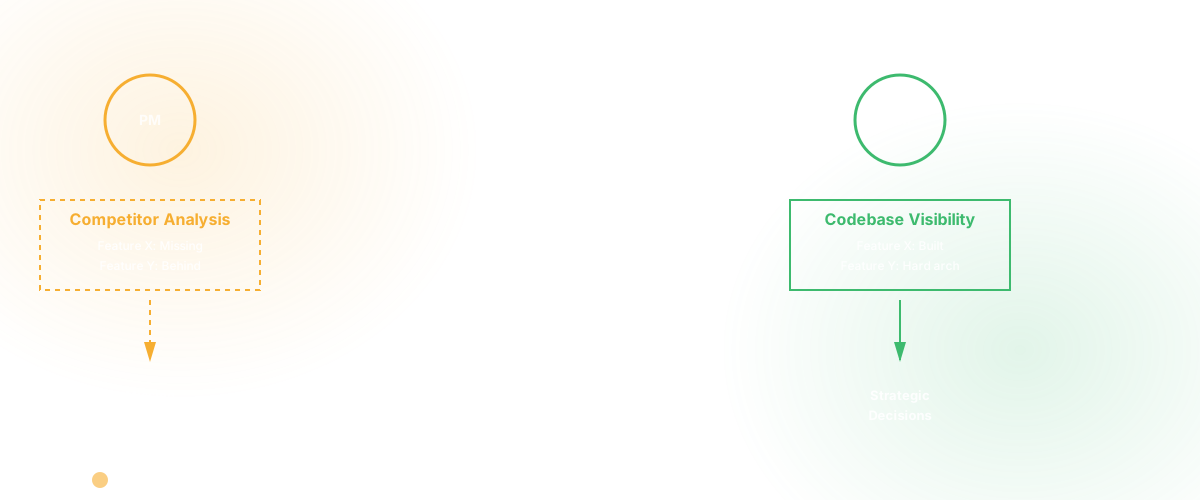
The asymmetry is brutal. I could spend four hours on a competitive teardown. I could spend two hours talking to customers about what they want relative to competitors. But if I'm doing that without visibility into my own product and my own codebase, I'm working with 30% of the information I need.
Here's what I've learned: competitive analysis starts with your own product.
The Blind Spot That Kills Strategy
Let me describe the specific scenario because I know it happens more than we talk about:
A PM at a fintech company hears that a competitor just shipped two-factor authentication. The PM knows this is important to the market, sees it as a gap, and recommends it as a priority for the next quarter.
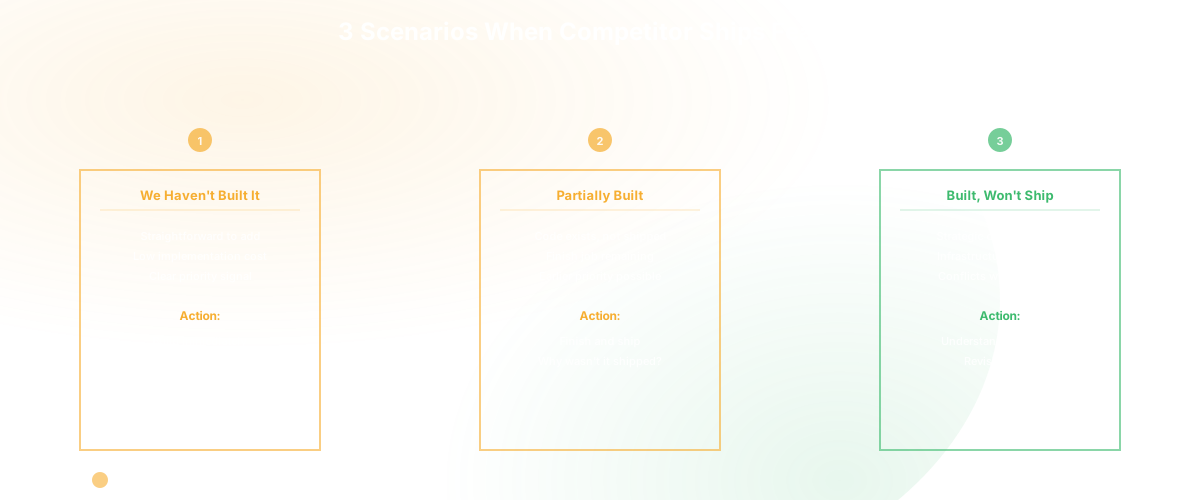
Three things could be true:
The company hasn't built it, and it's straightforward to add - this is a real opportunity.
The company has partially built it, and shipping it is mainly a job of finishing it - the PM could have prioritized this much earlier if they knew.
The company has built it already, but it wasn't shipped for good reason. Maybe the infrastructure wasn't ready. Maybe it required a design decision about customer support that hadn't been made. Maybe it conflicted with another part of the roadmap. But the decision to not ship it wasn't made carelessly - it was deferred pending other work.
Without visibility into the codebase, the PM looks at the competitor's feature and either thinks "we don't have this" (which might be wrong) or "we need to build this" (which might also be wrong).
Now scale that across competitive analysis. Multiply it by the number of features you're comparing. The number of half - built things. The number of things you could ship but chose not to. The things in the roadmap that the competitor doesn't even know about yet.
Competitive analysis without codebase visibility is basically guesswork with confidence.
What Good Competitive Analysis Looks Like
I'm not saying you need to read code. I'm saying you need to know your own product deeply enough to answer these questions:
What have we actually built? This is a simple question with a surprisingly complex answer. You might think you know. Most PMs don't. There's stuff half - built in branches. There's code shipped without corresponding product changes. There's features that are technically there but not documented, so nobody knows they exist. A competitive feature audit against a product you don't fully understand is incomplete by definition.
Why haven't we shipped some of the things we've built? This is where strategy lives. A feature might be technically complete but we deferred shipping it because we wanted to pair it with something else, or because it required more infrastructure work, or because we decided a different approach would be better. If a competitor ships that feature in isolation, and you don't understand why you built it differently, you're not going to make good decisions about response.
What's our architectural reality? Two features that look the same in terms of scope can differ wildly in implementation difficulty depending on whether they touch stable systems or systems that are already marked for refactor. If you're doing competitive analysis without understanding which parts of your codebase are solid and which are fragile, you're going to recommend things that are technically possible but strategically stupid.
What could we realistically ship in the next two quarters? This is where most competitive analysis fails. PMs map out competitor features, recommend priorities based on what they see in the market, but don't have any sense of what's actually feasible given the team's capacity and the codebase's constraints. So you end up recommending something competitive that would require rearchitecting a core system, and then engineering has to explain why that's not happening. You lose credibility and the team loses momentum on the actual priorities.
Competitive Analysis as a Design Discipline
What I've learned from having codebase visibility is that competitive analysis should actually be more narrow than most teams do it. Not "list all features competitors have" but "where are we strategically different, and what does that mean?"
If a competitor has feature X and we don't, the question isn't automatically "should we build it?" The question is "do our customers need this? Does it fit our roadmap? Can we build it well?" That third question is where most analysis falls apart.
Here's how I approach it now:
Identify which competitive features actually matter to your ICP. Not "the competitor has it," but "the customer we're selling to needs it." These are different things. Plenty of features in Salesforce don't matter to you because they're not for your use case.
Assess strategic alignment. If the feature is important to your ICP, does closing that gap align with where you're going? Sometimes the answer is no. Sometimes you're building a different product on purpose. When that's true, you don't build to match competitors. You build to own a different position.
Assess feasibility against your actual architecture. This is the step that requires codebase visibility. And it's not a "can we do this" question. It's a "can we do this well?" A feature might be technically possible but require so much rework that shipping it would destabilize other things.
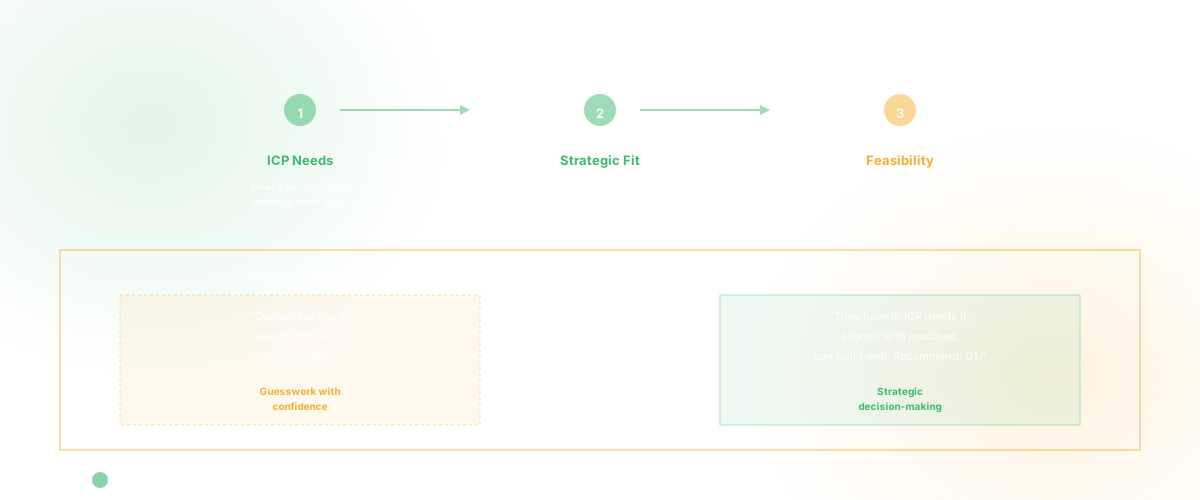
Do those three assessments, and you've got a real competitive analysis. "We see competitor has X. Our ICP needs it. It's aligned with our roadmap. We can build it well using existing systems. Recommend: build it." Or alternatively: "They have it, our ICP needs it, but it conflicts with architectural work we're already committed to, so recommend: build it in quarter 3, not quarter 1."
That's different from "they have it, we don't, priority high."
The PM's Credibility Problem
Here's the thing I care most about: when you recommend something competitive without understanding whether you can actually build it, you lose credibility with engineering. You look like you're chasing the market instead of building a strategy. You look like you're reacting instead of leading.
When you have codebase visibility, you don't stop recommending competitive things. But when you do, you have an explanation. "This matters to our customers, it's feasible for us to build because X, here's how it fits our timeline, and here's what we're willing to sacrifice to make room for it."
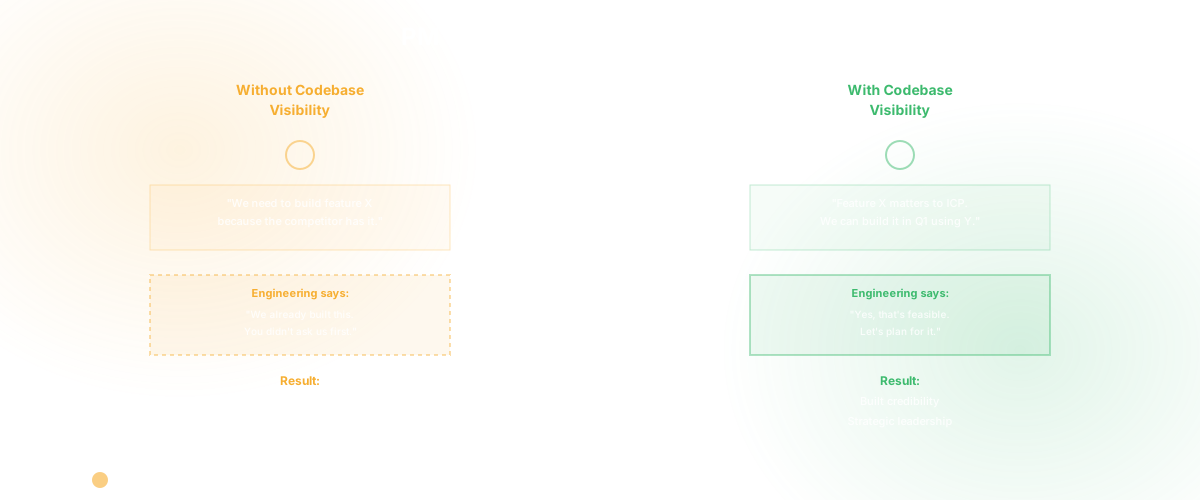
That's the conversation that earns you credibility. Not looking at the feature list and saying "we need to do what they do."
How This Connects to Your Tools
Competitive analysis, done well, requires you to know your own product better than anyone. That's hard if the only way to know what's been built is asking senior engineers. It's easier if you can explore your codebase and understand what's there, what's stable, what's fragile, what's planned.
This is where tools that surface codebase intelligence matter. I can look at a competitive feature and think "have we built this?" and actually find out. I can understand the architecture well enough to have an educated opinion on whether something is feasible. I can talk to engineering not as someone asking a question, but as someone who's already done the research and is asking for validation.
That changes the conversation entirely.
Frequently Asked Questions
Q: How deep do PMs actually need to understand the codebase? A: You don't need to understand it at a code level. You need to understand it at an architecture level. What are your core systems? What's the data model? What's been refactored recently and what's on the roadmap to refactor? What parts of the system are stable and which are known pain points? Software architecture documentation and dependency mapping help surface this visibility. If you can answer those questions, you have enough visibility to do competitive analysis well.
Q: What if I do competitive analysis and realize we've massively misunderstood our own feature set? A: Welcome to the club. This happens to most teams. It's actually valuable - it means you're about to make better decisions. Talk to your CEO and leadership about what you've learned. You might discover that you've been underselling something, or that you've got more capability than you realized. That's a windfall of information.
Q: How often should we redo competitive analysis? A: Quarterly, ideally. Competitors ship fast. But also, you ship. Your product capability changes. Your roadmap constraints change. Treating competitive analysis as a one - time thing is where you get into trouble. Treat it as an ongoing intelligence function, and it becomes a useful input to strategy instead of a surprise that contradicts your roadmap.
Related Reading
- AI Product Discovery: Why What You Build Next Should Not Be a Guess
- Product Intelligence Platform: What It Is and Why You Need One
- AI for Product Management: The Difference Between Typing Faster and Thinking Better
- The Product Manager's Guide to Understanding Your Codebase
- Product OS: Why Every Engineering Team Needs an Operating System
- Software Productivity: What It Really Means and How to Measure It