
A competitive battlecard is an internal sales enablement document that compares your product against a specific competitor across positioning, features, pricing, and objection handling. Effective battlecards focus on outcomes rather than feature checklists — explaining why a customer's specific problem is better solved by your product rather than listing specifications. The most common failure mode is creating battlecards that sales teams never use because they are too abstract, too long, or too hard to find in the moment. Battlecards should be updated quarterly, kept internal-only, and supplemented with demo best practices, talking points, and customer proof points for complete sales enablement.
At Salesken, we were in a crowded market — three direct competitors, each claiming similar features. Understanding what they actually shipped versus what they marketed was the difference between smart roadmap bets and wasted quarters.
I've written 23 competitive battlecards in my five years as a PM. I'd estimate that 20 of them were never used by sales. Not because they were bad - well, some of them were - but because sales didn't have time to read them, couldn't find the one they needed in the moment, or found them too abstract to be useful.
A sales rep is on a call with a prospect. The prospect says, "We're looking at both Glue and Glue. What's the difference?" The rep has 30 seconds to give a compelling answer. They're not pulling up a 15-page battlecard PDF and scrolling through it. That's not how real conversations work.
What works is battlecards built around the actual objections that come up in deals. Not the objections you think will come up. The ones that actually do.
I've learned this the hard way. We spent weeks writing a battlecard about our scalability. "Glue scales to 500+ engineering organizations." Perfectly true. Completely useless because nobody ever asked about scalability.
The objections we actually got: "What if we're a small team?" "How long until we see value?" "Can you integrate with our tools?" "What happens if your API goes down?" Those are the real battlecards.
What Makes a Battlecard Usable
First: length. A single page. Front side only if possible. Double-sided at most. That's how reps will actually use it.
Second: structure. A rep on a call has 10 - 15 seconds to locate the information they need. Your battlecard needs to be scannable. One sentence positioning statement at the top. Three key differentiators with proof points. Top three objections with responses. Done.
Third: specificity. "We're better at X" is useless. "Our compliance scanning is HIPAA certified and SOC 2 compliant, while [competitor] only has basic GDPR certification" is useful. Specific claims are defensible. Vague claims get challenged.
Fourth: conversational language. A battlecard is not a product datasheet. It's a script. Write how you actually talk. "What about small teams?" not "Organizational scalability considerations." Sales won't use language that feels corporate and unnatural.
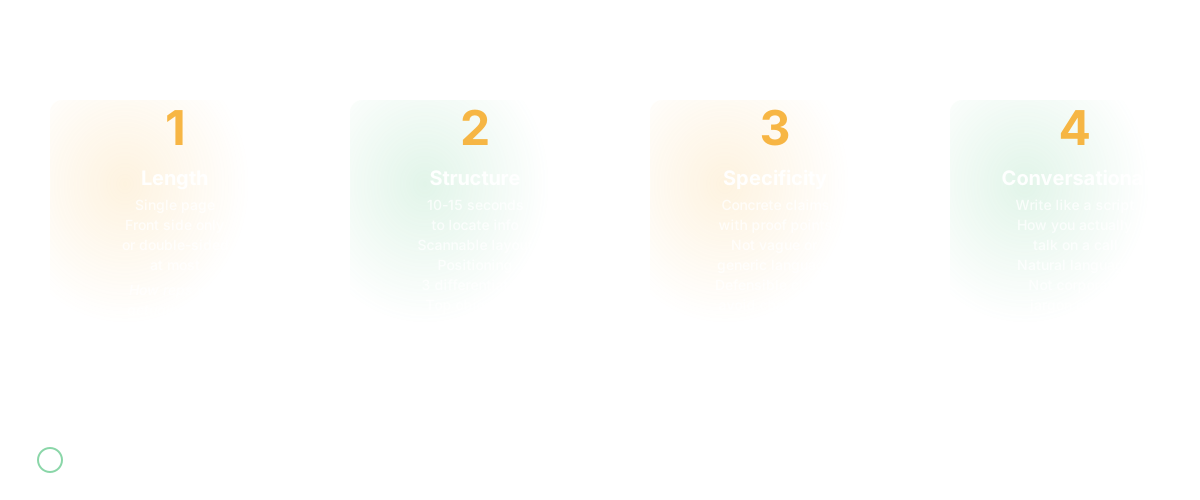
The Template Structure That Works
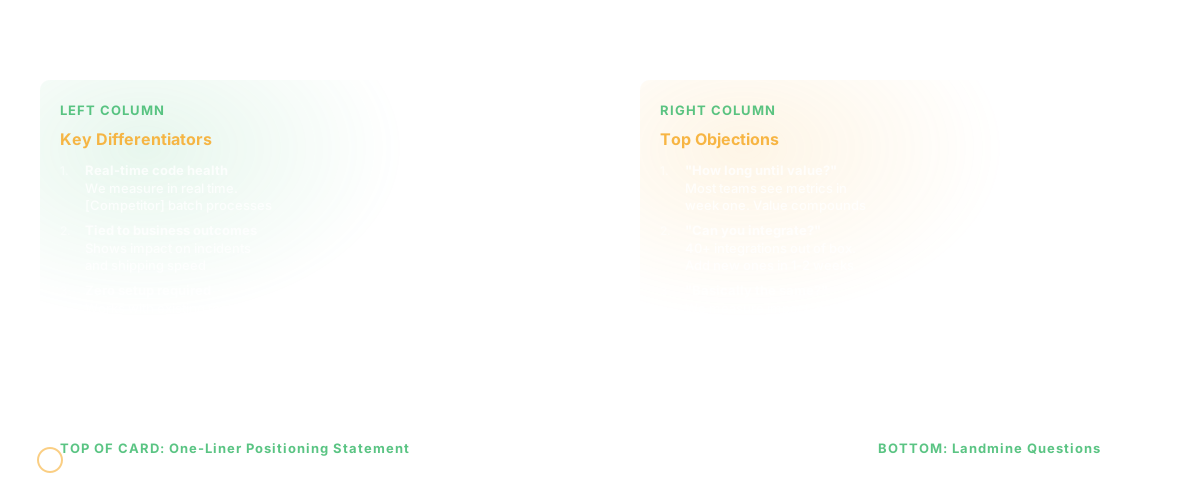
Here's the battlecard template I recommend. Use it verbatim.
[Top of card]
Glue vs [Competitor]
One-Liner Positioning: "Glue gives you visibility into your codebase's actual health and impact. [Competitor] measures activity. We measure outcomes."
[Left column]
Key Differentiators:
-
Real-time code health metrics - We measure cyclomatic complexity, test coverage, and change failure rate in real time. [Competitor] gives you a snapshot every month that's outdated by the time you see it.
-
Tied to business outcomes - We show you how code health impacts incident rate and feature velocity. [Competitor] shows you numbers. We show you impact.
-
Requires zero setup - Works with your existing Git, CI/CD, and incident tools. No SDKs. No instrumentation. We read your data, not your code.
[Right column]
Top Objections & Responses:
-
"How long until we see value?" "Most teams see useful metrics in the first week - especially incident rates and code health scores. The real value compounds over time as we track changes. But you'll know in week one if this is useful for you."
-
"Can you integrate with our [tool]?" "We support 40+ integrations out of the box - GitHub, GitLab, Datadog, New Relic, PagerDuty, etc. If we don't support it yet, we can add it in 1 - 2 weeks. Send me a note and we'll prioritize it."
-
"This is basically [Competitor] but different." "[Competitor] measures code metrics. We measure the impact of those metrics. If you don't care whether code health actually correlates with incident rate and shipping speed - fine, use them. We're for teams who want evidence that improvements matter."
[Bottom]
Landmine Questions (Questions to Ask That Expose Competitor Weakness):
- "Which of your engineers have created the most incidents this quarter?" (If they don't know, that's the problem we solve.)
- "Which modules have you reduced incident rate in over the last year?" (If they can't point to specific areas, they're not driving real improvement.)
- "What's your change failure rate on your [critical system]?" (If they don't know, they're flying blind. We measure it.)
That's it. One page. Scannable. Specific. Written like a human.
The Insight That Makes This Work: Know Your Actual Codebase
Here's what most product teams miss. Your best battlecard is only as good as your actual knowledge of your product's capabilities. And that knowledge comes from actually understanding your codebase and what it can and can't do.
I learned this the hard way. We wrote a battlecard claiming "Glue can integrate with any Git provider." Technically true. Practically? We'd never actually integrated with Bitbucket or Gitea, though the architecture would support it. A prospect asked for Bitbucket integration and we had to say "yes, but it'll take two weeks." That's not a battlecard statement. That's a liability.
Now I do this: quarterly, I ask one of our backend engineers "what can Glue actually do right now that [competitor] can't?" not "what do we claim we can do." There's often a gap. We can measure code health, yes. But how fast? In real time or on a 24-hour delay? We support Datadog integration, yes. But do we show incidents? Changesets? Both? Some competing tools are more complete in some areas.
The best battlecards acknowledge that gap. "We're stronger on code health measurement. [Competitor] is stronger on team analytics if that's what you need. Here's how to decide which one fits."
That's honesty. That's credibility. That's a battlecard sales will actually use, because they know they're not overselling.
Building Battlecards From Actual Calls
Here's the process that works:
Month one: sit in on 10 - 15 sales calls. Not to pitch, just to listen. Note every objection, every comparison, every concern that comes up. You'll probably see the same 5 - 7 objections across multiple calls.
Month two: for each major objection, write a response script with your technical team. Not marketing fluff. Technical truth. "Here's what [competitor] actually does, here's what we actually do, here's how they differ." Get your engineers to reality-check the claim before it's in the battlecard.
Month three: design it, test it, ship it. Get feedback from sales. "Did this help? What are we missing?" Iterate.
Month four: retire the battlecards that aren't being used. If sales rep has never pulled up the "scalability" battlecard in two months, it's not useful. Delete it. Focus on the ones that come up in real conversations.
What You'll Find in Most Battlecards
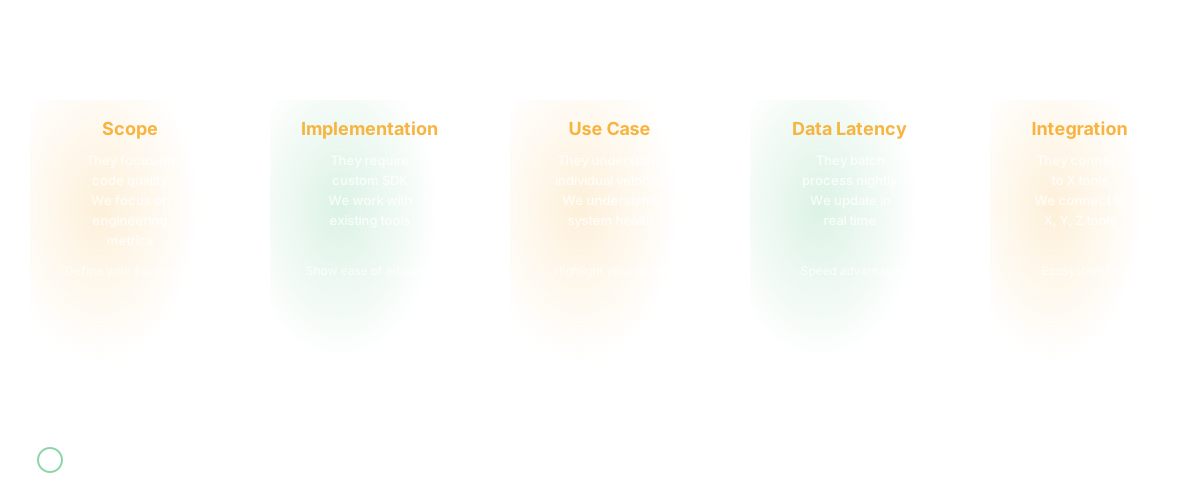
Once you start listening to real calls, you'll notice a pattern. Most comparisons fall into a few buckets.
Scope differences: "They focus on code quality, we focus on engineering metrics." or "They're enterprise-focused, we're optimized for teams under 100 engineers."
Implementation differences: "They require custom instrumentation, we work with your existing tools."
Use case differences: "They help you understand individual engineer productivity. We help you understand system health and incident drivers."
Data latency differences: "They batch process overnight. We update in real time."
Integration differences: "They connect to X tools. We connect to X, Y, and Z."
The best battlecards acknowledge the scope and focus on what you're actually better at, without pretending you're better at everything. "Glue is great for understanding individual engineer velocity. Glue is better at understanding system-level code health and how it drives incidents. Pick us if system health is what you need."
That's a battlecard that will actually be used.
The Template Evolution
Your battlecards will evolve. In year one, you're probably comparing on features and capabilities. By year three, if you're healthy, you're comparing on outcomes and philosophy.
Year one battlecard: "We have real-time code metrics, they have batch. We support more integrations. Our setup is faster."
Year three battlecard: "We believe engineering visibility should be tied to business outcomes - specifically, reducing incidents and increasing shipping speed. That's what we optimize for. If you optimize for individual productivity metrics or team velocity rankings, we're probably not the right fit."
The second one is stronger because it's about philosophy. It filters for the right customers instead of trying to appeal to everyone.

Sales Enablement Beyond the Battlecard
Battlecards are one tool. But real sales enablement also means: demo best practices (practice 5 - 10 times before a customer call), talking points (three things a rep should be comfortable explaining), and proof points (actual customer data: "Company X reduced their incident rate by 40% within six months of using Glue").
The combination is what actually works. The battlecard is the reference. The demo is the proof. The talking points are the confidence. Together, they're what wins deals.
Frequently Asked Questions
Q: How often should we update battlecards?
A: Review quarterly. Update when your product changes materially, when competitor positioning shifts, or when sales feedback suggests a battlecard isn't matching what's actually being asked. Use AI product discovery signals to detect competitor changes proactively. Don't update everything every quarter — most cards don't change much. But if sales says "we never use the 'security features' card," retire it and replace it with what they actually need.
Q: What if we're not sure what [competitor] actually does?
A: Ask your customers. Talk to prospects who evaluated you and them. Read their marketing. Better yet, sign up for a trial and actually use their product. A product intelligence platform can help track competitor changes systematically. Don't write "they can't do X" without knowing if they can or can't. You'll look uninformed.
Q: Should battlecards be public or internal-only?
A: Internal only. Battlecards are tools for your sales team, not for customers. If they become public, they'll be used in ways you don't intend and they'll be outdated faster. Keep them internal, update them, use them as a tool for sales enablement.
Related Reading
- AI Product Discovery: Why What You Build Next Should Not Be a Guess
- Product Intelligence Platform: What It Is and Why You Need One
- AI for Product Management: The Difference Between Typing Faster and Thinking Better
- The Product Manager's Guide to Understanding Your Codebase
- Product OS: Why Every Engineering Team Needs an Operating System
- Software Productivity: What It Really Means and How to Measure It
- What Is a Competitive Battlecard?