
Feature gap analysis requires three dimensions — importance (customer demand and competitive urgency), strategic alignment (fit with product positioning and architecture), and feasibility (codebase complexity, ownership clarity, and architectural readiness) — not just a spreadsheet comparing competitor features. Most teams assess gaps using only the first dimension, producing feature lists disconnected from engineering reality. Connecting gap analysis to codebase intelligence reveals which gaps are achievable within current architecture and which require foundational work first.
Here's a meeting that happened in my career more than once:
I finished building a competitive feature gap analysis. Eight features the competitors had that we didn't. I made the case for prioritizing all of them. Engineering came back with a list of which ones would require "architectural changes." It was about half.
I'd built the entire analysis on the assumption that if a competitor had it, we could build it too. I didn't account for whether we could build it well, or whether it fit our system, or whether the architectural cost was worth the capability gain.
The feature gap analysis has become a standard tool, which is good. But most teams do it wrong. They treat it like a checklist exercise: "they have X, we don't, add it to the priority list." Then they're surprised when shipping features takes longer than expected or when shipped features create new problems because they didn't integrate well with the existing system.
Real feature gap analysis is more sophisticated. It's not about which gaps exist. It's about which gaps matter, and whether closing them is actually the right move.
The Three Dimensions That Actually Matter
Every feature gap should be assessed on three dimensions, and I've watched teams fail at this by ignoring the third.
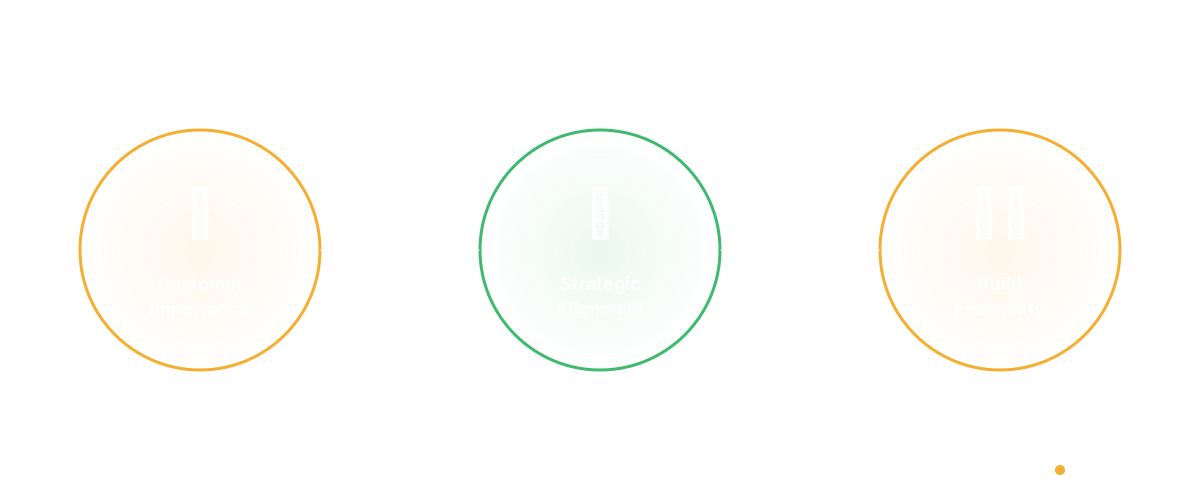
Dimension 1: Customer Importance
Does your ideal customer profile actually need this? This is where most teams start, and it's the right first question. You talk to customers, you look at request volume, you assess whether this is a "nice to have" or a "must have."
The mistake most teams make here is treating it as binary. Either customers want it or they don't. In reality, customer need lives on a spectrum. Some customers desperately need it. Some would use it if you had it. Most wouldn't notice if you didn't. You need to understand the shape of that demand.
I've seen teams prioritize features because two enterprise prospects said they wanted them. Then they shipped the features, won the deals, and never got asked about the feature again. Meanwhile, they deprioritized something that 60% of their customer base wanted.
Assess customer importance properly: "40% of our target segment wants this, and it's a must-have for 15% of them." That's a 6 out of 10 in customer importance. Not a 10. Not a 3. A 6.
Dimension 2: Strategic Alignment
Does closing this gap move you toward where you want to go as a product? This is where strategy actually matters.
A lot of feature gap analyses treat all gaps equally. If a competitor has it and you don't, it's a gap. But strategy means you're intentionally better at some things and intentionally not pursuing others. You're not trying to be everything to everyone. You're trying to own a position.
If a competitor has a feature that doesn't align with that position, closing that gap might actually move you away from your strategy, not toward it.
I've seen companies build features specifically to match competitors in ways that diluted their actual value proposition. They spent engineering resources that could have gone to something more defensible. They made their product more complicated. They succeeded at matching a competitor on a feature that customers didn't particularly care about.
Strategy is about saying no. Feature gap analysis is where you actually do the saying.
Dimension 3: Build Feasibility
Can you build this well given your actual architecture? This is the dimension that most feature gap analyses skip, and it's the one that costs teams the most time later.
A feature might be important to customers, strategically aligned, and completely unfeasible to build without doing massive architectural work first. You can either invest in that architectural work and then build the feature, or you can decide the feature isn't worth the infrastructure cost. But you can't make that decision from a spreadsheet that doesn't include feasibility assessment.
I learned this the hard way. I was building feature gap analysis against a larger competitor. They had a feature that sounded important. We didn't. I put it on the priority list, high priority. Engineering looked at it and said "we'd need to re - architect two core systems to build this well."
We had a choice: spend 8 weeks on rearchitecture and then 4 weeks building the feature, or build it badly on top of the current architecture and have technical debt forever. Or skip it.
If I'd done the feasibility assessment upfront, I would have either made a conscious choice to invest in the architecture (which would have changed the priority), or I would have deprioritized it in favor of things that were achievable without architectural rework.
How to Actually Do This
The framework is straightforward:
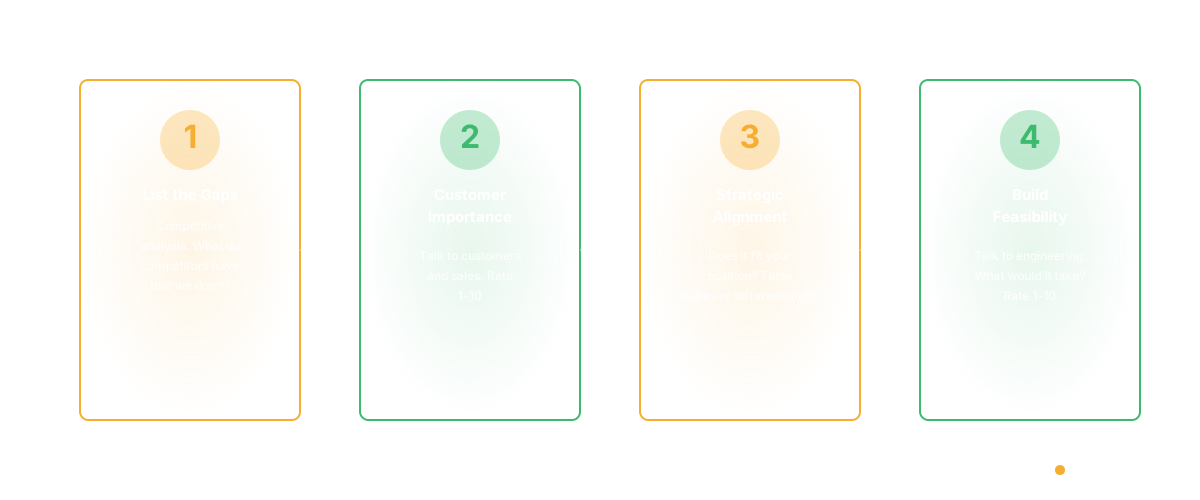
Step 1: List the gaps. This is the standard competitive analysis. What does the competitor have that you don't? Document it clearly.
Step 2: Assess customer importance. Talk to your sales team. Talk to customers. Understand how much of your target market actually needs this, how badly they need it, and whether it's a purchase driver or just a nice - to-have. Rate it 1 - 10.
Step 3: Assess strategic alignment. Does this move you toward the position you're trying to own? Or does it move you away? Is it table stakes, or is it differentiating? Rate it 1 - 10.
Step 4: Assess feasibility. This is where you talk to engineering. "If we wanted to build this, what would it take?" The answer might be "three weeks," or it might be "three weeks plus eight weeks of rearchitecture." You're not asking them to commit. You're asking them to characterize the work. Rate it 1 - 10, where 10 is "straightforward with existing systems" and 1 is "requires foundational changes."
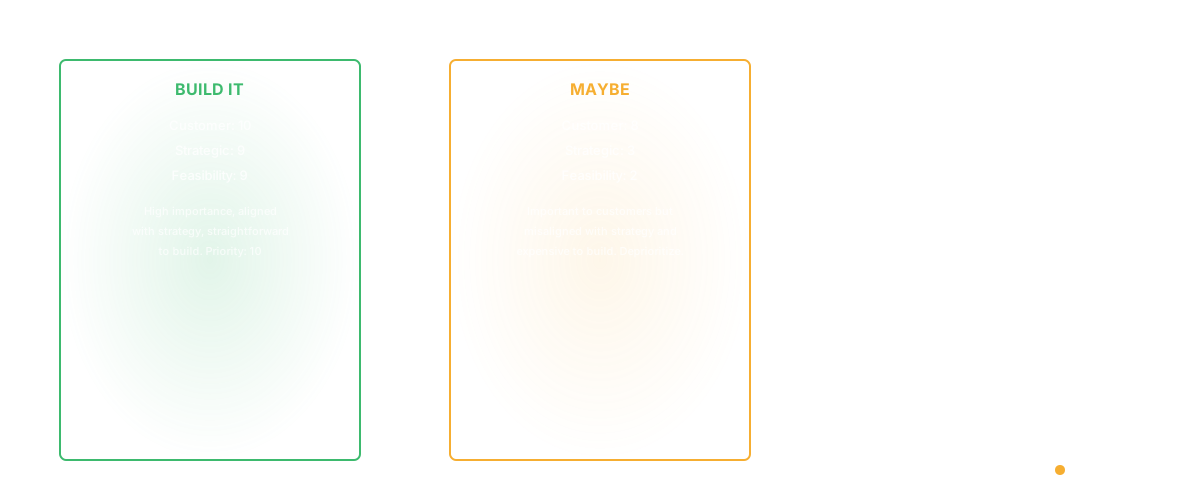
Then look at the scores. A feature that's 10 on customer importance, 9 on strategic alignment, and 9 on feasibility? That's a 10 overall priority. Build it.
A feature that's 8 on customer importance, 3 on strategic alignment, and 2 on feasibility? Maybe that stays off the roadmap. Or maybe you decide the customer importance is high enough that you're willing to invest in the architecture. But you make that choice consciously.
A feature that's 5 on customer importance, 7 on strategic alignment, and 8 on feasibility? That goes on the roadmap, maybe not immediately, but soon.
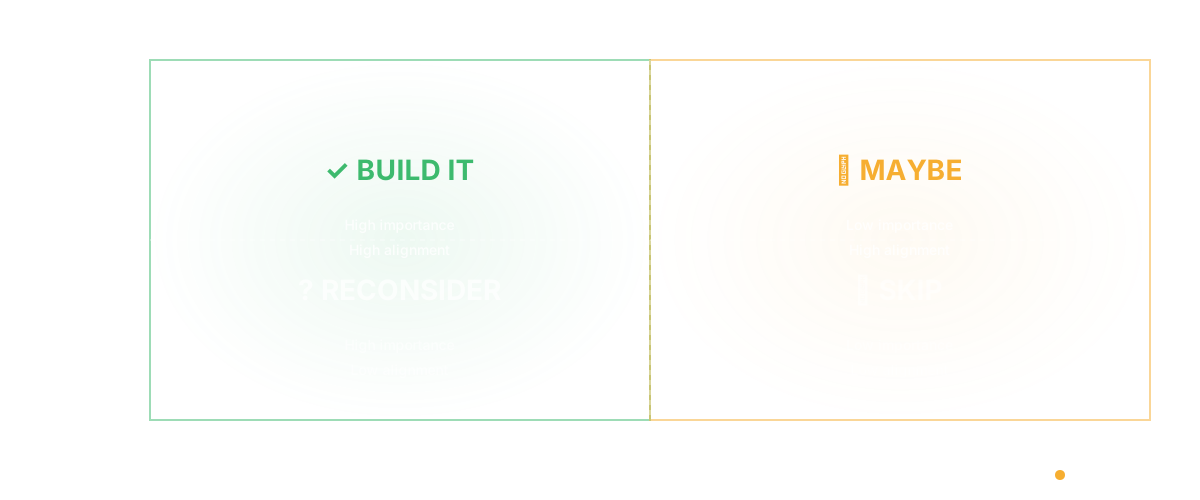
Understanding Your Scoring
How do you know if your scores make sense? Here are three real examples:
The PM's Gap: Understanding Your Own Constraints
Here's what I realized: most PMs can assess customer importance and strategic alignment. The gap is usually in feasibility assessment. And that's not because PMs are bad at thinking about architecture. It's because they don't have visibility into what their actual constraints are.
When I could see the codebase, when I understood which systems were stable and which were planned for refactor, when I could ask "what would this actually touch?" and get a clear answer, my feasibility assessments got much better.
This is one of those places where knowing the codebase changes everything. I stop recommending features blindly. I make recommendations rooted in reality.
Frequently Asked Questions
Q: Should we include cost as a fourth dimension? A: Implicitly yes, through feasibility. If something is a 10 on importance and alignment but requires three months of infrastructure work, the cost is embedded — and dependency mapping helps quantify that cost. You could add it as a separate dimension if you track engineering capacity differently, but usually feasibility captures it. The feasibility assessment should include "what else wouldn't we ship to build this?"
Q: What if a feature is important to customers, but breaks our strategic positioning? A: This is where you push back on the market and own your position. You say no. This is your job. If you say yes to everything that customers ask for, you dilute everything you're good at. The feature gap analysis is where you actually make strategic choices. Sometimes the choice is "we're going to be known for something else."
Q: How do we know if we're assessing feasibility correctly if we don't code? A: You ask the engineers who know the system best. Not in a planning meeting. You get curious. "If we wanted to build this feature, what parts of the codebase would it touch? How stable are those parts? What kind of rework would it require?" Codebase intelligence tools can also surface this data directly — showing code dependencies, complexity, and ownership patterns. Listen to how they talk about it. If there's a lot of uncertainty, there's probably high feasibility uncertainty. If they can quickly map it out, there's probably low risk. And over time, you'll learn your own codebase's patterns. Which systems are stable. Which are messy. Which get refactored frequently.
Related Reading
- AI Product Discovery: Why What You Build Next Should Not Be a Guess
- Product Intelligence Platform: What It Is and Why You Need One
- AI for Product Management: The Difference Between Typing Faster and Thinking Better
- The Product Manager's Guide to Understanding Your Codebase
- Product OS: Why Every Engineering Team Needs an Operating System
- Software Productivity: What It Really Means and How to Measure It
- What Is Competitive Gap Analysis?
- What Is a Feature Inventory?
- Glue for Competitive Gap Analysis
- Glue for Feature Discovery