Comparison
Swimm is manual code documentation. Glue generates docs automatically from code. Compare approaches to keeping documentation current for engineers and PMs.
I've evaluated dozens of engineering tools across three companies. What matters isn't the feature list — it's whether the tool actually changes how your team makes decisions.
Swimm is a code documentation platform that helps engineers write and maintain documentation that stays synced with the codebase. Glue generates codebase documentation automatically from the code itself and makes it accessible to non-engineers. Both address "documentation problems" but at different points and for different audiences. Swimm documents code FOR engineers. Glue makes code understandable TO non-engineers.
Swimm helps engineering teams create documentation about how code works. Engineers write "playbooks" and "documents" that reference specific code snippets, flows, and patterns. Documentation stays synced with code through automated checks - if code changes, Swimm alerts the author that documentation needs updating. Swimm's editor integrations let developers access documentation without leaving their IDE.
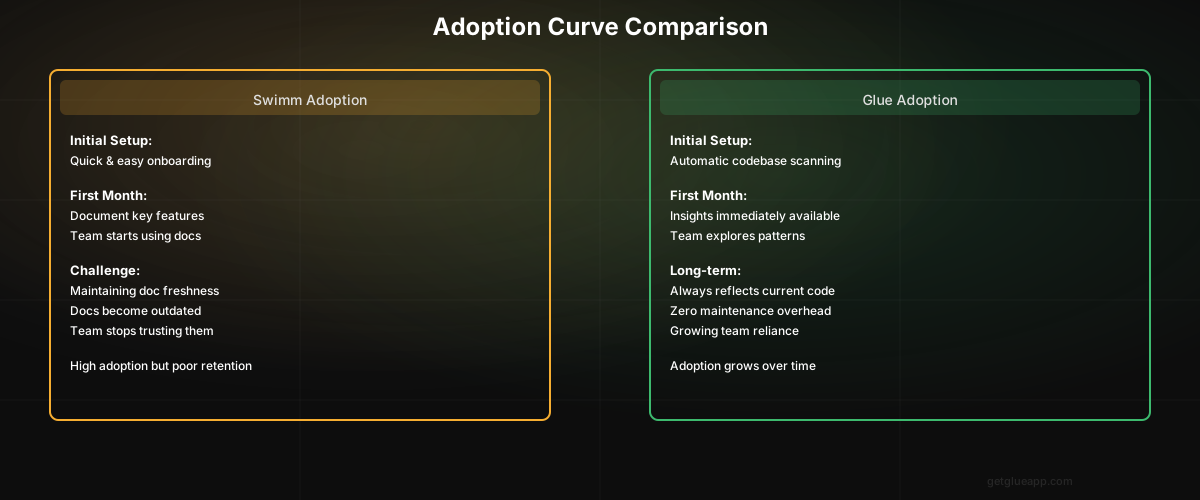
Swimm solves the "engineers don't understand each other's code" problem. It's powerful when your primary documentation problem is internal: new hires, context transfer between engineers, shared understanding of complex flows. The documentation is written by engineers, for engineers, with the specific goal of explaining how to work in the codebase.
Swimm requires ongoing engineering effort. Developers need to write and maintain documentation. But once written, it's accurate and accessible to anyone on the team.
Glue generates codebase documentation automatically by analyzing the code itself. You ask questions: "what does the checkout flow do?" "what's in the payments module?" "who owns each service?" Glue analyzes your codebase and answers in natural language. You don't write documentation - it's generated from the actual code on demand.
Glue solves the "PMs don't understand the codebase" problem. It's designed for people who don't read code but need to understand it for product decisions. A PM can ask Glue "what changed last sprint?" and get an accurate answer about which modules were touched, not a manually maintained document that's probably out of date.
Glue requires zero ongoing documentation maintenance. The documentation is always current because it's generated from the code.
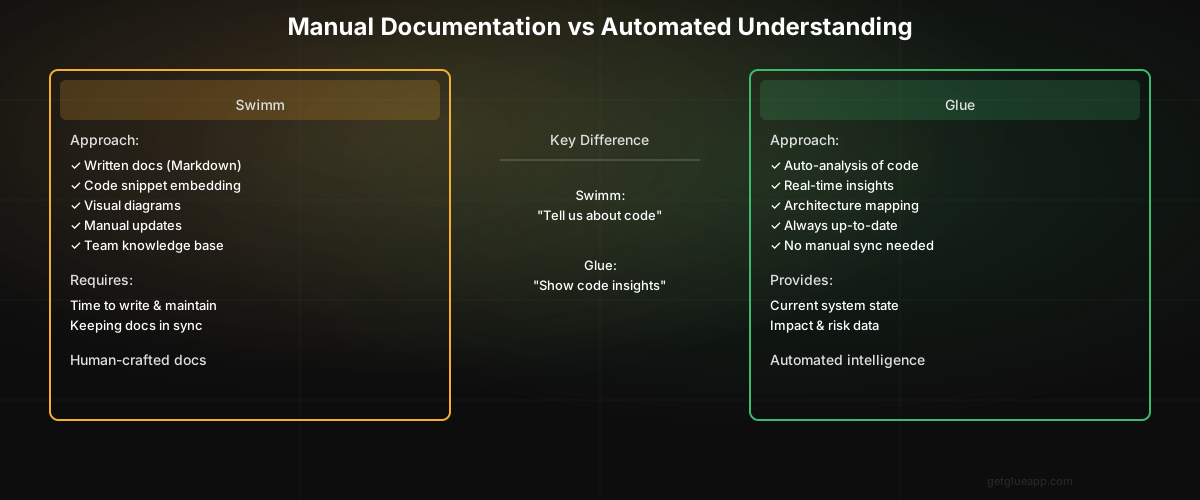
Swimm is about engineers documenting code FOR other engineers. Glue is about making code understandable TO non-engineers.
| Capability | Swimm | Glue |
|---|---|---|
| Documentation created by | Engineers | Automated analysis |
| Documentation maintenance | Manual | Automatic |
| Primary users | Developers | PMs, engineering managers |
| Explanation of flows | Hand-crafted | Generated from code |
| Editor integration | Yes | No |
| Natural language questions | No | Yes |
| Current by default | Requires discipline | Yes |
| Code review integration | Yes | No |
| Time to value | Weeks | Hours |
Choose Swimm if: your primary problem is engineers not understanding each other's code. You want to formalize knowledge about complex flows that only senior engineers understand. You have the engineering resources to maintain documentation and want that documentation in the IDE. You value hand-crafted explanations and architectural context.
Choose Glue if: your primary problem is PMs not understanding technical constraints. You need codebase documentation without engineers writing and maintaining it. You want non-engineers asking questions about the code. You want documentation that's guaranteed to be current. You want answers in hours, not weeks.
| Feature | Swimm | Glue |
|---|---|---|
| Code documentation | Engineer-written, synced with code | Auto-generated from code analysis |
| Documentation maintenance | Manual (with auto-sync alerts) | Fully automatic |
| IDE integration | VS Code, JetBrains, GitHub | Web-based interface |
| Code tours | Guided interactive walkthroughs | Not available |
| PR documentation | Auto-generated PR summaries | Not applicable |
| Natural language Q&A | Not available | Ask anything about your codebase |
| Dependency mapping | Not available | Full dependency graph |
| Code ownership | Not available | Git-history-derived ownership |
| Knowledge silo detection | Not available | Identifies knowledge concentration |
| Bus factor analysis | Not available | Calculates bus factor per module |
| Feature discovery | Not available | Catalogs product features from code |
| Primary audience | Engineers | PMs, Engineering Managers, CTOs |
| Time to value | Weeks (requires writing docs) | Hours (automatic analysis) |
Every engineering team wants better documentation. Few engineering teams write it. This is not laziness — it is economics. Writing documentation takes time away from shipping features. Maintaining documentation takes even more time. And documentation that drifts from reality is worse than no documentation because it creates false confidence.
Swimm addresses this with smart sync: documentation references specific code, and when that code changes, Swimm alerts the author. This is genuinely better than traditional docs. But it still requires someone to write the documentation in the first place.
Glue takes a different approach entirely: there is no documentation to write. Instead, the system analyzes the code and answers questions on demand. The "documentation" is generated in real-time from the actual state of the codebase.
Swimm's approach works when:
Glue's approach works when:
Both Swimm and Glue significantly improve developer onboarding, but differently:
Swimm onboarding: New engineers follow curated code tours created by senior engineers. They read documentation about key systems written by people who understand them deeply. The quality of onboarding depends on the quality of documentation already written. If the authentication module has a great Swimm doc, onboarding to auth is fast. If the billing module has no Swimm docs, onboarding to billing is slow.
Glue onboarding: New engineers ask questions directly. "How does the authentication flow work?" "What services depend on the user module?" "Who should I ask about the payment system?" Every module is equally accessible because the analysis is automatic. There are no gaps based on which modules have been documented.
The ideal setup for large teams: Swimm for deep architectural context written by senior engineers, Glue for everything else — quick answers, cross-cutting questions, and making the codebase accessible to the broader team.
Q: Can we use both Swimm and Glue?
Yes. A team might use Swimm for deep architectural documentation written by senior engineers and Glue for quick, on-demand questions from PMs. Swimm provides context; Glue provides accessibility.
Q: Does Glue require engineers to use it?
No. Glue's primary users are PMs and managers. Engineers can use it too, but it's not designed as an engineer-facing tool.
Q: Can Glue replace Swimm?
Depends on your problem. If you need engineers understanding each other's code, Swimm is better - it provides hand-crafted context that automated analysis misses. If you need PMs understanding the codebase, Glue is the answer.
Q: Which is more current?
Glue is always current because it analyzes the live codebase. Swimm is current only if engineers keep it updated. Both can drift - Swimm through neglect, Glue theoretically never.
Keep reading
Related resources