Glossary
Learn how engineering feedback loops drive improvement. Master tactical loops (fast) and architectural loops (insightful) for compound velocity gains.
At Salesken, our feedback loop from production to planning was broken. Incidents happened, we fixed them, but the lessons rarely made it back to sprint planning.
An engineering feedback loop is the cycle through which engineering teams receive information about the quality and impact of their work and use that information to improve future decisions. It encompasses multiple nested loops: tactical loops (does this test pass? does this deploy work?) and architectural loops (does this system remain stable? should we change how we build this type of system?).
A mature engineering feedback loop has fast tactical loops (test results in seconds, deployments in minutes) and intentional architectural loops (quarterly codebase health reviews, post-mortems that drive architectural change). The problem with most loops is that they're optimized for speed at the tactical level but invisible at the architectural level.
Feedback loops drive learning and improvement. Fast feedback loops enable rapid iteration. Insightful feedback loops enable long-term improvement.

Most teams excel at tactical loops. CI/CD is fast. Tests run quickly. Deployments are frequent. But architectural loops - "do the signals from production inform long-term architectural decisions?" - are rare.
This creates a pattern: teams stay operationally responsive (incidents are handled quickly) but don't improve structurally (the same types of incidents keep recurring, the same code areas keep causing issues, the same architectural patterns keep causing pain).
A mature engineering feedback loop connects these. Tactical signals (test results, deployment success, error rates) inform architectural decisions (is this module architecture working? Do we need to refactor? Do we need to change how we approach this type of problem?).
For product leaders, this means engineering velocity doesn't just stay high - it compounds over time. Teams don't just respond to problems - they get better at not creating them.
Code Review Loop
Developers propose changes. Peers review. Feedback is provided. Code is refined. Changes are merged. Loop time: hours.
Purpose: catch bugs before they ship, enforce standards, spread knowledge.
Testing Loop
Tests run automatically. Pass or fail feedback is immediate. Developers refine code. Loop time: seconds to minutes.
Purpose: catch bugs before deployment, ensure behavior, prevent regressions.
Deployment Loop
Code is deployed to production. System metrics start flowing in. Error rates, latency, traffic patterns become visible. Loop time: minutes to hours.
Purpose: understand real-world behavior, catch integration issues, measure impact.
Monitoring Loop
Production systems are monitored continuously. When metrics deviate (error rate spikes, latency increases), alerts fire. Engineers respond. Loop time: minutes to hours.
Purpose: detect failures in real-time, ensure reliability, catch unknown unknowns.
These are fast loops. Modern teams are good at these. The problem: they're all operational. They catch what's broken right now. They don't address why the same types of problems keep occurring.
This is the loop most teams don't have.

Example: Your payment system has had three major incidents in the past six months. Each was rooted in a different trigger (a timeout, an edge case, a race condition), but all three were rooted in the same architectural problem: the system was designed assuming synchronous request-response patterns, but it's operating in an asynchronous environment.
Without a meta-loop: each incident gets fixed. The system stabilizes temporarily. Six months later, a different incident surfaces. Same root cause, different trigger.
With a meta-loop: after the second incident, you ask "are we seeing a pattern?" The answer is yes. You don't just fix the current incident - you address the architectural problem. You redesign the system to handle asynchronous patterns properly.
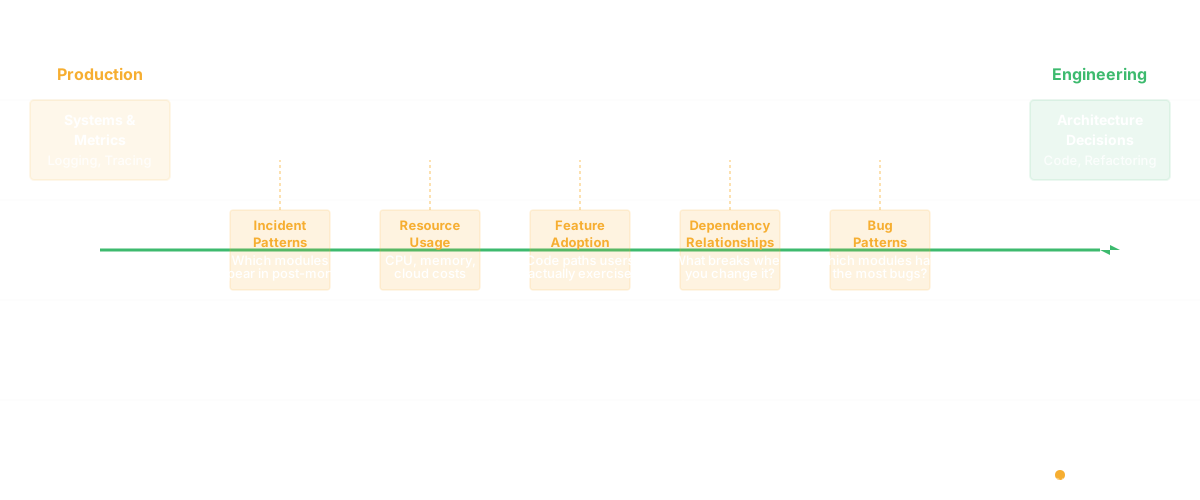
The meta-loop requires:
Standard monitoring gives you operational signals: error rate, latency, incident frequency. These are invaluable. But they're context-light.
Codebase intelligence adds context. When an incident fires, you don't just know "payment service error rate is high." You know:
This context transforms feedback loops. Instead of responding to an alert, you're investigating a signal with full context. Instead of assuming the fix will work, you understand the architectural factors that created the problem.
Fast feedback loops are always better: Fast feedback is good for tactical loops (tests, CI). But architectural feedback requires reflection time. The question "is our system architecture working?" can't be answered in seconds. It requires looking at patterns over weeks or months.
Feedback loops are only about responding to problems: False. They can be about noticing emerging risks. Feedback loops can signal "our test coverage is declining" before it causes test failures. They can signal "this module is getting complex" before it causes bugs.
We have good feedback loops because we have fast CI/CD: Not necessarily. Fast tactical loops don't guarantee good architectural loops. You might deploy quickly but keep making the same architectural mistakes.
Q: How often should we run the meta-loop (architectural feedback)?
Once a quarter is typical. Review signals from the past quarter: what patterns emerged? Did the same types of incidents occur? Are certain systems showing degradation? Did complexity increase in critical paths? Use that to inform the next quarter's work.
Q: What if we don't have the data to close feedback loops?
Start tracking. Pick a critical system. Start monitoring (error rate, latency, incident frequency, change frequency). In three months, you'll have data. In six months, you'll see patterns.
Q: Does this require special tools?
Partially. Some feedback loops are free (CI/CD is usually built-in). Some require monitoring tools. The meta-loop benefits from codebase intelligence tools that surface architectural context. But most of it is practice - asking the right questions regularly.
Keep reading
Related resources
Blog