Glossary
Agile estimation uses relative units and velocity trends to forecast iteratively. Learn story points, throughput forecasting, and Monte Carlo probability.
I've shipped hundreds of estimates across three companies. My accuracy improved dramatically when I stopped relying on gut feel and started using historical data from our actual codebase.
Agile estimation is the practice of predicting work effort in iterative software development cycles, typically using relative units (story points, t-shirt sizes like Small/Medium/Large, or no estimation at all via the #NoEstimates movement) rather than absolute time estimates in hours or days. Agile estimation embraces uncertainty by using probabilistic forecasting methods (like Monte Carlo simulation) to predict sprint outcomes and delivery timelines. The philosophy is fundamentally different from traditional project estimation: instead of predicting "this will take 14 weeks," agile teams forecast "we'll likely complete 40-50 points per sprint, so a 100-point feature should deliver in 2-3 sprints."
Agile estimation's core value is not prediction accuracy ( - ) agile estimates are frequently wrong ( - ) but continuous recalibration. By re-estimating every sprint based on actual completed work (velocity), teams adapt to reality rather than defending a plan made weeks ago. A team that estimated 120 days for a project upfront and misses by 40 days learns the lesson too late. An agile team that forecasts based on rolling velocity catches estimation bias in the first sprint and adjusts.
Product managers should understand that agile estimation methods shift the question from "exactly how long will this take?" to "how confident are we in this timeline?" Confidence changes based on velocity trends, scope uncertainty, and team changes. Instead of forcing a commitment to a fixed date, agile forecasting allows PMs to communicate realistic timelines and respond to changes without replanning the entire roadmap.
Engineering managers use agile estimation to set expectations and manage scope. "We're completing 45 points per sprint. The feature is scoped at 120 points. That's 2.7 sprints, or about 6 weeks." If business requirements expand to 180 points, the forecast becomes "9 weeks, or we need to reduce scope." This clarity helps product and engineering align on trade-offs.
A mobile app company using Scrum and story points runs a sprint planning meeting for a feature sprint: "Add a new in-app messaging system." The product manager brings a list of user stories:
Total: 42 points of work.
The team's recent velocity: 38 points per sprint (averaged over the past 4 sprints).
Forecast: 42 points ÷ 38 points/sprint = 1.1 sprints. The feature fits in the upcoming sprint with room for 3-4 points of buffer (about 10% contingency).
Sprint execution: Week 1 ( - ) the team completes real-time message delivery (8 points) and message history (3 points) = 11 points. Week 2 ( - ) complete message sending (5 points) and notifications (5 points) = 10 points. Week 3 ( - ) backend infrastructure (13 points). Week 4 ( - ) admin dashboard (8 points) + user testing + bug fixes.
Actual sprint result: 39 points completed, one story (admin dashboard) carried over to the next sprint.
Learning: The team forecasted 38 points capacity based on historical velocity, came in at 39. The forecast was accurate. Admin dashboard was estimated at 8 points but required more work than expected ( - ) next sprint, they'll refine how they estimate admin features.

Choose an Estimation Method.
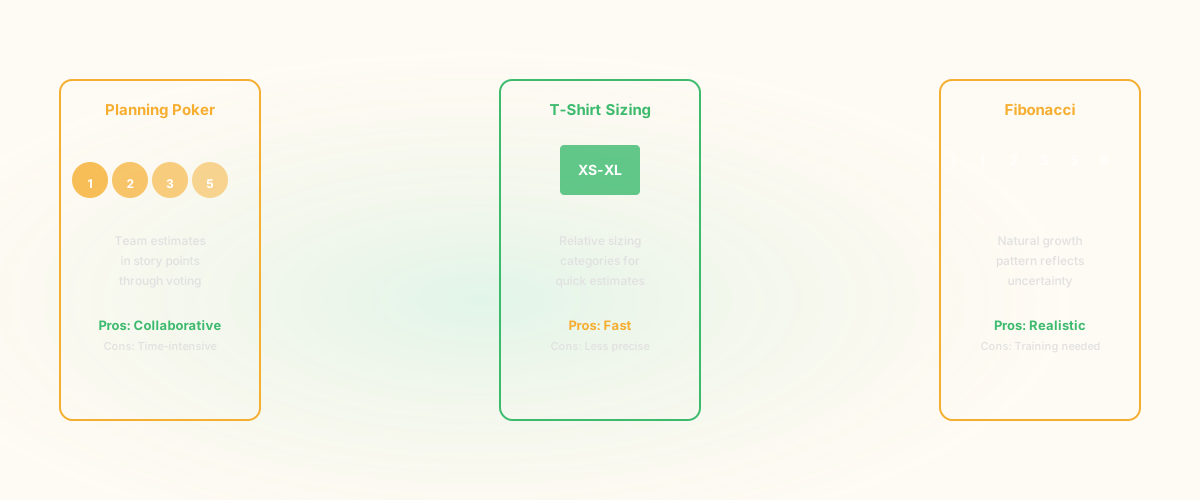
Story Points (Fibonacci): Relative sizing using the Fibonacci sequence (1, 2, 3, 5, 8, 13, 21, 34...). Most popular in Scrum teams. Requires calibration and can be gamed.
T-Shirt Sizing: XS, S, M, L, XL, XXL. Faster than story points, less precise, works well for high-level planning. Convert to points later if needed (XS = 1, S = 2, M = 5, L = 13, etc.).
#NoEstimates: Don't estimate individual stories; instead, forecast based on throughput (number of stories completed per sprint). Works well for teams with consistent story size. Doesn't work if story size varies widely.
3-Point Estimation: For each story, estimate optimistic (O), pessimistic (P), and most-likely (M). Forecast = (O + 4*M + P) / 6. Accounts for uncertainty. More thorough than single-point estimates but takes longer.
Choose the method that your team can sustain without overhead becoming a burden. If estimation meetings take 4 hours per sprint for a two-week sprint, you're overweighting estimation.
Track Velocity and Forecast Trends. Velocity = total points completed in a sprint. Track it every sprint. Plot a trendline over 6-8 sprints. Is velocity stable (±5 points per sprint)? Trending up (team improving)? Trending down (team hitting obstacles, accumulating technical debt)? Use the trend to forecast, not just the most recent sprint.
Example: Velocity has been 35, 38, 40, 39, 37, 36 over six sprints. Average is 37.5. You can forecast with confidence that the team will complete approximately 37-38 points next sprint. If you need to complete 120 points, that's 3.2 sprints with 95% confidence, 3.8 sprints with extreme safety.
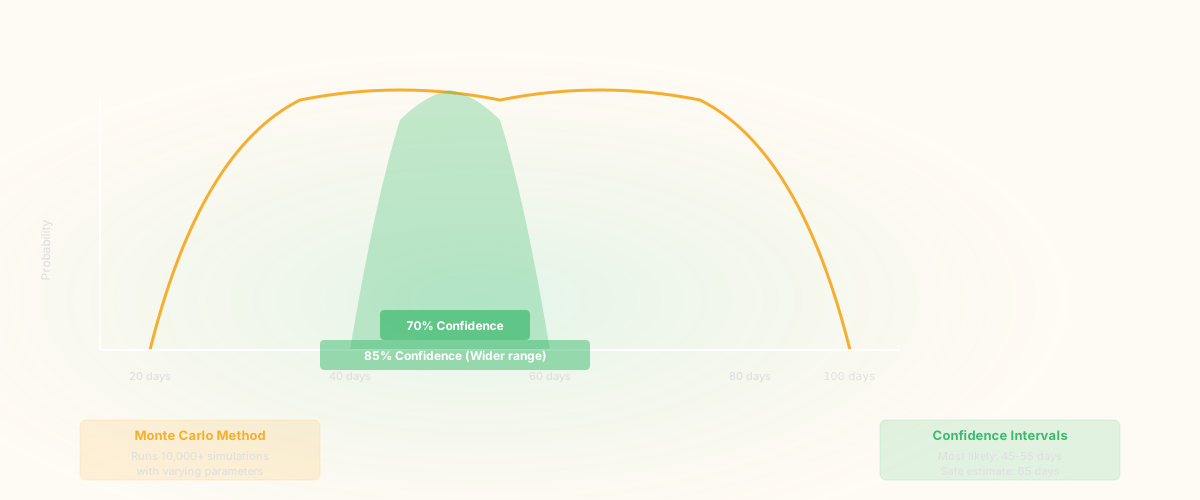
Use Probabilistic Forecasting for Major Deliverables. Monte Carlo simulation: Assume your team's velocity varies normally around the average (mean = 37, standard deviation = 2). Run a simulation 1,000 times, each time assigning a random velocity from the distribution and asking "how many sprints until we complete 120 points?" The results show: 10th percentile = 2.8 sprints (optimistic), 50th percentile = 3.2 sprints (median), 90th percentile = 3.8 sprints (pessimistic). This gives PMs a realistic range for commitment.
Many tools (Jira, Azure DevOps) have Monte Carlo built in. Use it for major feature forecasts.
Recalibrate Estimates When Reality Diverges. If a story estimated at 5 points consistently takes 13 points of work, the estimation is biased. Quarterly, compare estimates vs. actual completion time. Adjust your reference frame. If "5-point stories" used to take 3 days but now take 5 days, your team has either grown in complexity or lost productivity. Investigate and recalibrate.
Misconception 1: Agile estimation is more accurate than traditional estimation. Correction - agile estimation is not more accurate in the short term. A single-sprint forecast might be off by 20%. But agile estimation is more accurate over time because it recalibrates every sprint. A team that forecasts wrong in sprint 1 corrects course in sprint 2. A team that estimated a project upfront and missed by weeks has no recourse.
Misconception 2: Higher velocity always means the team is more productive. Correction - velocity only compares work completed across sprints with the same team. Velocity increasing from 35 to 50 could mean the team is more productive, or it could mean stories were re-estimated to be larger (point inflation), or the team reduced their quality standards. Velocity is a capacity signal, not a productivity signal.
Misconception 3: Once you have a velocity baseline, you can predict project timelines with confidence. Correction - velocity is useful only if it's stable and if the work is similar to historical work. When you're building something new (first time integrating a new technology, entering a new market, rebuilding a core system), historical velocity is a poor predictor. Be humble about confidence in forecasts when venturing into unfamiliar territory.
Q: Our velocity bounces between 20 and 50 points per sprint. How do we forecast? Use the median or 10th percentile of velocity distribution, not the mean. If velocity is 20, 35, 50, 22, 48, 25 over six sprints, the median is 30. Forecast with 30 points per sprint for major timelines. Investigate why velocity is unstable ( - ) are interruptions variable? Does team size vary? Are stories inconsistently estimated? Solving the instability is more valuable than improving forecast techniques.
Q: We're using story points, but our stakeholders want time estimates. What do we do? If required to translate points to time, establish a historical conversion: "Our 5-point stories take an average of 3 days to complete." Then multiply: 100 points = 20 stories = 60 days calendar time. But make clear this is an estimate range, not a commitment. Better: educate stakeholders on why velocity-based forecasting is more robust than time estimates.
Q: How do we handle external dependencies in agile estimation? Add a buffer to your velocity-based forecasts when external dependencies exist. If your team's velocity is 40 points and a feature depends on a third-party API that takes 1-2 weeks to integrate, add 2 weeks of calendar time to the forecast (1-2 weeks waiting, overlap with other work). Track actual dependency latency and adjust the buffer in future forecasts.
Keep reading
Related resources