Glossary
Scope creep is uncontrolled expansion of project scope mid-development. Learn how to prevent it with codebase visibility and architectural clarity.
At every company I've led, scope creep was the silent killer of sprints. At Salesken, I tracked it explicitly — 40% of our sprint overruns were caused by requirements that expanded after planning.
Scope creep is uncontrolled expansion of a project's scope beyond its original definition. It happens when requirements change, new features are added, or edge cases are discovered after a project has already begun.
Example: "We're building an export feature." Original scope: export as CSV, basic fields. Mid-project, a stakeholder asks: "Can we export as Excel too?" Then: "Can we support custom field selection?" Then: "Can we schedule exports?" Scope has crept from 2 weeks of work to 5 weeks.
Scope creep isn't always bad. Sometimes new requirements emerge that are important. Sometimes you discover edge cases that need handling. But uncontrolled scope creep is a project killer.
Scope creep causes three problems:
First, it breaks schedules. When scope expands but timeline doesn't, something gives. Usually it's quality (testing is skipped) or velocity (people work nights/weekends, leading to burnout). Either way, projects that suffer scope creep usually miss deadlines.
Second, it erodes team morale. Engineers estimate 2 weeks of work. Halfway through, scope expands. The finish line moves. This happens repeatedly. Teams get demoralizedwhat they're asked to deliver keeps changing. Morale suffers.
Third, it wastes resources. Uncontrolled scope creep means projects take longer and cost more. Budget that should go to next quarter's work goes to finishing this quarter's work.
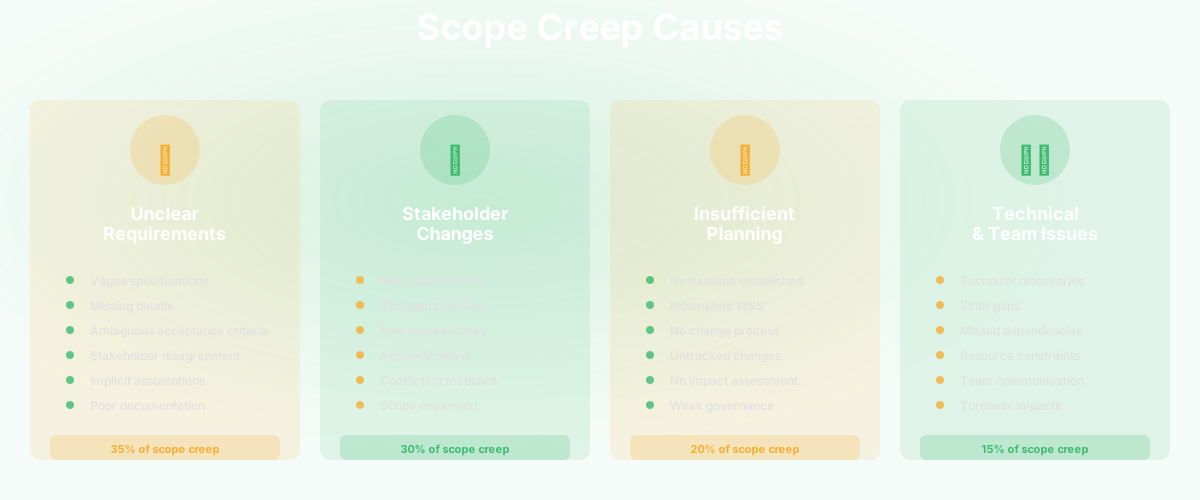
Unclear requirements: Requirements aren't documented or agreed-upon upfront. What seems obviously in-scope to one person seems out-of-scope to another. Mid-project, disagreement surfaces.
Evolving understanding: As you build, you discover things. "Oh, we should also handle X because of Y." These discoveries feel important and hard to push back on.
Stakeholder changes: Different stakeholder priorities surface. A leader sees the feature and thinks of a use case it should support. Instead of pushing back, you add it.
Underestimation: The project is harder than expected. To make progress, you cut scope. But often scope doesn't get cut, timeline extends. That's scope creep in reverse (the work expands to fill time).
Gold-plating: The team decides to "do it right" by adding polish or edge case handling that wasn't in scope. Well-intentioned scope creep, but creep nonetheless.
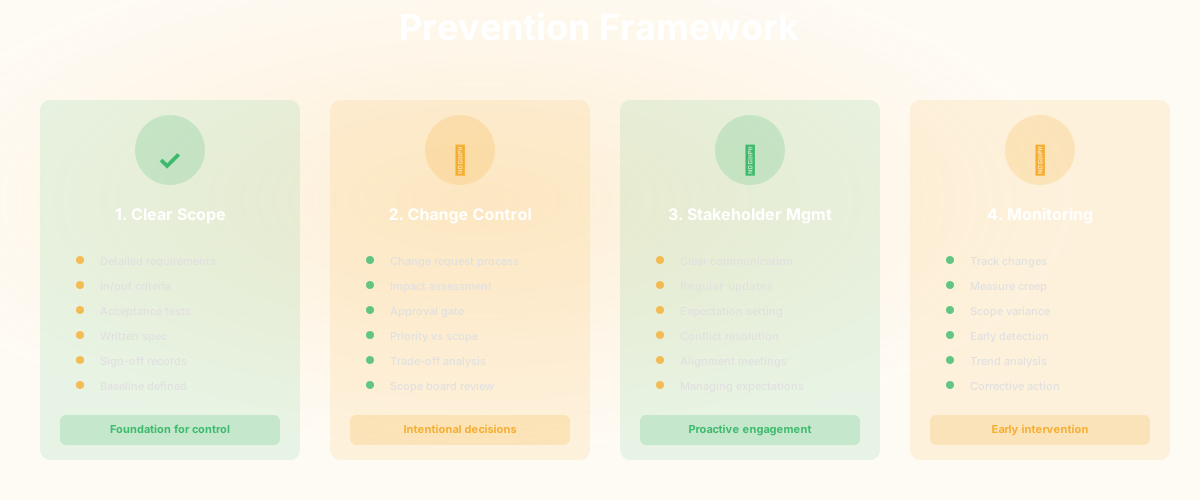
1. Define scope explicitly upfront. "Here's what's in scope. Here's what's explicitly out of scope." Get agreement from all stakeholders. Write it down.
2. Have a change control process. When new requirements emerge mid-project, don't just add them. Discuss: Is this in scope? If not, is it important enough to be? If yes, what gets cut to make room?
3. Protect the schedule. Scope creep trades time for completeness. If you have fixed timeline and budget, be disciplined about what makes it in. "That's a great idea, but it's out of scope for this release. Let's add it next time."
4. De-risk upfront. In planning, ask: "What could we discover that would expand scope?" API requirements? Third-party dependencies? Regulatory constraints? Try to discover and understand these upfront rather than mid-project.
5. Define "done" clearly. What does it mean for this feature to be shipped? Does it need documentation? Does it need a knowledge base article? Does it need a tutorial? Define this upfront so there's no ambiguity at the end.
6. Build incrementally. Scope creep is easier to prevent if you're not building everything at once. Ship the core feature. Then add enhancements. If you discover something important, you can add it in the next iteration without derailing the current project.
Scope creep = uncontrolled expansion of a fixed project.
Iteration = intentional cycles of build, learn, improve.
With scope creep, you commit to 2 weeks, then keep adding work, then miss the deadline.
With iteration, you commit to 2 weeks, ship something, learn, then plan the next iteration. Each iteration is separate.
The difference is: planned vs. unplanned change.
"Scope creep is always bad." Not always. Sometimes new requirements are more important than original scope. The problem isn't adding work - it's adding work without cutting something else or adjusting timeline. Conscious scope changes are fine. Unconscious ones are the problem.
"We can prevent scope creep by being strict." You can reduce it, but you can't eliminate it. Some requirements will emerge. The goal is: minimize scope creep, handle it consciously when it happens, and protect schedule/quality.
"Scope creep only affects engineering." It affects everyone. Product managers spend more time planning. Design spends more time iterating. Support spends more time training users on features that grew beyond spec. It's a team problem.
"Agile prevents scope creep." Agile reduces it. Instead of one big project with creeping scope, you have small sprints with smaller risk of creep. But each sprint can still experience scope creep if not managed.
Q: How do we handle scope creep in Agile? A: In Agile, scope creep manifests as: work items growing in complexity mid-sprint, or new items being added mid-sprint. Solutions: strict sprint boundaries (once sprint starts, no new work gets added), regular retros to discuss creep, and honest pointing (if scope expanded, the story should be repointed).
Q: What if we don't have a choice? Scope is fixed, timeline is fixed, and requirements keep changing. A: That's a broken constraint. You can't satisfy all three (scope + timeline + quality) simultaneously. Something has to give. The question is: which? Usually quality is sacrificed first. Push back on stakeholders: "We can fix scope, extend timeline, or reduce quality. Which?"
Q: How do we get stakeholders to accept the idea that scope is fixed? A: Show them the data. "Last time we said scope was flexible, we missed the deadline and burned out the team. This time, scope is fixed. New great ideas go in the next release." Most stakeholders prefer a shipped feature on time to a delayed feature with everything they dreamed of.
Keep reading
Related resources