
AI product discovery uses codebase intelligence and market signal analysis to replace guesswork in deciding what to build next. Traditional product discovery fails because it operates without two critical inputs: the real technical constraints embedded in code architecture and the competitive feature gaps visible only through systematic analysis. AI-powered discovery connects customer demand signals with codebase reality—dependencies, technical debt, architectural constraints—to produce roadmap decisions grounded in what's actually buildable.
I've been in that roadmap meeting a hundred times. The customer says they need something. The data suggests it matters. Engineering says it'll take longer than you thought. You nod, push back, someone suggests a compromise, and everyone leaves with a plan that nobody fully believes in.
The problem isn't that people are bad at their jobs. The problem is that product discovery — figuring out what to build — is fundamentally incomplete without two pieces of information that are almost never in the same room.
One: real signals about what customers actually do. Not what they say in interviews. What they actually do, measured.
Two: real understanding of what your codebase can actually deliver. Not estimates. Not general software engineering knowledge. What your specific system can handle, in what timeframe, at what cost.
At Salesken, where I was CTO building real-time voice AI, we had a roadmap meeting in 2023 where we decided to deprioritize multi-language support because engineering estimated it at 4 months. That estimate was based on the assumption that we'd need to rebuild the coaching engine per language. Nobody checked whether the coaching engine was already language-agnostic (it was — it operated on transcribed text, not audio). We lost two months of lead time on a feature that actually required 3 weeks.
That's what happens when technical reality is invisible during discovery.
What Product Discovery Actually Is
Product discovery is the process of figuring out: given our customers, our strategy, and our constraints — what should we actually build next?
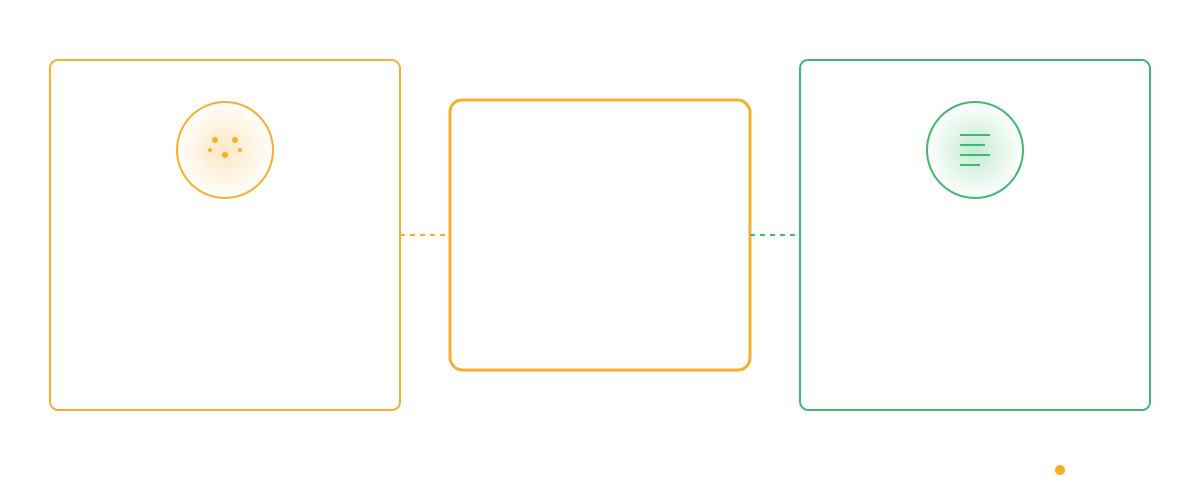
Three parts. Understanding what customers need (customer reality). Understanding what we can build (technical reality). Understanding what matters to the business (strategic reality). Then synthesizing all three into a decision.
Most teams shortcut this. They gather customer feedback, build a roadmap in a spreadsheet, and hand it to engineering. At UshaOm, where I led a 27-engineer e-commerce team, we did exactly this for two years. The result: features that took twice as long as expected and customers who said "that's not what we needed" about 30% of what we shipped.
Why does this happen? Because full discovery is hard. Customer research is time-consuming. Engineering estimates are imprecise. And most teams don't have a structured process for it. You rely on intuition, judgment, and whoever talks loudest in the meeting.
That works when you're small. When your whole company is 20 people and everybody knows everybody else's constraints, discovery happens naturally through hallway conversations. When you scale, it falls apart. Product and engineering stop sharing context. Customer signals get lost in Slack. Technical constraints get communicated through estimates that are really just guesses.
The Two Gaps That Kill Product Decisions
Even when teams do discovery well, they're working with incomplete information.
Gap one: customer signal. Your team has a sense of what customers want, but it's filtered. You hear from your largest customers in sales calls. You see patterns in support tickets. You might run surveys. But you're missing the long tail — the customers who are quiet but frustrated, the behaviors that contradict what people say in interviews.
Tools exist for this. Pendo, Amplitude, PostHog — these solved the problem of making customer behavior visible. If you're a modern product team, you're probably using something here. The data shows where people get stuck, what features they use, where they drop off.
Gap two: technical reality. When your data shows customers dropping off at a particular point, you still have to ask — can we actually fix this? How long would it take? What would it break?
Right now, you answer those questions by asking an engineer. You get an estimate. The estimate is made without full context. You push back. They push back. You end up with a negotiated guess.
Or — and this happened to us at Salesken more than I'd like to admit — you start building, and halfway through hit a constraint nobody saw coming. Some architectural decision from 2020 means your elegant solution won't work. Now you're redesigning on the fly.
All of this happens because technical reality — what your specific codebase can actually do — is invisible during discovery.
Closing the Technical Reality Gap
This is where codebase intelligence changes things.
When your behavioral data shows customers dropping off at the import step, you don't just need to know that. You need to know: why are they dropping off (customer reality), and what would it actually take to fix it in our system (technical reality).
Right now, those two conversations happen in different meetings, with different people, using different language. With codebase intelligence — tools that understand your architecture, your patterns, your constraints — you can have both conversations at the same time.
You can ask: "Customers are dropping off when they try to import data with special characters. What's the constraint?" The tool doesn't just give you an estimate. It says: "Your validation logic treats special characters as invalid. That's a design decision from 2019 to prevent SQL injection. You could relax it by adding prepared statement checks — that's 2-3 days. Or add a pre-import sanitization step — 1 day, but slower for users."
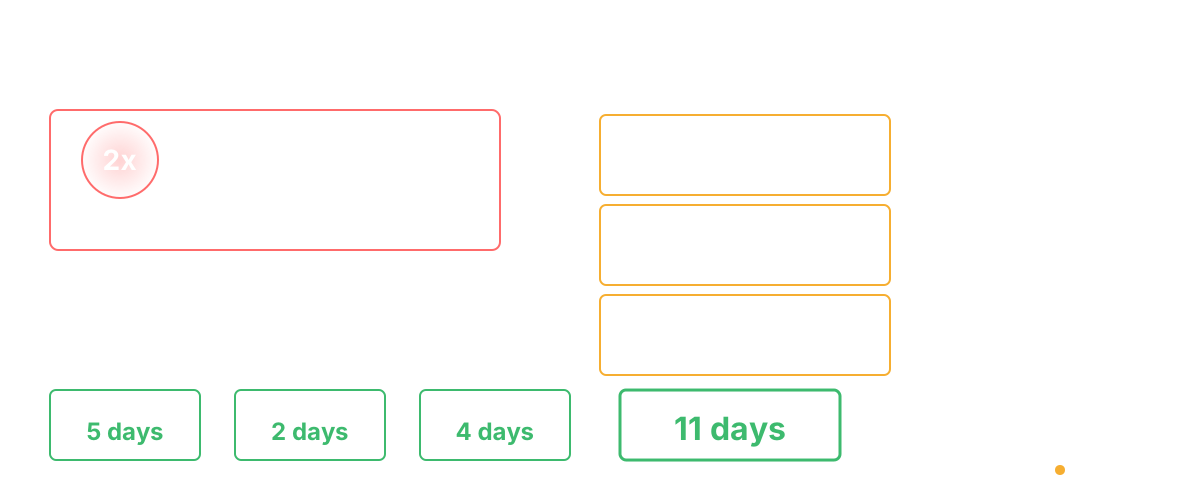
Now you have real options. You can discuss tradeoffs with engineering in specific terms. You can estimate accurately. You can talk to the customer about what's actually coming and when.
What AI-Powered Discovery Looks Like
Let me walk through a concrete example.
You're a PM at a B2B data company. Behavioral data shows API customers churn at 2x the rate of UI customers. The churn happens in the first 30 days. Support tickets reveal three recurring issues: unclear rate limiting, unhelpful error messages, and data validation that fails silently.
Without codebase intelligence: You ask engineering "can we fix the API experience?" They estimate four weeks. You negotiate down to two. You start building and discover that rate limiting is wired into the database layer in a way that's hard to expose clearly. Now it's six weeks.
With codebase intelligence: You ask the tool about each issue specifically. It tells you: "Error handling is decentralized — errors raised in 17 different places without a standard format. That's a refactor, 5 days. Rate limiting is configurable at the API gateway level, exposable in 2 days with clear docs. Data validation is hardcoded in the model layer — 4 days to make it surface errors instead of failing silently."
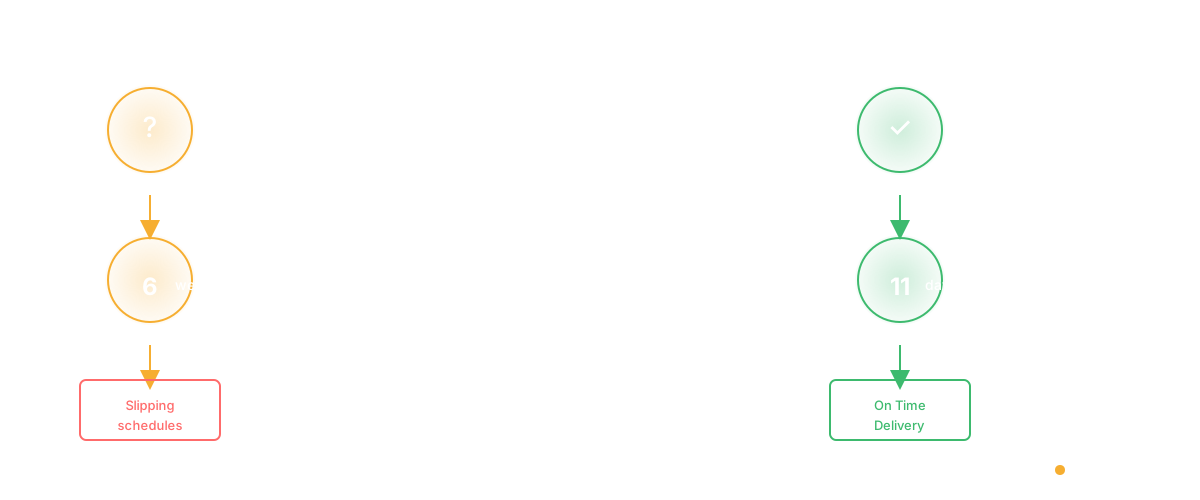
11 days of work, clearly scoped. You can prioritize: maybe error handling is the biggest churn driver, so you tackle that first. Maybe rate limiting is the quick win that buys time for the validation refactor. You can also see ripple effects: "Those error handling changes require updates in three maintained integrations." Now you know to coordinate with the integrations team.
At Salesken, we had a similar situation with our coaching hints API. Enterprise customers were complaining about inconsistent response formats. Our PM assumed it was a 3-week standardization project. Codebase analysis showed the inconsistency came from three different engineers having implemented hints for different call types with no shared response schema. The fix was defining a shared schema and adapting 4 endpoints — 4 days of work, not 3 weeks.
The Future: Agentic Discovery
Here's where it gets interesting.
Right now, AI tools help you discover — they make information visible. A PM asks questions about the codebase. An engineer reviews. Everyone discusses. A decision gets made. That's better than the status quo, but still human-driven.
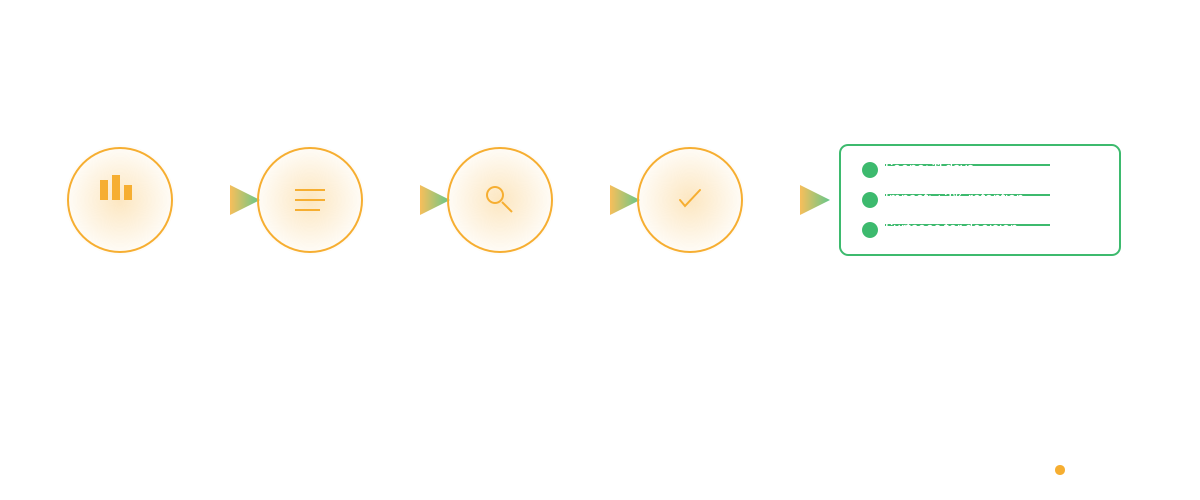
The next step is agentic discovery — where the loop runs partially autonomously. An agent notices behavioral data showing a retention issue. It queries your codebase. It identifies the technical root cause. It suggests a fix with accurate scope. It surfaces this to the product team for a decision.
We're not there yet. But the pieces — behavioral data, codebase intelligence, scope modeling — exist. Stitching them into agentic discovery is the obvious next step. I wrote about this shift in AI Code Assistant vs Codebase Intelligence — the pattern is consistent: tools that understand your specific codebase are more useful than tools that understand code generally.
What to Look For in AI Discovery Tools
Accuracy grounded in your actual codebase. Any tool can claim to understand your system. Test it: ask about your most complex architectural decision. Does it get it right? Wrong information is worse than no information — you'll make decisions based on it.
Clarity about what it doesn't know. The best tools say "I'm confident about this, but less sure about this other constraint — verify with an engineer." That's honesty. That's useful. At Glue, we're building this explicitly — the tool should tell you its confidence level, not present everything with equal certainty.
Integration with your actual workflow. The tool doesn't matter if nobody uses it. It needs to fit where discovery happens — roadmap meetings, customer calls, prioritization discussions. If it requires a separate process, adoption will be low.
Transparency about limitations. How does it handle implicit dependencies? Runtime configuration? Feature flags that change behavior? These are hard problems. A tool that pretends they don't exist is hiding risk. A tool that's honest about the gaps is safer to rely on.
FAQ
Doesn't this require perfect codebase documentation?
No. It's most useful for codebases that are poorly documented. Clean, well-documented systems are easy to understand — just ask an engineer. Legacy systems with unclear architecture and hidden code dependencies are where codebase intelligence saves weeks.
Does this replace conversations with engineering?
No. It changes them. Instead of "how long would this take?" you're asking "what are the specific constraints?" Instead of negotiated estimates, you're discussing specific tradeoffs. The conversation gets better because both sides start from the same information.
What if our codebase is a mess?
Then the tool will tell you it's a mess. That's valuable data. If the tool can't figure out your architecture, your architecture is unclear — a problem worth solving independently. Even for messy systems, codebase intelligence is more useful than guessing.
Related Reading
- Cursor for Product Managers: The Next AI Shift Nobody Is Talking About
- AI Code Assistant vs Codebase Intelligence: Why Agentic Coding Changes Everything
- AI for Product Teams Playbook: The 2026 Practical Guide
- The Product Manager's Guide to Understanding Your Codebase
- Lead Time: Definition, Measurement, and How to Reduce It
- Code Dependencies: The Complete Guide
- The Non-Technical PM Advantage
- Can AI Replace Product Managers?
- AI for Product Management
- What Is AI for Product Strategy?
- What Is AI Feature Prioritization?
- What Is ML for Product Managers?
- Best Perplexity AI Alternatives
- Complete Guide to Competitive Intelligence for SaaS
- Competitive Battlecards
- How to Do Competitive Analysis When You Can't See Code
- Beyond the Spreadsheet: Feature Gaps
- Glue for Feature Discovery