
Tribal knowledge — the undocumented understanding about architecture decisions, workarounds, and system behaviors that exists only in engineers' heads — is the single largest hidden productivity cost in software teams, adding 23 hours per developer per month in knowledge-seeking time. When key engineers leave, teams lose institutional context that takes 3–6 months to rebuild, creating a bus factor risk that compounds with every departure.
At UshaOm with 27 engineers, tribal knowledge was our biggest risk. When two senior engineers left in the same month, we lost institutional context that took six months to rebuild.
By Vaibhav Verma
I watched a $4.2 million engineering hire fail because of something that never showed up in a single dashboard.
We had recruited a senior architect away from Stripe. Brilliant engineer. Perfect cultural fit. She started on a Monday. By Friday, she had asked the same question to four different people and gotten four different answers about how our payment processing pipeline worked. By week six, she was spending more time in Slack archaeology than writing code. By month three, she gave her notice. "I can't be effective here," she told me. "The system makes sense to people who built it. I'm not one of them."
The system she was describing had a name, though we didn't use it at the time: tribal knowledge. The institutional understanding that exists only in people's heads, never in documentation or code clarity, and transfers only through oral tradition - one frustrated conversation at a time.
What Tribal Knowledge Actually Is
Tribal knowledge in software development is not just "stuff we haven't documented yet." That framing makes it sound like a documentation problem with a documentation solution. It's deeper than that.
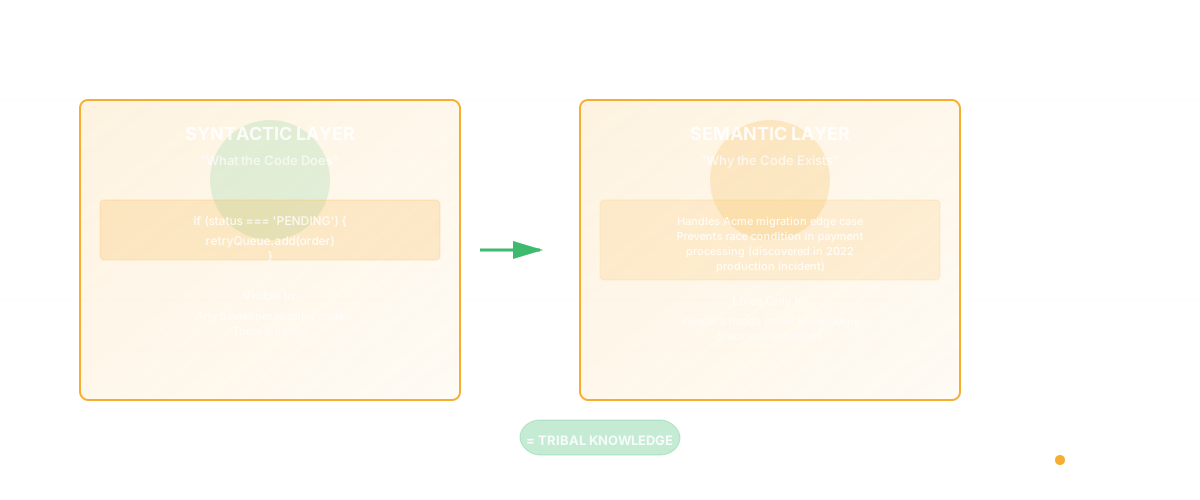
Tribal knowledge is the gap between what your code does and why it does it that way. It's the architectural decisions made in a meeting three years ago that nobody recorded. It's the workaround in the billing service that prevents a race condition but looks like a bug to anyone who wasn't there when the incident happened. It's the reason your event bus uses a specific message schema that only makes sense if you know the constraint it was designed around.
Every codebase has two layers of meaning. The first layer is syntactic: what the code literally does, which anyone can read. The second layer is semantic: why the code exists in this form, which lives exclusively in the minds of the people who wrote it. Tribal knowledge is that second layer, and it's the layer that determines whether a team can move fast or gets stuck in interpretation loops every time something needs to change.
Why It Compounds Silently
The reason tribal knowledge is so destructive is that it doesn't announce itself. It hides inside processes that feel normal.
A product manager asks "can we add real-time notifications?" The engineering lead doesn't say "I don't know." They say "let me check with Marcus." Marcus built the event system two years ago. He spends forty-five minutes explaining the constraints. The PM gets a qualified answer three days later. Everyone treats this as normal. It's not normal. It's a three-day delay on a thirty-minute question, and it happens dozens of times per quarter.
A new engineer joins the team. They're assigned a bug in the checkout flow. The code looks straightforward, but there's a conditional branch that doesn't make sense. They ask about it on Slack. Someone responds: "Oh, that handles the edge case from the Acme migration. Don't touch it." There's no documentation. No comment in the code. No test that explains the behavior. The new engineer patches around it. Six months later, someone else removes the branch. The Acme edge case breaks in production on a Saturday night.
These aren't hypothetical scenarios. I've watched some version of both happen at every company I've worked at. The pattern is always the same: critical knowledge lives in one or two people, gets transmitted through interruption, and eventually gets lost when those people leave or forget.
The Bus Factor Problem
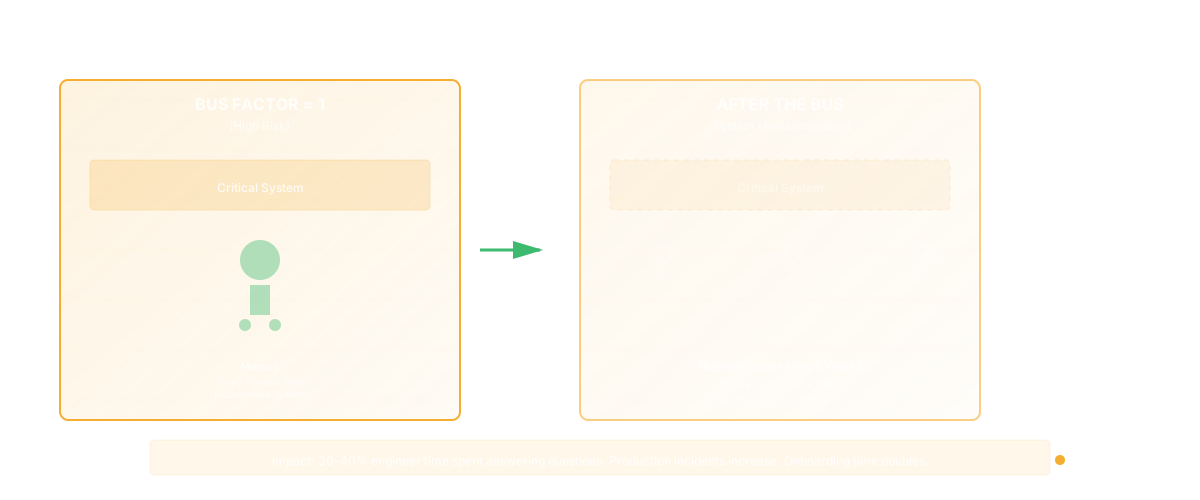
The software industry has a blunt term for this: the bus factor. How many people can get hit by a bus before a system becomes unmaintainable?
For most teams, the honest answer for their most critical systems is one. Sometimes zero, because the person who understood it already left.
A 2023 study by Stripe found that developers spend an average of 17.3 hours per week on maintenance, technical debt, and "bad code" - much of it navigating systems they don't fully understand. That's 42% of their working time spent not building new things, but trying to understand old things that were never made legible.
The bus factor problem isn't really about buses. It's about concentration risk. When critical knowledge concentrates in one person, every decision that touches their domain requires their involvement. They become a bottleneck not because they're slow, but because they're the only translator between the code and everyone else. I've seen senior engineers spend 30-40% of their week answering questions instead of building, simply because they're the only person who understands a critical subsystem.
This creates a perverse incentive structure. The more tribal knowledge you accumulate, the more indispensable you become, and the less time you have to actually distribute that knowledge. The bottleneck reinforces itself.
How Knowledge Silos Form
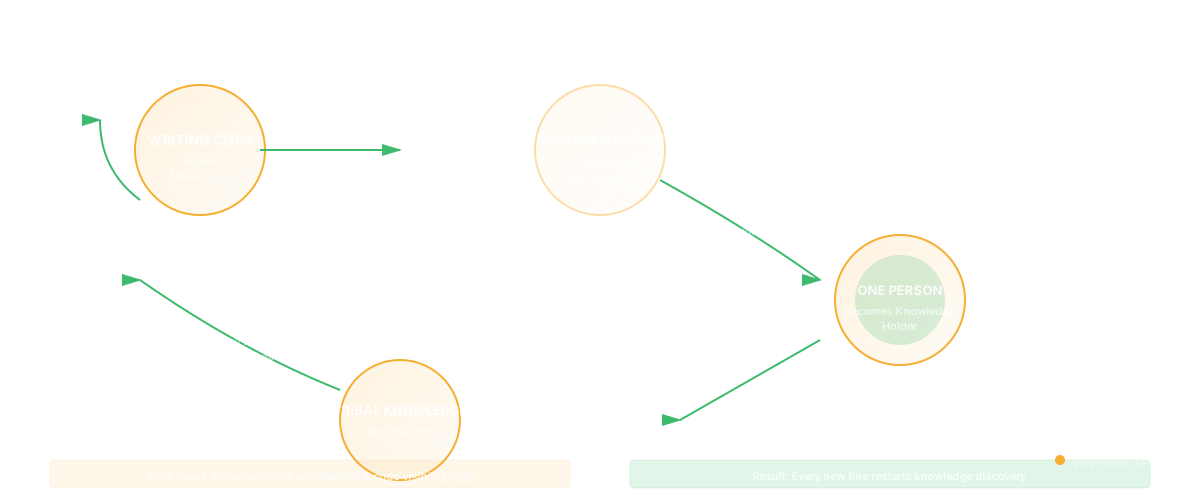
Knowledge silos don't form because engineers are bad at documentation. They form because the incentive structure makes documentation irrational at the individual level.
Writing code is visible, measurable, and rewarded. It ships features. It closes tickets. It shows up in velocity metrics. Writing documentation is invisible, unmeasurable, and unrewarded. Nobody gets promoted for a great ADR. Nobody's performance review mentions that their architecture documentation saved three new hires twenty hours each.
So engineers do the rational thing: they explain things verbally when asked, and they move on to the next ticket. The knowledge transfers to exactly one person. Then that person becomes the new tribal knowledge holder for the people who joined after them. The chain continues until the original context is so diluted that nobody remembers why things work the way they do.
There's a second structural cause that's less discussed: code evolves faster than any documentation system can track. You write a systems overview on Monday. By Thursday, two services have been refactored and a new dependency has been added. The overview is now partially wrong. Partially wrong documentation is worse than no documentation, because it creates false confidence. Teams stop trusting the docs, which makes nobody want to write docs, which completes the cycle.
The Real Cost
Let me put numbers on this, because "tribal knowledge is bad" is the kind of vague statement I'm arguing against.
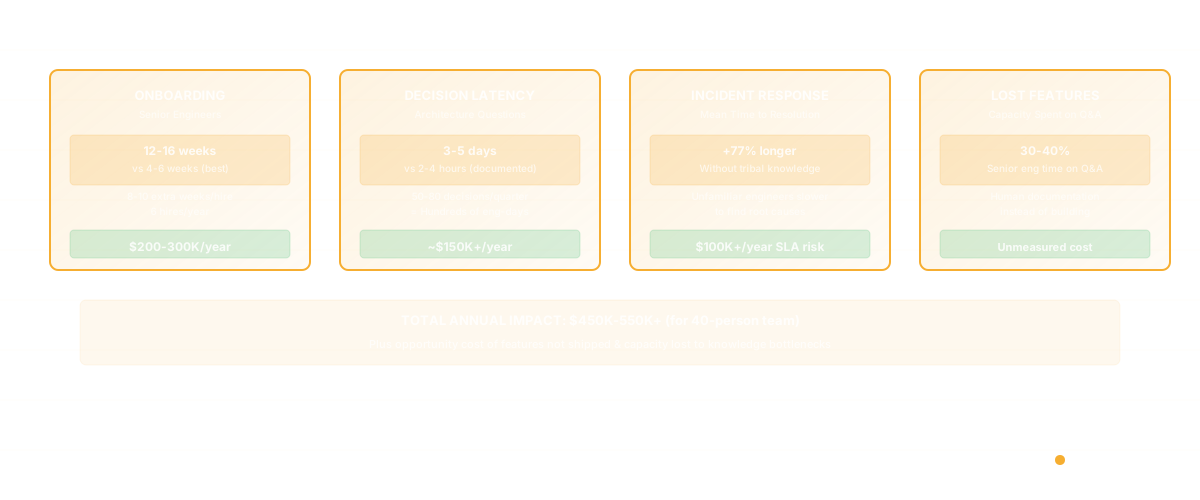
For a 40-person engineering team at a Series B SaaS company (I'm drawing from three teams I've worked with closely, all running microservices architectures in TypeScript or Go). Technical debt statistics show how knowledge loss compounds:
Senior engineer onboarding takes 12-16 weeks to full productivity when tribal knowledge is high. Industry benchmarks for well-documented teams are 4-6 weeks. That's 8-10 extra weeks per senior hire at a fully loaded cost of roughly $4,000-5,000 per week. For a team hiring 6 senior engineers per year, that's $200K-300K in lost productivity annually, just from slow onboarding.
Decision latency on architectural questions averages 3-5 days when they require tribal knowledge consultation, versus 2-4 hours when the information is codified. Across 50-80 architectural decisions per quarter, that's hundreds of engineering-days lost to waiting.
Incident response time roughly doubles when the on-call engineer doesn't have the tribal knowledge about the failing system. A 2024 PagerDuty report found that mean time to resolution increases by 77% when the responding engineer hasn't previously worked on the affected service.
And then there's the cost nobody measures: the features you didn't build because your most experienced engineers were spending a third of their time being human documentation systems instead of building.
How to Surface and Distribute Tribal Knowledge
The instinct is to say "write more documentation." That's partially right but mostly wrong, because it ignores why documentation fails in the first place.
The approach that actually works has three layers.
Make the code itself legible. Not through comments - comments lie as soon as the code changes. Through naming, structure, and patterns. When a codebase uses consistent patterns, a new engineer can infer behavior from convention. When every service handles errors differently, every service requires its own tribal knowledge. Code consistency is a form of distributed documentation.
Record decisions, not descriptions. Architecture Decision Records (ADRs) capture why something was built a certain way, which is the part tribal knowledge actually holds. You don't need to document what every function does - the code shows that. You need to document why you chose this database, why the service boundary is here, why the queue exists. These decisions change infrequently, so the documentation stays accurate.
Use technology to read the codebase continuously. This is what convinced me to build Glue. The fundamental problem with documentation is that it's a manual process trying to keep pace with an automated one. Code changes through PRs dozens of times a day. Documentation changes when someone remembers to update it, which is rarely.
Codebase intelligence tools solve this by analyzing the code directly - extracting architecture, dependencies, ownership patterns, and knowledge concentration automatically. A new engineer can ask "how does authentication work?" and get an answer derived from the actual code, not from a wiki page that was last updated eighteen months ago. A product manager can ask "what would it take to add real-time notifications?" and get an answer based on the current state of the event system, not on Marcus's memory of how it worked when he built it.
The point isn't that documentation is useless. The point is that tribal knowledge is a dynamic problem, and static solutions like wikis and READMEs can't keep pace with it. You need a system that reads your codebase the way your most experienced engineer would - continuously, comprehensively, and without requiring anyone to interrupt their work to explain it.
Measuring Knowledge Risk
You can't manage tribal knowledge if you can't see it. Here's how to measure it:
Ownership concentration. For each critical service or module, count how many engineers have committed meaningful changes in the last 90 days. If the answer is one, that's a bus factor of one. If the answer is zero (the author left), that's a bus factor of zero and you have an orphaned system.
Question frequency. Track how often the same questions get asked in Slack or standups. Repeated questions about the same system are a direct signal of tribal knowledge. If three people have asked "how does the billing retry logic work?" in the last quarter, that's knowledge that should be codified.
Onboarding velocity. Measure time-to-first-meaningful-PR for new hires. If it's longer than four weeks, tribal knowledge is likely the bottleneck. Compare across teams - if Team A onboards in three weeks and Team B takes twelve, Team B has a knowledge problem.
Incident correlation. Track whether incidents disproportionately affect systems with concentrated ownership. If your highest-incident systems are also your highest-tribal-knowledge systems, the relationship is causal, not coincidental.
The Deeper Issue
Tribal knowledge is ultimately a symptom of a structural gap in how software teams operate. The people writing code have deep contextual understanding. The people making product decisions - PMs, engineering leaders, CTOs - often don't. And the transfer mechanism between those two groups is informal, interruptive, and lossy.
Every time a PM asks an engineer "how hard would this be?" and the engineer sighs and says "it depends," that's the tribal knowledge gap in action. The engineer knows the answer but can't communicate it efficiently. The PM needs the answer but can't access it independently. Both are frustrated. Both are rational. The system is what's broken.
Fixing tribal knowledge isn't about better documentation habits. It's about building systems that make institutional knowledge accessible to everyone who needs it, automatically, without requiring the people who hold it to stop what they're doing and explain it one more time.
Your best engineers should be building. Not narrating.
Frequently Asked Questions
Q: What is tribal knowledge in software development?
Tribal knowledge is the institutional understanding about a codebase that exists only in people's heads - architectural decisions, workarounds, system behaviors, and context that never made it into documentation or code clarity. It's the gap between what the code does and why it does it that way.
Q: How do you reduce bus factor on engineering teams?
Start by measuring it: for each critical system, count engineers who've made meaningful commits in the last 90 days. Then distribute knowledge through pairing, code reviews that emphasize context transfer, Architecture Decision Records, and codebase intelligence tools that extract understanding directly from the code.
Q: Is tribal knowledge always bad?
Not inherently. Experiential intuition - knowing that a system behaves unpredictably under specific load patterns, for instance - is valuable. The problem is when critical operational knowledge exists only in tribal form, because that creates concentration risk, slows decisions, and makes onboarding expensive.
Q: What tools help surface tribal knowledge?
Architecture Decision Records (ADRs) capture decision context. Code ownership tools like GitHub's CODEOWNERS track who knows what. Codebase intelligence platforms like Glue analyze your code directly to surface architecture, dependencies, and knowledge risk without requiring manual documentation.
Related Reading
- Knowledge Management System Software for Engineering Teams
- Software Architecture Documentation: A Practical Guide
- Conway's Law: Why Your Architecture Mirrors Your Org Chart
- Developer Onboarding Metrics: How to Measure and Accelerate Time-to-Productivity
- Code Dependencies: The Complete Guide
- What Is a Technical Lead? More Than Just the Best Coder
- Bus Factor Risk
- Bus Factor in Software Engineering
- Knowledge Silos Are a Product Problem
- The Hidden Cost of a Codebase Nobody Understands
- The Real Cost of Nobody Knowing How the System Works
- Tribal Knowledge Guide
- What Is Tribal Knowledge?
- What Is a Knowledge Silo?