
At UshaOm, I hired 27 engineers over two years. Our onboarding was a Google Doc and a 'find a buddy' message. Some engineers shipped their first PR in a week. Others took two months. The difference wasn't talent.
You're handing a new engineer their laptop on day one. They've got their Slack set up, they can access the repo, someone walked them through how your sprint process works. By the metrics your onboarding checklist tracks, they're fully onboarded. But two weeks later, they're still asking questions about why a certain piece of code works the way it does, or why the database schema looks like it was designed by someone from 2015. And you're watching their productivity stay flat.
I've been the PM in that situation more times than I want to admit. The frustrating part? The new developer isn't slow because they're not smart. They're slow because they don't have what I call "codebase fluency" - the ability to read the code and understand not just what it does, but why it was built that way.
The best practices for onboarding software engineers focus on codebase fluency, not process checklists. What actually determines if a new developer gets productive is whether they understand why the code was built the way it was — not just where things are. The most effective onboarding programs invest heavily in structured architecture walkthroughs, pair new engineers with domain experts for contextual first tasks, and use codebase intelligence tools to let engineers self-serve on "why" questions without blocking senior teammates.
Here's what I've learned: most onboarding programs get the easy stuff right. Access, process, tools - these are checkboxes. But they completely miss the thing that actually determines how fast a new engineer gets productive - and that's understanding the codebase's history, architecture decisions, and the implicit knowledge that lives in the heads of senior engineers.
The Real Measure of Onboarding Success
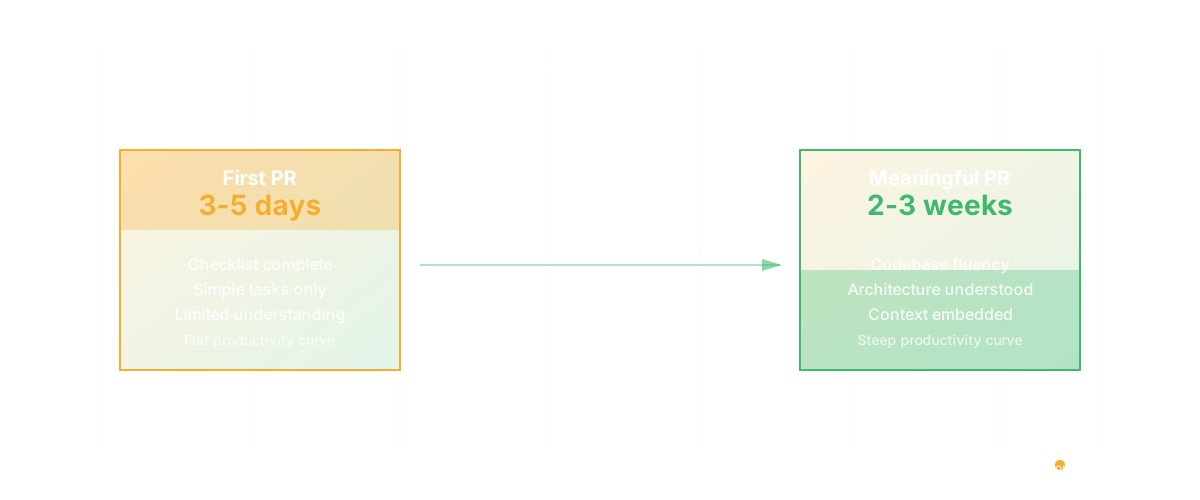
There's a meaningful difference between "time to first PR" and "time to meaningful PR." A new engineer can submit their first pull request in a few days - usually something small, something they didn't have to understand deeply to accomplish. But a meaningful PR, one where they've navigated the codebase, understood the architecture, and made a change that doesn't break something else in a subtle way three months later - that's what takes time.
in my experience, teams I've talked to paints a consistent picture: teams that get new engineers to meaningful productivity in 2 - 3 weeks (versus the 2 month average) have one thing in common. They obsess over giving new developers codebase intelligence, not just codebase access.
What separates these teams? They answer the questions that slow onboarding down:
Why does this code look like this? A new engineer encounters a piece of code that seems unnecessarily complex, or follows a pattern they don't recognize. If they have to wait two days for an answer from a senior engineer, they're stuck. If the codebase has the context embedded - comments that explain the why, documentation that maps architectural decisions, or tools that surface this history automatically - they stay moving.
Who would know if I break this? When you don't understand the relationships between parts of your codebase, every change feels risky. You write more conservative code. You ask for more reviews. You move slower. Engineers with codebase fluency know which changes are isolated and which ones could cascade.
Where do I even start on this feature? A well-documented codebase isn't just about having better READMEs. It's about having someone who built the system available to walk you through it, or having a systematic way to trace dependencies and understand scope. Without this, new engineers either take a very long time to understand what they're working with, or they start building without a complete picture and hit a refactor they didn't anticipate.
The PM's Role in Onboarding
Here's something I realized after years of watching this: as a PM, you have more influence over onboarding success than you probably think. Not because you're running the onboarding program - engineering owns that. But because PMs who understand the codebase write better specs.
When I write a feature spec without understanding the architecture, I'm almost guaranteed to create uncertainty. I describe what I want to build without understanding what we've already built, where it fits in our system, or what the tradeoffs are. Engineers have to spend time in code review asking clarifying questions. They discover during implementation that something I thought would be simple actually requires touching three different services. This uncertainty is what kills productivity - for new engineers especially.
Contrast that with a PM who knows the codebase. Not coding-level knowledge, but fluency - I understand our data model, I know which modules are stable and which are fragile, I understand our architectural constraints. When I write a spec, it's rooted in reality. Fewer surprises in code review. Fewer scope changes. Fewer "actually, we can't do that without rebuilding X" moments.
New engineers onboarded into that kind of clarity move faster than those onboarded into ambiguity, regardless of your checklist.
What Actually Works
The teams that get onboarding right do these things:
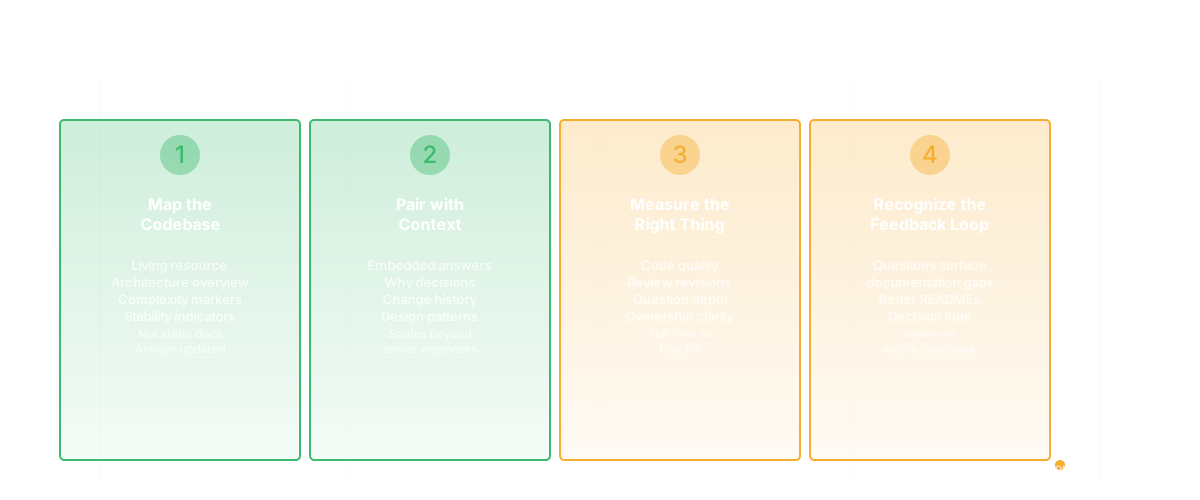
They map the codebase intentionally. Not as a static document (those get stale immediately), but as a living resource. Architecture overviews that can be navigated. A clear mapping of "this code is stable, this is in flux." Points of complexity called out explicitly.
They pair new engineers with context, not just mentors. A mentor is great for answering questions, but that's a scarce resource. What's more scalable is a system where the code itself tells a story. Why was this design pattern chosen? When did this system's role change? What happens if you remove this module? Answers to these questions, embedded in codebase visibility, speed up every new engineer's ramp.
They measure the right thing. Time to first PR is a vanity metric. Time to writing code that doesn't need major revisions in review, time to understanding which parts of the system are their responsibility, time to asking questions that suggest deep understanding instead of surface confusion - those are the measures that actually predict productivity.
They recognize that codebase intelligence is a forcing function for better documentation. When you start asking "why does this work this way?" as a normal part of onboarding, you surface the gaps in your documentation. That pressure forces you to write better READMEs, better architecture guides, better decision logs. You end up with a more maintainable codebase as a side effect.
How This Connects to Your Dev Tools
Here's where I'll be honest: this is something you can only get right if you have visibility into your codebase. If the only way a new engineer learns why code is structured the way it is, is by asking senior engineers, you've got a scaling problem. Those senior engineers become bottlenecks.
What I've seen work is tools that give context - not the code itself, but the story of the code. Architecture mappings, dependency diagrams, that show scope clearly. Change history that explains why decisions were made. The ability to ask "what changed here and why?" and get a useful answer without digging through git logs.
Tools like Glue help here because they surface codebase intelligence without requiring someone to be an expert documenter. When a new engineer encounters unfamiliar code, they can understand its scope, its dependencies, and how it fits into the bigger picture, without having to bother an engineer who's trying to ship a feature.
That's the non-negotiable piece of modern onboarding. Not better checklists. Not better orientation schedules. But better codebase visibility so your new engineers can learn from the code itself.
Frequently Asked Questions
Q: Doesn't this require a lot of extra documentation? A: Not if you approach it right. The goal isn't comprehensive documentation of every function - that's unmaintainable. It's strategic documentation that maps architecture, explains key decisions, and calls out complexity. This usually lives in a few well-maintained files plus comments in code that explain "why," not "what." Tools that extract this from your existing codebase and surface it automatically take a lot of the burden off.
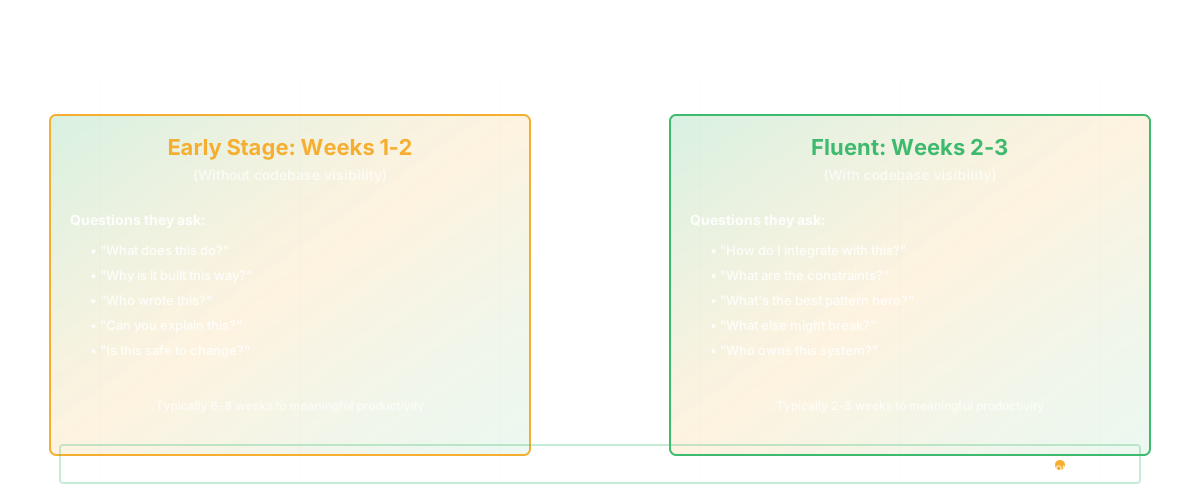
Q: How do we know when a new engineer has enough codebase fluency to move fast? A: Look for the shift from "What does this do?" questions to "How do I integrate with this?" questions. When they stop asking for clarification on existing code and start asking about constraints and best practices for new code, they have fluency. That usually happens around week 2 - 3 for engineers with good codebase visibility, versus week 6 - 8 without it.
Q: Can codebase fluency ever get lost? What about engineers who've been here for two years? A: Yes, completely. The longer your codebase goes without good documentation of its architecture, the more knowledge becomes tribal. You end up with senior engineers who know the history by heart, and newer engineers who have to learn by osmosis. This is why teams that automate codebase visibility actually get more stable. It's not about onboarding anymore - it becomes about institutional memory.
Related Reading
- Developer Experience: The Ultimate Guide to Building a World-Class DevEx Program
- Developer Onboarding Metrics: How to Measure and Accelerate Time-to-Productivity
- Software Architecture Documentation: A Practical Guide
- Knowledge Management System Software for Engineering Teams
- What Is a Technical Lead? More Than Just the Best Coder
- Software Productivity: What It Really Means and How to Measure It