
Cursor for product managers represents a paradigm shift: just as Cursor connected AI to your actual codebase for engineering, codebase intelligence tools connect product leaders to their product's technical reality—architecture, dependencies, constraints, and capabilities—enabling faster and more informed product decisions. The core insight is that Cursor's breakthrough wasn't better AI; it was better context, and the same principle applies to product management tooling.
When I started building Glue, I watched something happen across our early users that confirmed my thesis. Every founder or engineering leader who tried it had the same reaction: "Why didn't we have this before?" Not because Glue does something magical. Because it does something obvious once you see it — it gives product leaders the same kind of leverage that Cursor gave to engineers.
Cursor didn't invent AI code completion. What it did was connect AI to your actual codebase. Autocomplete stopped being generic and started understanding your architecture, your patterns, your tech stack. Engineers shipped faster because the tool was finally grounded in their reality.
Product managers are still waiting for their equivalent. And the gap is getting wider, not narrower, because AI coding tools are accelerating the supply side (code production) while the demand side (knowing what to build) remains unchanged.
The Cursor Moment
Before Cursor, you had Copilot. Copilot was trained on the internet — billions of code patterns. Genuinely useful. But when you opened a file in your specific codebase, with your naming conventions and your particular approach to error handling, Copilot had to start from scratch. It generated technically correct code that didn't match your project.
Cursor changed that. It indexed your codebase. It understood your patterns. When you asked it to complete a function, it didn't just know programming — it knew your programming.
I experienced this firsthand at Salesken. We adopted Cursor in 2024, and deployment frequency tripled in two months. But something else happened that nobody talks about: the PMs got left further behind. Engineers were shipping faster than the PMs could scope and prioritize. Features would appear in staging before the PM had finished the spec. The information asymmetry between "people who write code" and "people who decide what to build" widened with every Cursor-assisted PR.
That's the moment that matters. Not the AI itself. The grounding — and who gets it.
What Product Managers Actually Need
Think about what happens in a typical roadmap meeting.
Engineering says a feature request from your largest customer will take three sprints. The PM has a hunch it shouldn't take that long. Product intuition says the codebase can handle it in one sprint. But the PM can't open the code and verify — that's not their job. So they guess. They negotiate. They push back based on feeling.
I've been on both sides of this table. As CTO at Salesken, I watched PMs accept inflated estimates because they couldn't verify them. I also watched PMs push back on accurate estimates because they didn't understand the technical constraints. Both failures come from the same root cause: information asymmetry.
At UshaOm, where I ran a 27-engineer e-commerce team, our head of product spent an estimated 8-10 hours per week in "technical translation" meetings — sessions where she'd ask engineers to explain what was possible and how long things would take. Those hours weren't building product understanding. They were compensating for a visibility gap.
The bottleneck isn't the decision-making process. It's the information asymmetry. Product managers make strategic calls about a codebase they can't see.

What "Cursor for PMs" Actually Looks Like
Let me ground this in a real workflow.
You're a PM at a Series B SaaS company. A large customer asks: "Can you add bulk-import from our legacy system? We have 500,000 records to migrate."
Without codebase intelligence: You ask engineering. They say six weeks — validation, error handling, rate limiting, reconciliation. You push back. They push harder. You're at an impasse based on gut feel on both sides.
With codebase intelligence: You ask the tool: "Can we build bulk import in two weeks?" It reads your import architecture. It sees you already have validation for single-record imports. It knows your rate limiting is configurable. It comes back: "Two weeks is tight but doable. Blockers: the validation layer needs refactoring for batch operations (3 days), and reconciliation logic doesn't handle partial failures (2 days). But rate limiting is already flexible. If those two things get done first, bulk import is a two-week add-on."
Now you have a real conversation. Not "can we do it" but "what specifically needs to happen first." You can close the deal with a credible plan, grounded in actual code architecture, not negotiated estimates.
At Salesken, we had a version of this play out with our multi-language coaching feature. The PM assumed it was a 4-month project because "we'd need to rebuild the coaching engine for each language." If she'd had codebase intelligence, she would have seen that our STT provider already supported 12 languages, and the coaching engine was language-agnostic — it operated on transcribed text, not audio. The actual work was 3 weeks of integration and testing, not 4 months of rebuilding. We lost two months of lead time because the PM didn't have visibility into what the code already supported.
Why This Matters Right Now
YC published their Winter 2026 Request for Startups with a category called "Cursor for Product Managers." Andrew Miklas framed it simply: "Cursor solved code implementation. Nobody has solved product discovery."
Here's why the timing is now. Agentic coding tools — Cursor, Claude Code, Devin — are making code implementation nearly free from an effort perspective. You'll ship features faster than ever. But the bottleneck moves upstream. The constraint won't be implementation. It'll be deciding what to implement.
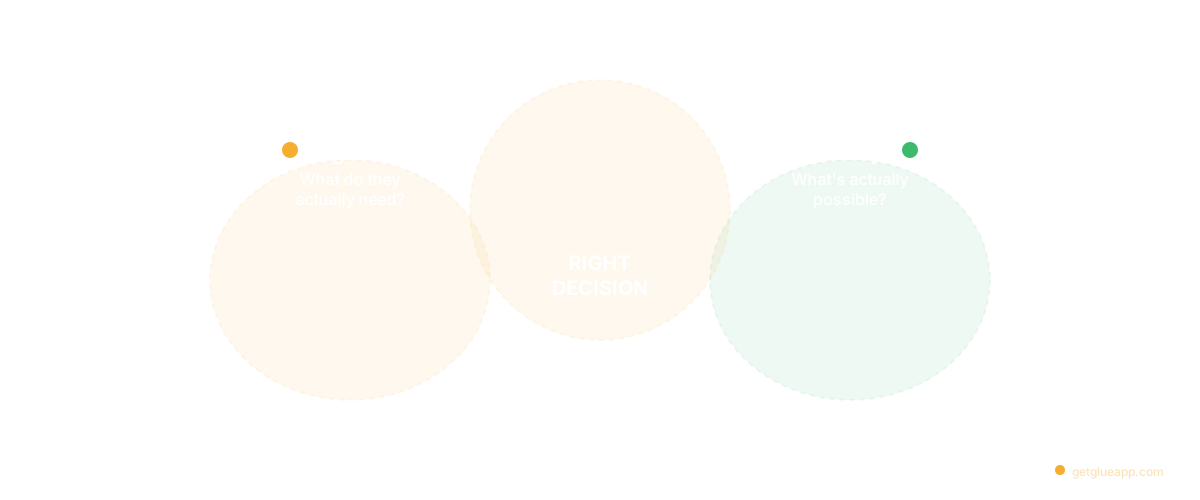
What to build gets decided by whichever team has the clearest view into three things:
- Customer signals — what customers need
- Codebase reality — what's technically possible and how hard
- Business strategy — what moves the business forward
Right now, most product teams lack visibility into at least one. Customer signals are noisy. Business strategy is clearer but often disconnected from ground truth. And codebase reality? That's a black box.
At Salesken, codebase reality was the bottleneck. Our PM could research customer needs and align with business strategy. But every technical feasibility question required scheduling a meeting with an engineer, waiting for their analysis, and interpreting their answer through layers of translation. That loop took 3-5 days per question. With codebase intelligence, it should take 3-5 minutes.
The Competitive Advantage
The teams that close the gap between product reality and codebase reality will ship better products, faster, with higher confidence. They'll take on customer requests that competitors reject as infeasible. They'll deprioritize work that looks good until you understand the technical cost.
I talked about this on LinkedIn and the response surprised me. Aalok Pandit said "just point Cursor at the repo and ask." He's right if you're a developer. But a PM will never open an IDE. Rishabh Aggarwal said Copilot already does this. It doesn't — Copilot helps you write code, not understand what code can do for your product strategy.
The people who came back in DMs weren't developers. They were PMs scoping features who couldn't understand the impact of what they were asking for. CTOs deciding what to prioritize without seeing the structural constraints. EMs trying to understand why something is taking 3x longer than expected.
These people will never open an IDE. They need their own interface to codebase reality.
Where This Category Is Going
The "Cursor for Product Managers" category is just emerging. What will become obvious: the gap between product reality and codebase reality is where most product risk lives. Close it, and you eliminate an entire class of surprises — scope creep, missed requirements, technical pivots mid-development.
Close it well, and you don't just reduce risk. You accelerate. You can take more customer requests seriously because you know which ones are feasible. You can scope correctly because you understand constraints upfront. You can make roadmap decisions faster because the information is there.
The honest limitation: codebase intelligence today handles explicit code relationships well — imports, function calls, API endpoints. Implicit relationships — runtime behavior, feature flag interactions, environment-specific configuration — are harder to surface automatically. We're getting better, but a PM asking "what happens if we change the pricing model?" still needs an engineer for the parts that live in business logic rather than code structure.
That's Cursor's lesson applied to product leadership. Not magic. Not automation. The right information at the moment of decision.
FAQ
Doesn't engineering already communicate codebase constraints?
Through estimates and pushback — very blunt instruments. A three-sprint estimate doesn't tell you which sprint is blocked by what constraint. Codebase intelligence creates a shared language about what's actually possible — surfacing dependencies and technical debt — which leads to better conversations, not fewer.
Won't this slow down product decisions?
The opposite. Decisions made without full information surface constraints during development. That's expensive. Surfacing constraints upfront — during discovery, during planning — actually speeds up the end-to-end process even if the individual decision takes slightly longer.
What about messy legacy codebases?
They benefit most. Clean code is easy to understand — you can ask an engineer and get a fast answer. Messy systems with unclear architecture? That's where codebase intelligence saves weeks of discovery and prevents decisions based on outdated mental models.
Does this replace product-engineering collaboration?
No. It enhances it. Instead of engineering spending hours explaining architecture to product, the tool does some of that translation. You end up with better conversations because both sides start from the same information.
Related Reading
- AI Code Assistant vs Codebase Intelligence: Why Agentic Coding Changes Everything
- GitHub Copilot Doesn't Know What Your Codebase Does
- Devin AI Alternatives: Why You Need Agents That Monitor, Not Just Code
- AI for Product Teams Playbook: The 2026 Practical Guide
- The Product Manager's Guide to Understanding Your Codebase
- The CTO's Guide to Product Visibility
- The PM-Codebase Gap
- The PM AI Assistant in 2026
- Should PMs Learn to Code?
- Can AI Replace Product Managers?
- ChatGPT for Product Managers
- What Is an AI Product Manager?