
The best developer experience (DevEx) platforms for engineering teams include Glue (engineering intelligence connecting DevEx metrics to business outcomes), Backstage by Spotify (internal developer portal and service catalog), Port (developer portal with self-service workflows), DX by Abi Noda (survey-based DevEx measurement), and Cortex (service reliability and ownership tracking). Investing in developer experience typically yields 20-40% improvements in onboarding speed, incident resolution time, and deployment frequency within the first quarter.
At Salesken, I invested a full quarter in developer experience — faster CI, better docs, streamlined onboarding. The ROI was clear within 60 days.
By Vaibhav Verma
A VP of Engineering at a 80-person B2B SaaS company asked her CTO to invest $200K in developer experience infrastructure. He said no. His reasoning: developers are expensive enough, and we're shipping. "We have a velocity problem, not a developer problem," he said.
Three months later, a critical incident took 14 hours to resolve because nobody understood the payment system architecture. Two senior engineers quit because the codebase felt unmaintainable. Onboarding the replacements cost eight weeks of lost productivity per engineer. That $200K investment would have paid for itself in incident response alone.
The disconnect is real: engineering leaders think about developer experience as a perk, not as technical risk management. But the business case is brutal if you look at it right.
The Hidden Cost of Context Switching
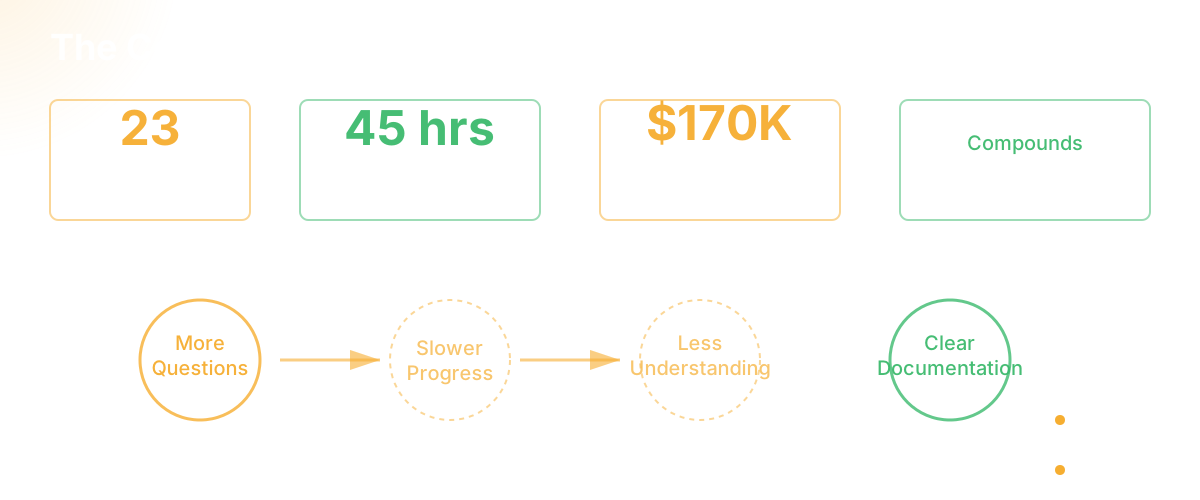
In 2019, a team at UC Irvine studied what happens when engineers get interrupted. After one interruption, it takes 23 minutes to regain focus. After two, it's longer. The implication is subtle but powerful: in a codebase where nothing is documented and knowledge is hoarded, engineers get interrupted constantly by people asking "wait, does this function exist?" or "why does this work this way?" Those aren't meetings. They're context switches that multiply across your team.
Take a 15-person engineering team. If each engineer loses 3 hours a week to context-switching in a poorly-understood codebase, that's 45 engineer-hours a week. At a fully-loaded cost of $200K per engineer per year (salary + benefits + equipment), that's $170K a quarter in pure productivity loss. Not revenue loss. Not feature loss. Just the cost of engineers working slower because the codebase doesn't answer basic questions.
Now factor in that this compounds. Better DX means faster context-switches, which means more focus time, which means higher productivity. Worse DX compounds in the opposite direction. Engineers spend more time context-switching, which means they understand the system less, which means they make less informed decisions, which makes the next engineer's job harder.
Onboarding as Multiplied Waste
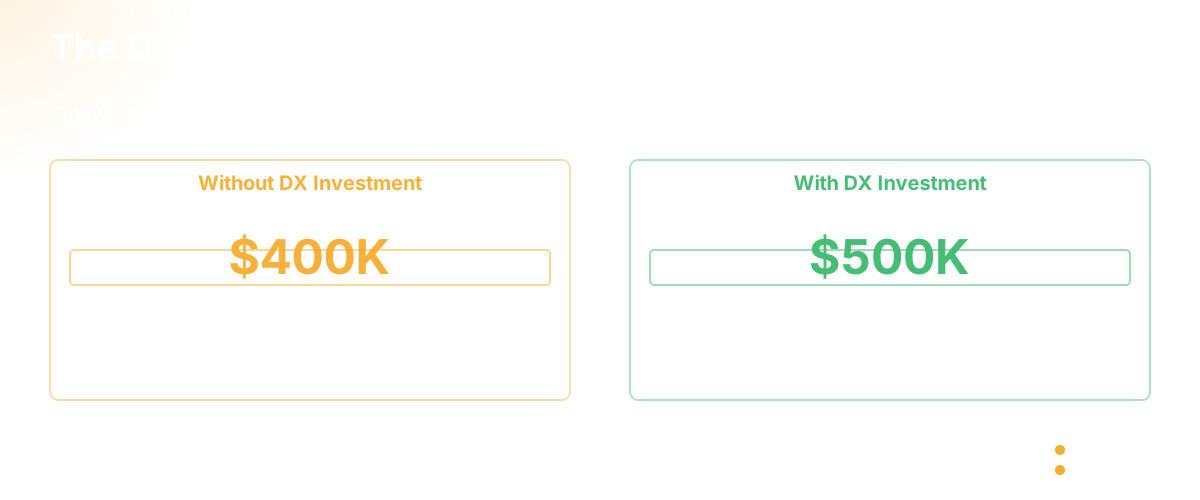
Most teams take 6 ( - 8) weeks for a new engineer to hit "full speed." Technically, that engineer is working. But they're creating technical debt, writing slower code, and asking questions that slow down existing engineers.
Multiply this across your hiring: if you bring on four new engineers a year (which is normal growth for a fast-growing company), you've effectively paid for two full engineers worth of productivity loss just in onboarding. That's $400K a year.
Now, a DX investment doesn't eliminate this. But it shortens it. Good onboarding materials, clear codebase organization, and accessible documentation can cut that time to 3 ( - 4) weeks. For a team that hires eight engineers a year, that's six weeks of productivity reclaimed annually. At full-loaded cost, that's $500K back in productivity.
The math gets more aggressive if your team is growing faster or if your onboarding time is worse (which it usually is at 50 ( - 150) person companies in particular, where you're big enough to have accumulated debt but not big enough to have invested in scaling the onboarding process).
Architectural Drift and the Compounding Problem
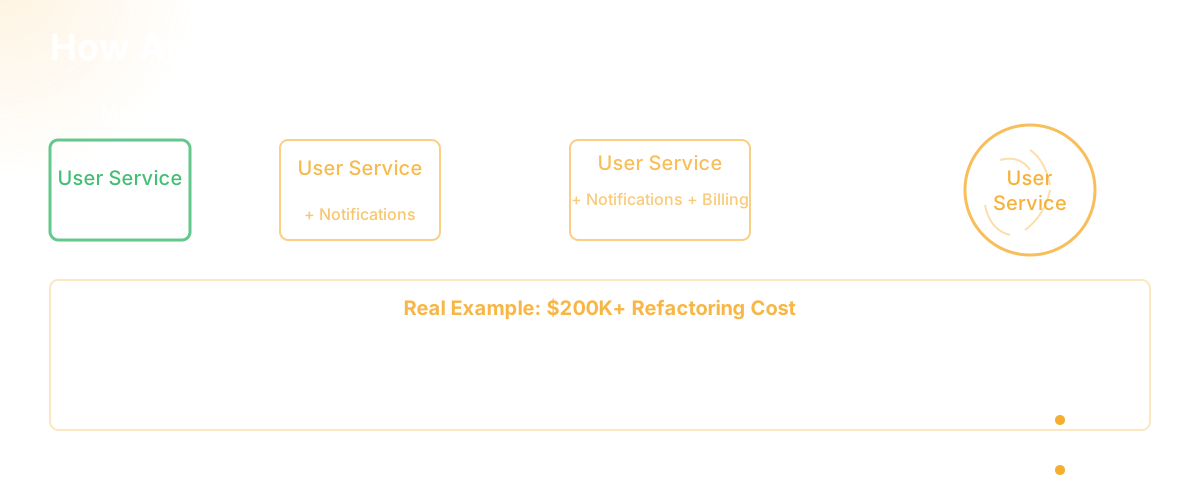
Here's the thing that kills CTOs at night, even if they don't talk about it in business meetings: when engineers don't understand the system, they make locally reasonable decisions that damage the global system.
A new engineer joins. They need to add a feature. The clean place to add it doesn't make sense to them because the architecture was never explained. So they add it somewhere "close enough." That's fine. But now the next engineer sees that it was added there, so they add the next thing in the same area. Within three months, you've got a muddy subsystem that nobody wanted.
This is architectural drift, and it's invisible until it's expensive. A team I worked with had a "user service" that originally handled user creation and authentication. Over time, because nobody was actively managing the boundaries of the system, it picked up notification logic, billing queries, and a caching layer. It became a hairball that touched every service. Refactoring it took 16 weeks and halted all feature development.
That refactoring wasn't necessary if they'd invested in DX from the start: clear ownership of the module, regular codebase reviews where architects asked "is this still doing one thing?", and documentation about why boundaries existed.
The CTO Reframe
The pitch to your CTO should not be "developers will be happier." That's true, but it's not a business argument. The pitch is this: "DX investment is technical risk management."
Quantifiable risks: (1) Every week a key module is maintained by one person is a week we're exposed to sudden loss of knowledge. (2) Every month the onboarding process stays unoptimized, we're losing $30K in productivity per hire. (3) Every quarter we don't address architectural drift, the cost of the next refactoring grows by 20%. (4) Every incident that takes 10 hours instead of 3 to resolve is a sign the codebase is a liability, not an asset.
These aren't soft arguments. These are ROI arguments. And they're conservative. Most teams that measure carefully find that DX improvements pay for themselves in 4 ( - 6) months through incident reduction and onboarding efficiency alone.
Where Investment Actually Goes
When we talk about DX investment, we're talking about concrete things:
Clear documentation of system design and ownership. This is not a wiki. It's documentation tied to the code itself, updated when the code changes, with actual owners responsible for keeping it true.
Onboarding tooling. Some teams use codebase walkthroughs. Some use interactive tutorials. Some use "shadow an engineer" on the critical path. The tool doesn't matter. The investment does.
Monitoring tooling for codebase health. Tools like Glue let teams ask "who owns what?" and "what changed?" without context-switching to five different people. This sounds small. At scale it's enormous. A 100-person engineering organization where every architectural question requires a Slack conversation is a disaster. A 100-person organization where any engineer can ask "how do these systems interact?" and get an answer in 30 seconds is one where decisions are informed instead of political.
Testing and continuous integration infrastructure. Faster feedback on code changes means engineers can refactor with confidence. That's a DX investment with measurable ROI in incident reduction.
Time budgeted for refactoring and technical debt paydown. Not as a penalty, but as scheduled capacity. A team that spends 20% of its time on refactoring doesn't ship 20% fewer features ( - in practice, they ship them faster because the codebase is cleaner.
The Hidden Calculation
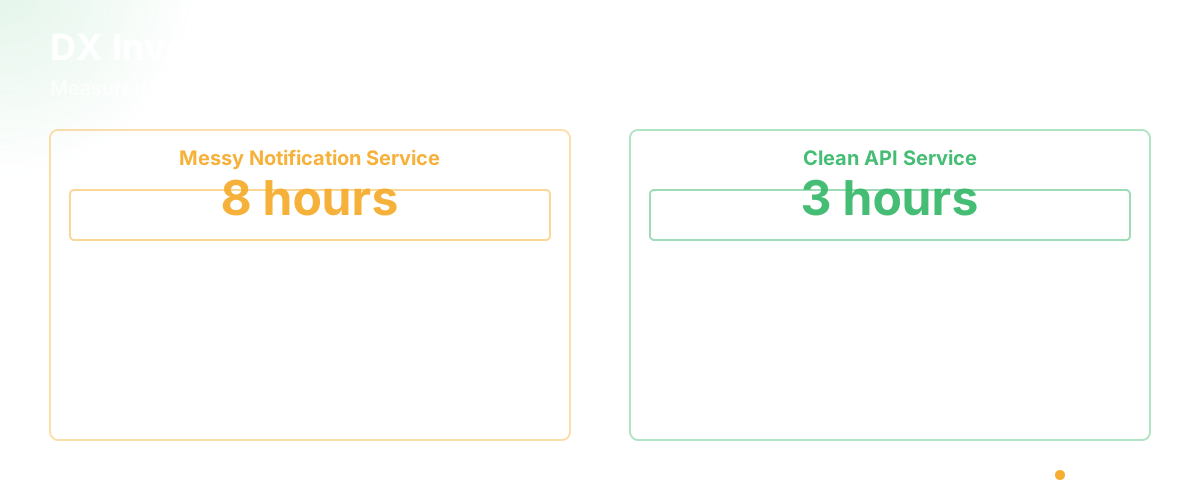
Here's the conversation to have with your CTO: "What if we measured the actual cost of poor DX?" Start with one metric: incident resolution time in your most opaque module vs. your clearest module. The difference is a proxy for the cost of confusion.
If your messy notification service takes 8 hours to debug an incident and your clean API service takes 3 hours, that's five hours per incident. If you have two incidents a quarter in each, that's 40 hours a year lost to confusion. Multiply by the team size that touches these services. The number gets large quickly.
That's the CTO pitch. Not "developers want better DX." But "we're paying 40% more in incident response costs because our codebase is opaque. Here's how much it would cost to fix that. Here's why it's profitable."
Frequently Asked Questions
Q: What are the best developer experience platforms for engineering teams?
A: The best developer experience platforms include Glue (engineering intelligence connecting DX metrics to business outcomes like cycle time and incident cost), Backstage by Spotify (open-source internal developer portal with a plugin ecosystem), Port (self-service developer platform with workflow automation), DX by Abi Noda (survey-based developer experience measurement), Cortex (service reliability and ownership tracking), and Swarmia (team-level productivity with collaboration metrics). The ROI case for DX investment is straightforward: measure incident resolution time in your most opaque module vs. your clearest module — the difference is what poor DX costs you per incident, multiplied by incident frequency.
Q: We're a startup. Can we afford to care about DX?
Startups should care more than large companies because you're scaling. The DX decisions you make at 15 people determine whether you scale to 50 people or 150 people smoothly. The cheap move ( - no DX investment ( - looks good for six months and then becomes your bottleneck. By then it's expensive to fix.
Q: Doesn't this just mean we need to hire better engineers?
Better engineers amplify the problem. They're more aware of the technical debt and less willing to stay. Your best engineers are the first to leave bad codebases.
Q: How do we get the board to fund this?
Don't. This isn't a "nice to have" that needs special funding. This is part of the engineering budget. It's as essential as continuous integration. If your CTO frames it as optional, you have a CTO problem, not a funding problem.
Related Reading
- Developer Experience: The Ultimate Guide to Building a World-Class DevEx Program
- Developer Onboarding Metrics: How to Measure and Accelerate Time-to-Productivity
- Software Architecture Documentation: A Practical Guide
- Knowledge Management System Software for Engineering Teams
- What Is a Technical Lead? More Than Just the Best Coder
- Software Productivity: What It Really Means and How to Measure It