
AI coding tools like GitHub Copilot and Cursor create technical debt approximately 4x faster than human developers because they generate code that is syntactically correct but architecturally naive—duplicating logic instead of extending existing abstractions, ignoring cross-service dependencies, and producing "cognitive debt" (code nobody fully understands). Teams using AI coding tools without guardrails see velocity metrics improve while defect density, maintenance burden, onboarding time, and incident rates all degrade.
At Salesken, we had a 'tech debt' label in Jira with 200+ tickets. When our board asked how much technical debt we had, I couldn't give them a number. That experience taught me that unmeasured debt is invisible debt.
Your sprint velocity has never looked better. Forty-two points delivered last quarter, up from thirty-one. Your CTO is presenting the numbers at the board meeting. GitHub Copilot is getting the credit.
Meanwhile, your P1 incident count just hit a six-month high. Three senior engineers are quietly updating their LinkedIn profiles. And the feature your biggest customer has been waiting on - the one that should have taken two weeks - is entering its seventh week because nobody can untangle the authentication module anymore.
This is not a coincidence. This is what happens when you optimize for code output without investing in code coherence.
The Speed Trap
The pitch for AI coding tools is seductive: developers write code faster, so features ship faster, so the business moves faster. And the first part is true. GitHub's own in my experience, Copilot users complete tasks 55% faster. A 2025 here's what I've seen: MIT found that AI-assisted developers produced 126% more code per week.
But more code and better software are not the same thing. They never have been.
An Ox Security report published in November 2025 found that AI-generated code is, in their words, "highly functional but systematically lacking in architectural judgment." Translation: it works when you test it in isolation. It breaks when it meets your actual system.
I tracked this closely with a 25-engineer B2B SaaS team running a TypeScript/React stack with roughly 400K lines of code. Over one quarter after adopting Copilot, code output rose 32%. But bug density per feature climbed 36%, PR review cycles stretched from 1.2 days to 1.9 days on average, and the ratio of new-feature work to maintenance shifted from 70/30 to 55/45. More output. Less progress.
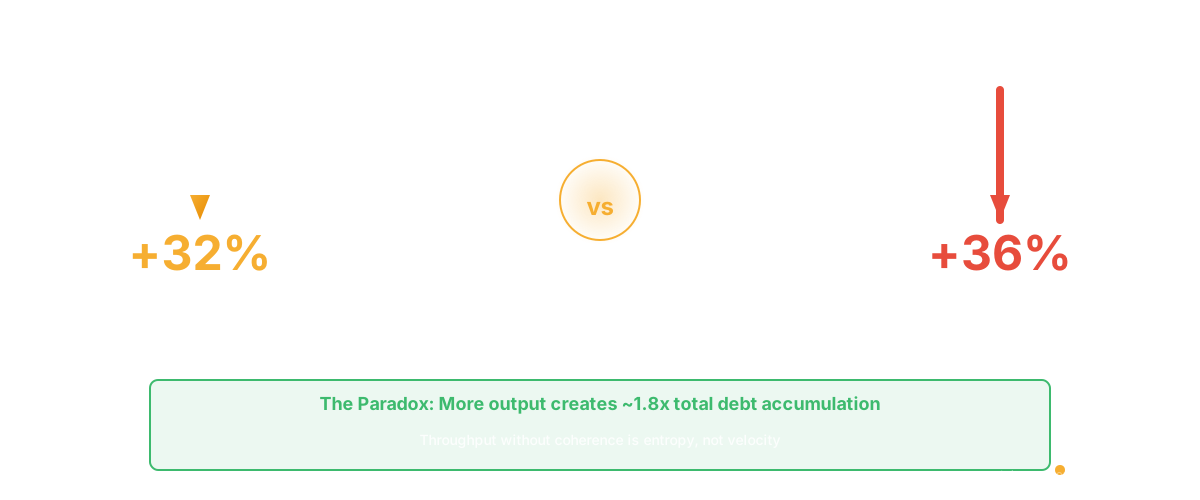
The Throughput-Coherence Tradeoff
This is what I call the Copilot Paradox, and it's worth understanding structurally, not just anecdotally.
AI coding tools optimize for local throughput: finish this function, complete this file, generate this test. But software quality is a system property, not a local one. Architectural integrity, naming consistency, dependency discipline - these emerge from hundreds of small decisions that all point in the same direction. When you 10x the rate of local decisions without any mechanism to enforce system-level coherence, you get a codebase that passes every unit test and fails as a whole.
This is the same tension you see in any complex system. A factory can optimize each station individually and still produce garbage if the stations aren't coordinated. AI coding tools are the equivalent of giving every station a faster machine without updating the production plan.
Without explicit architectural guidance - repository context, system-level prompts, codebase-aware RAG pipelines - AI tools generate code in a vacuum. And yes, some teams are building these guardrails. But the default experience, which is how 90% of teams use these tools, has none of that.
Why AI Code Rots Faster
There are three structural reasons, and they compound.
Without context, AI fragments your architecture. A senior engineer knows your team uses the repository pattern for data access, that the auth module is a singleton, and that the event bus expects a specific schema. They know this from two years of PR arguments. Without explicit codebase indexing or architectural prompts, Copilot doesn't have access to any of this. It generates code that works but uses whatever pattern it trained on. Six months later you have six different data access patterns in a codebase designed around one.
AI optimizes for completion, not comprehension. The objective function is "finish this code block," not "finish this code block in a way a new hire can understand in thirty minutes." The result is code that passes tests but erodes the shared understanding that makes a codebase maintainable. Margaret Storey at the University of Victoria calls this "cognitive debt" - code that works but that nobody on the team fully understands. It's more dangerous than traditional technical debt because it's invisible until someone tries to change it.
AI shifts engineers from authors to reviewers. When you spend an hour writing a function, you've thought through edge cases and made deliberate choices. When Copilot generates it in ten seconds, your role becomes reviewer. A 2025 Stanford study found that developers accepted 40% of Copilot suggestions without meaningful review. This isn't a tool problem. It's a human cognition problem: people are systematically worse at reviewing work they didn't create.
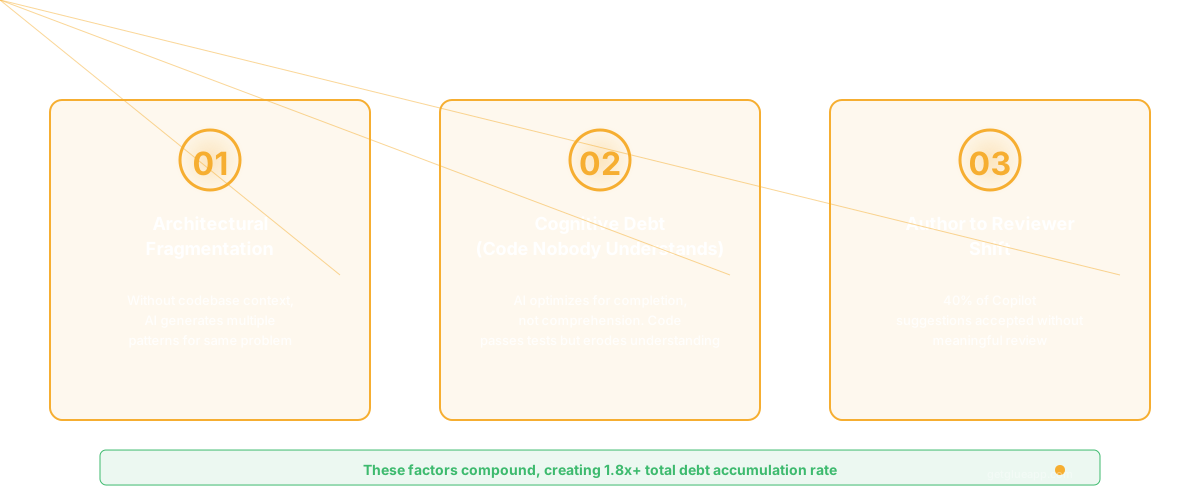
The Compounding Math
If your team generates 30% more code and that code has a 36% higher defect rate, you're not looking at a linear increase in problems. You're looking at roughly 1.8x the total debt accumulation rate. And that's before accounting for the pattern fragmentation and cognitive debt that don't show up in any dashboard.
The StackOverflow blog put it bluntly in January 2026: AI can 10x developers - in creating tech debt. The Sonar team's in my experience, February 2026 confirmed the pattern.
Sprint velocity is a trap metric. It measures throughput. It does not measure coherence. And coherence is what determines whether your codebase will still be workable in twelve months.
What to Actually Do About It
The answer is not to stop using Copilot. AI coding tools are too useful to abandon. The answer is to invest in system-level understanding at the same rate you're investing in local generation.
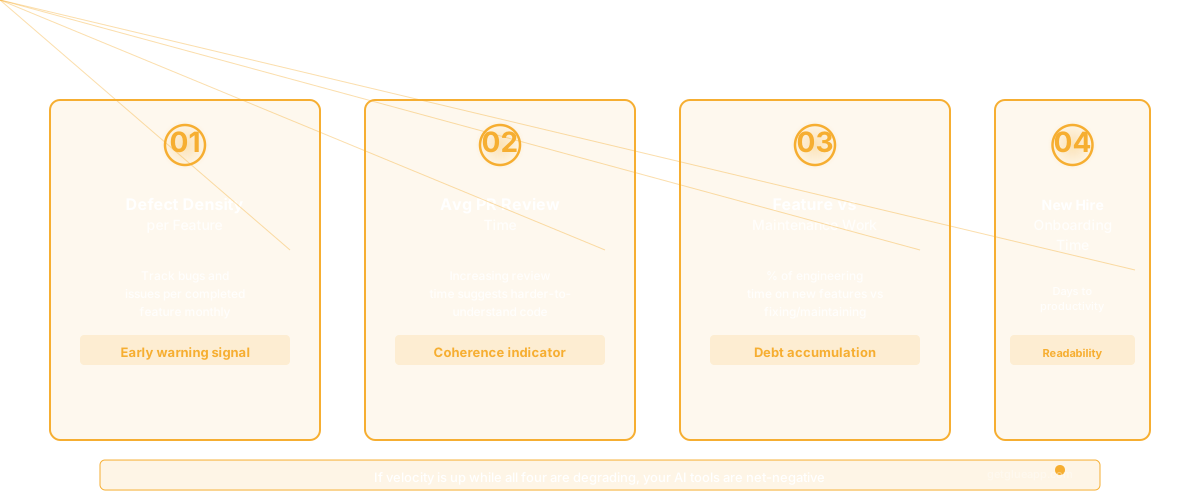
Measure coherence, not just output. Track defect density per feature, time-to-merge trends, the ratio of new-feature work to maintenance work, and new engineer onboarding time. If velocity is up and all four of those are degrading, your AI tools are net-negative.
Treat AI-generated code as junior developer code. Every line gets reviewed. Every new pattern gets justified. The efficiency gain should come from faster first drafts, not from skipping quality gates.
Enforce architectural guardrails before you scale generation. Invest in linters, architectural fitness functions, and automated checks that catch pattern violations before merge. The stricter your guardrails, the more safely you can use AI.
Make your codebase legible to the people making decisions about it. This is the root cause nobody talks about. AI coding tools create debt partly because they don't understand your codebase. But do your product managers understand it? Does your VP of Engineering? Can your CTO explain the dependency chain for your highest-revenue feature?
If the humans making product decisions can't see what's in the codebase, they have no hope of managing what AI puts into it. This is why we built Glue - a codebase intelligence layer that reads your codebase continuously and translates its state into language product and engineering leadership can act on. But whether you use Glue or build something internal, the principle is the same: you need system-level visibility to match your system-level generation speed.
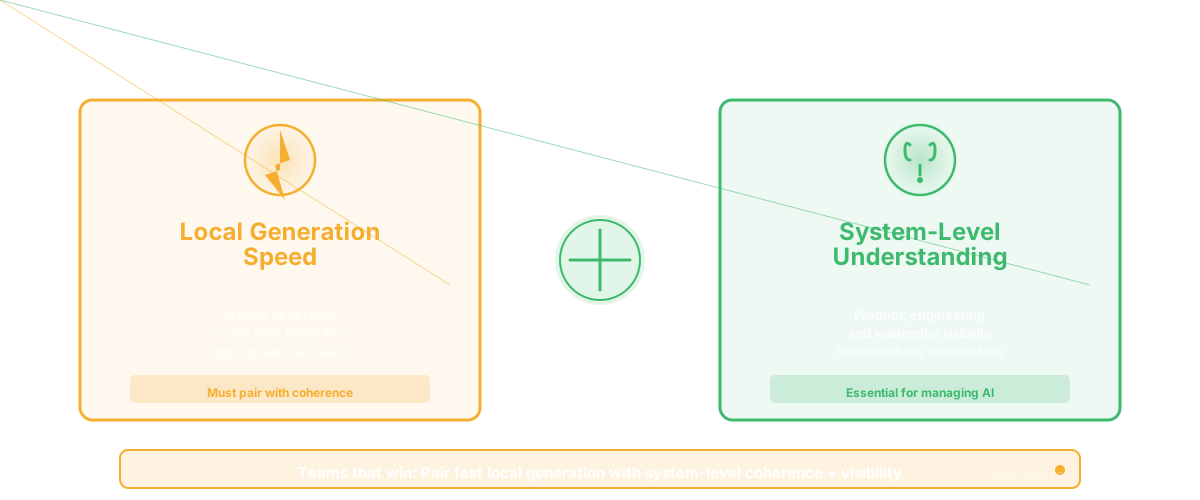
The Real Question
The debate usually gets framed as "are AI coding tools good or bad?" That's the wrong question.
The right question: does your organization have the visibility to know whether AI is helping or hurting? Most don't. Most are watching velocity charts and assuming everything is fine.
The teams that will win the next five years are the ones that pair local generation speed with system-level understanding. Speed without coherence isn't velocity. It's entropy.
Frequently Asked Questions
Q: Should we stop using GitHub Copilot or Cursor?
No. The productivity gains are real for the right tasks: boilerplate, tests, documentation, simple utilities. The problem is using these tools without guardrails. Ban unreviewed AI code, not the tools themselves.
Q: How do we measure if AI-generated code is creating debt?
Track four metrics monthly: defect density per feature, average PR review time, percentage of engineering time on maintenance vs. new features, and new engineer onboarding time. If deployment frequency is up while those four are degrading, your AI tools are net-negative.
Q: Can AI tools help reduce technical debt instead of creating it?
In theory, yes. AI shows promise for automated refactoring, test generation, and documentation. In practice, these capabilities are immature. Today, AI is much better at generating new code than understanding and improving existing code. That gap will close, but it hasn't yet.
Q: What's the difference between technical debt and cognitive debt?
Technical debt is code built with known shortcuts — you know it needs fixing. Cognitive debt is code that nobody fully understands — you don't even know what needs fixing. AI tools primarily create cognitive debt, which is harder to detect and more expensive to resolve. This is closely related to the knowledge silo problem and rising bus factor risk.
Related Reading
- Technical Debt: The Complete Guide for Engineering Leaders
- Code Refactoring: The Complete Guide to Improving Your Codebase
- DORA Metrics: The Complete Guide for Engineering Leaders
- Software Productivity: What It Really Means and How to Measure It
- Code Quality Metrics: What Actually Matters
- Cycle Time: Definition, Formula, and Why It Matters
- Cursor and Copilot Don't Reduce Technical Debt
- What Is AI Technical Debt?