
Brooks' Law states that adding manpower to a late software project makes it later — because new team members require ramp-up time, communication overhead grows quadratically with team size (the formula is n(n-1)/2 channels), and non-divisible tasks on the critical path cannot be parallelized. The most effective alternatives to adding headcount are cutting scope, breaking sequential dependencies to enable parallel work, reducing coordination overhead on the existing team, and using codebase intelligence to make implicit knowledge explicit.
I've been asked this question at least a dozen times across three companies — at Salesken, at UshaOm, at Shiksha Infotech. The answer is almost always no, and the reason has been understood since 1975.
Your project is six weeks behind. Leadership asks the obvious question: "Can we add more engineers to get back on track?" Every experienced engineering leader knows the answer. And every time, they struggle to explain it convincingly enough to stop the request.
Fred Brooks wrote the answer in 1975 in "The Mythical Man-Month": adding manpower to a late software project makes it later. Fifty years later, teams are still learning this the hard way.
The problem isn't that Brooks' Law is unknown. It's that it's poorly understood. Most people treat it as a cute aphorism rather than a measurable phenomenon with specific mechanics that can be visualized, quantified, and - in some cases - mitigated.
What Brooks' Law Actually Says
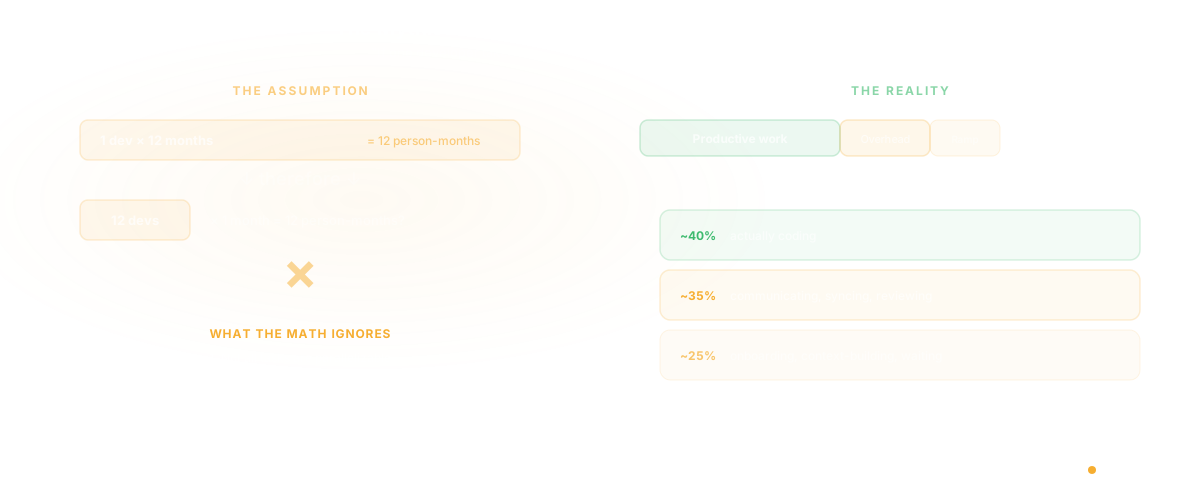
The formal statement: "Adding manpower to a late software project makes it later." But Brooks was making a precise observation about three specific forces, not a vague complaint about scaling:
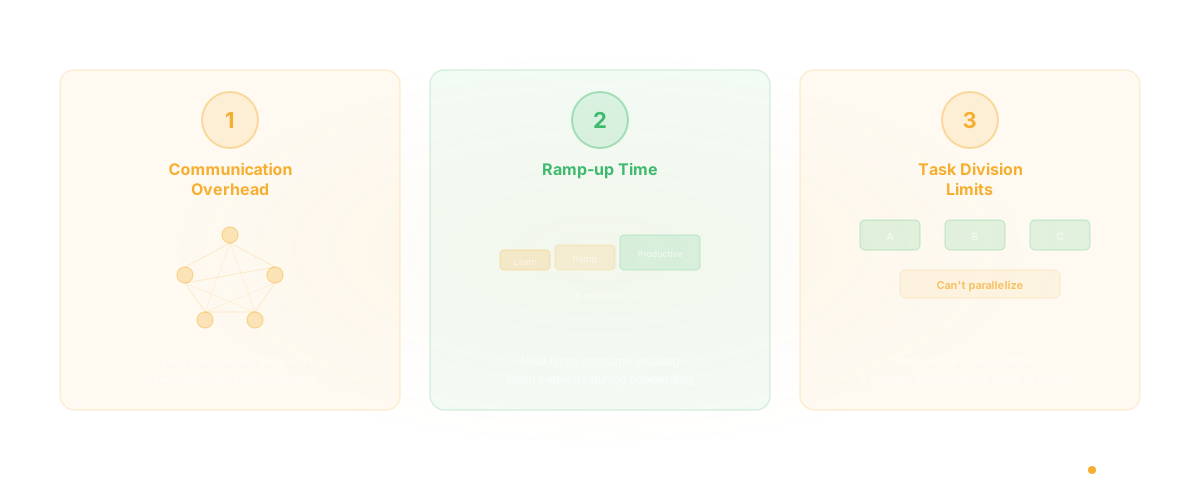
1. Ramp-up time is real and non-trivial. A new engineer joining an existing project doesn't contribute on day one. They need to understand the codebase, the architecture, the conventions, the deployment pipeline, and the implicit decisions that never made it into documentation. For a complex system, productive ramp-up takes 2-4 months. During that time, the new hire is a net negative on productivity - they consume existing team members' time through questions, code reviews, and pair programming sessions.
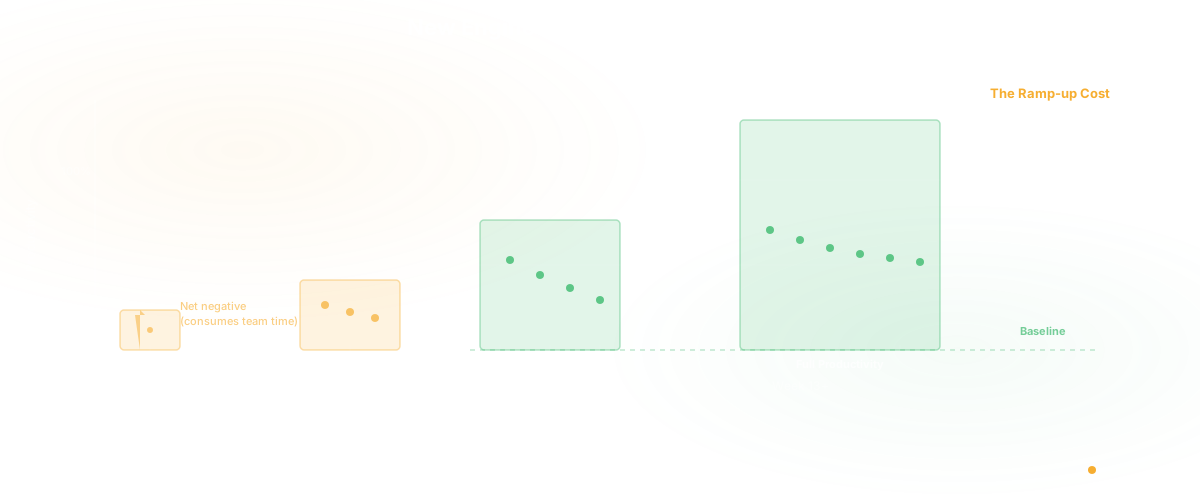
2. Communication overhead grows quadratically. A team of 4 has 6 communication channels. A team of 8 has 28. A team of 12 has 66. This isn't just an abstract math exercise - it shows up as more meetings, more Slack threads, more "let me sync with the team before committing to this approach" delays. The formula is n(n-1)/2, where n is team size. Every person you add increases the communication burden on every existing member.
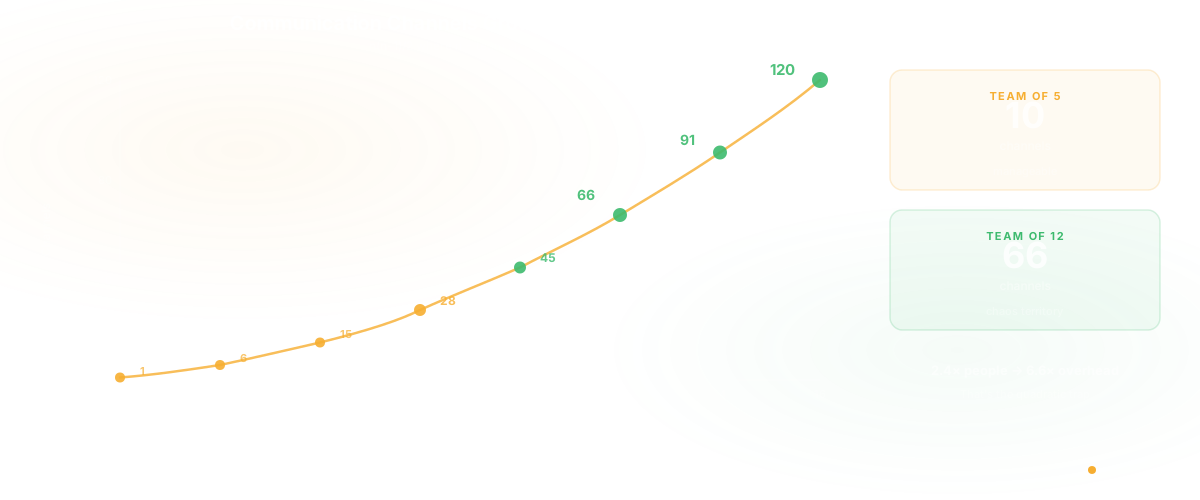
3. Not all work is divisible. Some tasks can't be parallelized. You can't make a baby in one month by assigning nine women to the project. In software, sequential dependencies - where task B requires the output of task A - create critical paths that more people can't shorten. Adding engineers to the non-critical path doesn't help if the bottleneck is on the critical path.
Visualizing Brooks' Law: What the Data Actually Shows
CodeScene's Adam Tornhill pioneered the approach of using version control data to visualize Brooks' Law in action. The concept is powerful: your Git history contains a record of who changed what, when, and how those changes interacted.
Here's how to see Brooks' Law in your own codebase:
Communication cost visualization. Map which engineers are modifying the same files or modules within the same sprint. When two engineers both need to change the same file, they need to coordinate - one waits for the other, they resolve merge conflicts, or they accidentally step on each other's changes. The density of these overlaps is a direct measure of coordination cost.
A 20-engineer team working on a monolithic Rails application tracked file-level coordination for one quarter. When they operated as two independent pods of 10, the average number of coordination conflicts per sprint was 8. When they temporarily combined into one pod of 20 for a "critical push," coordination conflicts jumped to 31 - nearly 4x - and sprint velocity dropped by 22%.
The onboarding tax. Track commit frequency for new team members over their first 90 days. Typically, the pattern looks like this: weeks 1-2 produce near-zero meaningful commits, weeks 3-6 produce small, safe changes (documentation, tests, minor fixes), and weeks 7-12 show the engineer reaching baseline productivity. During this entire ramp-up, they're consuming senior engineers' time for context, review, and mentoring.
Critical path bottleneck. Identify your codebase's dependency chains. If Service A depends on Service B depends on Service C, adding ten engineers to Service A won't help if the bottleneck is a single engineer's work on Service C. Visualize this by mapping which changes block other changes in your PR workflow.
The Math Behind Brooks' Law
Brooks himself provided the formula, though most discussions skip the math. Here's the simplified version:
For a project with T total work units, a team of N people, a ramp-up cost of R per new person, and a communication overhead of C per pair:
Effective capacity = N - R(new hires) - C * N(N-1)/2
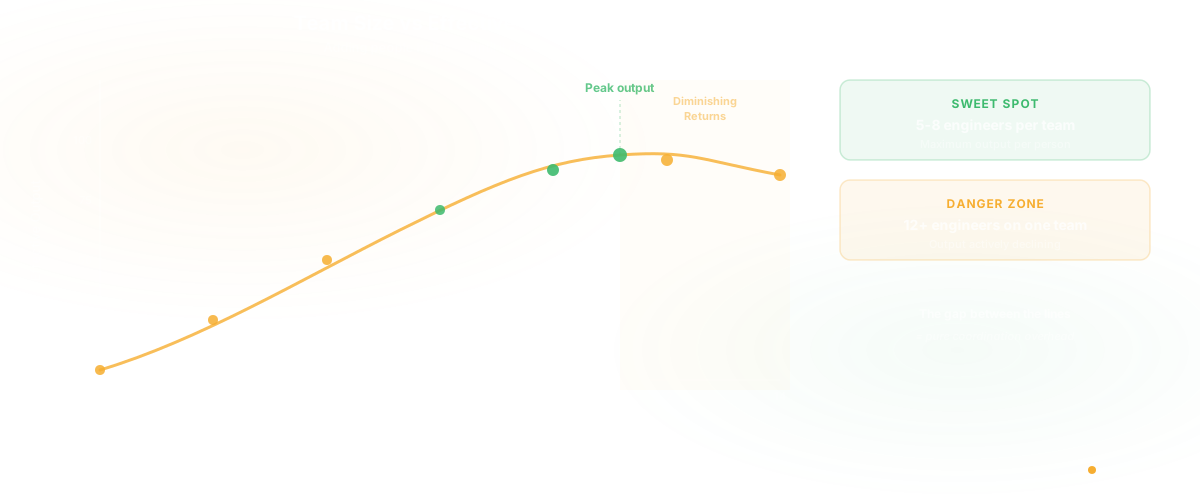
When N is small, the communication term C * N(N-1)/2 is negligible. When N grows, the quadratic term dominates. There exists a specific team size where adding one more person produces zero additional output - and beyond that, each new person actively reduces total output.
For a typical software project with moderate interdependency (C = 0.05), this inflection point hits around 8-12 people. Beyond that, you're fighting the math.
When Brooks' Law Doesn't Apply (And When It Does)
Brooks' Law is not universal. It has specific conditions:
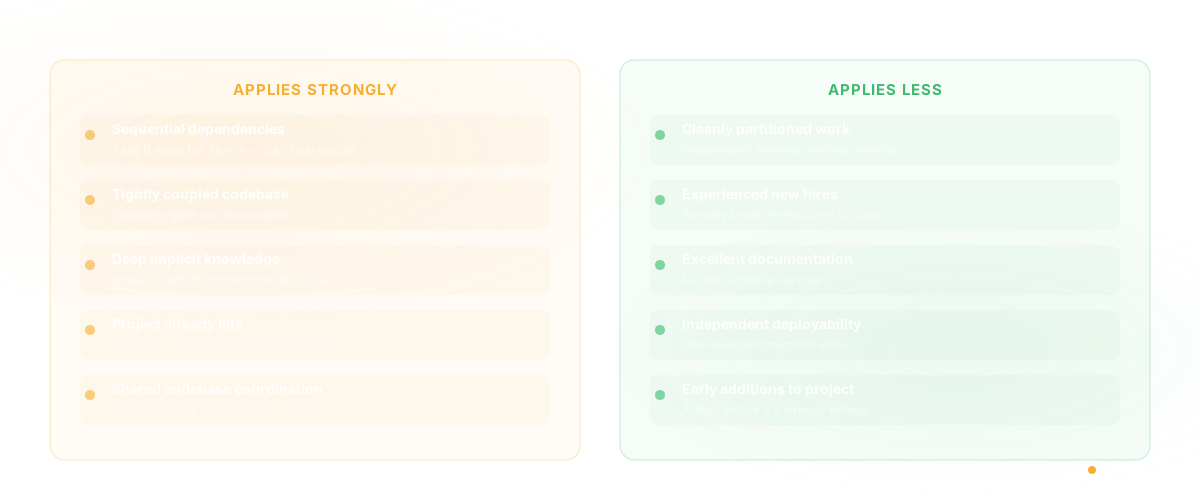
It applies most strongly when:
- The project has significant sequential dependencies
- The codebase has high coupling (changes ripple across modules)
- The existing team has accumulated deep implicit knowledge
- The project is already late (pressure reduces patience for ramp-up)
- The work requires coordination across a shared codebase
It applies less when:
- Work can be cleanly partitioned into independent streams
- New team members have prior experience with the specific technology and domain
- The team has excellent documentation and onboarding processes
- The architecture supports independent deployability (well-designed microservices)
- You're adding people early, not after the project is already behind
Steve McConnell wrote an influential response arguing Brooks' Law can be "repealed" under specific conditions - primarily when work is partitioned and ramp-up cost is minimized. He's right, but the conditions are narrow and require deliberate architectural choices made before the project falls behind.
What to Do Instead of Adding People
When a project is behind and adding headcount won't help, these approaches actually work:
Cut scope ruthlessly. This is always the fastest lever. If the project is 6 weeks behind, find 6 weeks of scope to defer. Not cut - defer. The distinction matters politically. Work with your PM to identify the minimum viable delivery that still achieves the business objective.
Remove dependencies, not add people. If the bottleneck is a sequential dependency between teams or modules, break the dependency. Can Service A use a mock or stub while Service C is being built? Can you ship a degraded version that doesn't require the blocking component?
Reduce coordination overhead on the existing team. Fewer meetings, clearer ownership boundaries, more autonomous decision-making authority. If the team is spending 30% of their time coordinating, recovering even half of that time is equivalent to adding 15% more headcount - without the ramp-up cost.
Make the implicit explicit. Much of the ramp-up cost for new team members comes from undocumented architecture decisions, implicit coding conventions, and tribal knowledge. Tools like Glue surface this codebase knowledge automatically, dramatically reducing the time it takes for anyone - new hires or existing team members working in unfamiliar areas - to understand how the system works. When the architecture, dependencies, and ownership patterns are visible and queryable, the "ask the senior engineer" bottleneck disappears.
Add people to the next project, not this one. If you have budget for additional engineers, start them on the next initiative rather than the current fire. They'll be ramped up and productive by the time the current project ships, instead of slowing it down while contributing little.
Brooks' Law and AI Code Generation
AI coding tools present an interesting test of Brooks' Law. Tools like Copilot and Cursor add "virtual headcount" without the human communication overhead. But they introduce their own version of the problem:
For the organizational dynamics behind these scaling problems, see our post on Conway's Law - the relationship between team structure and architecture is central to understanding why adding people doesn't help. Also relevant: our guide on technical debt types, since architectural residue from team changes is a primary debt generator.
AI-generated code still needs review by humans. Every AI-generated PR is a coordination point. If your senior engineers are spending 40% of their time reviewing AI-generated code, you've traded one form of overhead for another. The ramp-up cost is zero, but the review cost is not.
The deeper issue is that AI tools don't understand the project's critical path. They generate code for whatever you point them at, regardless of whether that work is on the bottleneck or the non-critical path. Without codebase intelligence that maps dependencies and identifies the actual critical path, AI acceleration gets applied to the wrong work.
Frequently Asked Questions
What is Brooks' Law in software engineering?
Brooks' Law states that "adding manpower to a late software project makes it later." Coined by Fred Brooks in his 1975 book "The Mythical Man-Month," it describes how new team members require ramp-up time, increase communication overhead (which grows quadratically with team size), and can't help with non-divisible tasks on the critical path.
Does adding more programmers speed up a project?
Only under specific conditions: when work can be cleanly partitioned into independent streams, when new members have relevant experience, and when the codebase architecture supports parallel development. For tightly coupled systems with sequential dependencies, adding programmers more often slows the project down due to ramp-up time and coordination costs. Measuring lead time reveals whether adding people actually improved delivery speed.
What is the Brooks' Law formula?
The communication overhead formula is n(n-1)/2, where n is team size. A team of 5 has 10 communication channels. A team of 10 has 45. A team of 20 has 190. This quadratic growth means doubling team size more than quadruples the coordination burden.
How do you overcome Brooks' Law?
The most effective approaches are: cutting scope instead of adding people, breaking sequential dependencies so work can be parallelized, reducing coordination overhead on the existing team, and using codebase intelligence tools to make implicit knowledge explicit - reducing the ramp-up cost that makes new additions so expensive.
Related Reading
- Conway's Law: Why Your Architecture Mirrors Your Org Chart
- Software Productivity: What It Really Means and How to Measure It
- Lead Time: Definition, Measurement, and How to Reduce It
- What Is a Technical Lead? More Than Just the Best Coder
- Programmer Productivity: Why Measuring Output Is the Wrong Question
- DORA Metrics: The Complete Guide for Engineering Leaders