Glossary
AI roadmaps require unique planning: model training, data preparation, evaluation cycles. Learn how to estimate and risk-manage AI-powered features.
Building products across three companies — Shiksha Infotech, UshaOm, and Salesken — taught me that the hardest part of product development isn't building. It's knowing what to build and why.
An AI product roadmap is a strategic plan for developing AI-powered features, where planning explicitly accounts for the unique constraints of AI work ( - ) data dependencies, model training cycles, evaluation requirements, and the inherent unpredictability of AI system behavior. Unlike traditional software roadmaps where feature complexity is estimated in person-weeks, AI features require probability distributions, not point estimates. A feature described as "add real-time fraud detection" might require four weeks of setup, eight weeks of data preparation, two weeks of model iteration, and four weeks of evaluation to establish that the model generalizes to production data.
Product teams building AI features often apply the same estimation and planning frameworks used for traditional software, and this causes systematic planning failure. A feature that sounds straightforward ( - ) "add sentiment analysis to user feedback" ( - ) can reveal hidden constraints at each stage: insufficient labeled training data, a model that performs well in testing but fails on real customer text, or an evaluation framework that doesn't exist yet (how do you measure sentiment accuracy when ground truth is subjective?). Teams that don't account for these constraints systematically miss timelines.
The core challenge is that AI work introduces stages that traditional software doesn't have. You can't begin model evaluation until you have training data. You can't deploy a model until you've validated it on production-like data. You can't ship a feature until you know the model won't degrade user experience. Each stage can unblock or block forward progress, and surprises compound.
Product managers need to understand their team's current AI infrastructure maturity and data architecture constraints before committing to AI roadmap dates. A team with a mature data pipeline and existing model serving infrastructure can add a new model capability in six weeks. A team building their first ML pipeline from scratch needs 12 weeks just for infrastructure before model work begins.
A fintech startup decides to add investment recommendation features. The product roadmap goal is "launch recommendations in Q2," six months out. The PM talks to the ML team, and here's what unfolds:
The team says: "We have training data for stock recommendations but not cryptocurrency. For crypto, we'd need to collect and label two years of price history plus trading volume signals. That's four weeks of data engineering. Then we build a baseline model (three weeks), evaluate it on held-out test data (one week), find it performs poorly on assets with low trading volume (two weeks fixing that), then run a month-long backtesting phase to simulate historical trading performance. Then we need a six-week evaluation period with a small user cohort before general launch. Best case, 18 weeks. If the model fails evaluation, add another iteration cycle."
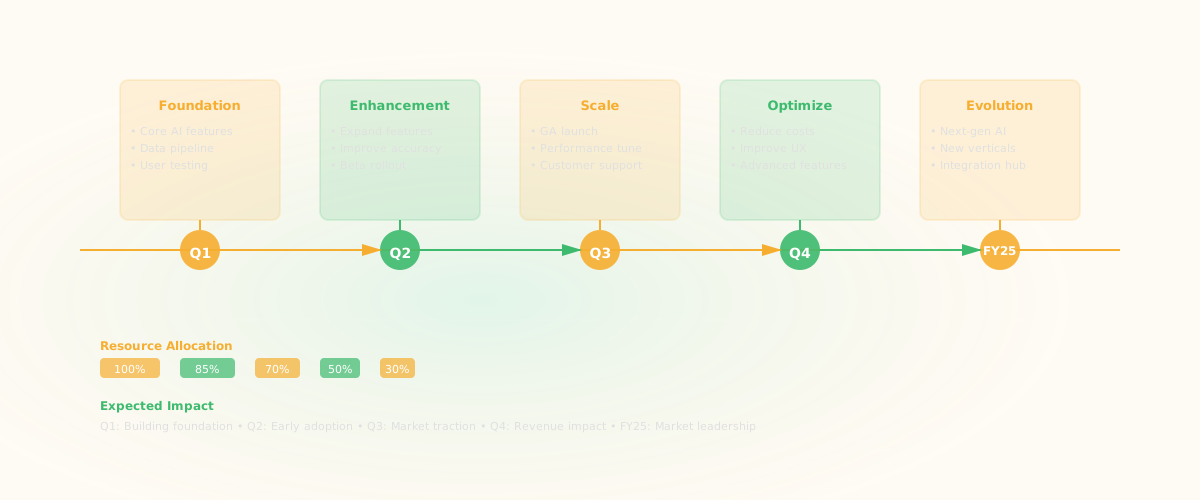
The PM realizes Q2 is not feasible. Instead, the roadmap becomes: Q1 ( - ) infrastructure and data pipeline setup. Q2 ( - ) baseline model and evaluation. Q3 ( - ) production launch with limited user cohort. This transparency prevents a crisis when the team misses the original Q2 date.
Second example: The team says: "We can add sentiment analysis to feedback in four weeks using an existing fine-tuned model from our system." But the PM asks: "Will it work on customer text?" The team discovers that customer feedback uses industry jargon and abbreviations the model wasn't trained on. After evaluation, accuracy is 64%, below the 85% threshold for launch. The team can either ( - ) relabel training data to include industry-specific examples (two weeks) or ( - ) use a simpler baseline that gets 76% accuracy but works fine for the first iteration. They choose the simpler approach, ship faster, and iterate based on user feedback.
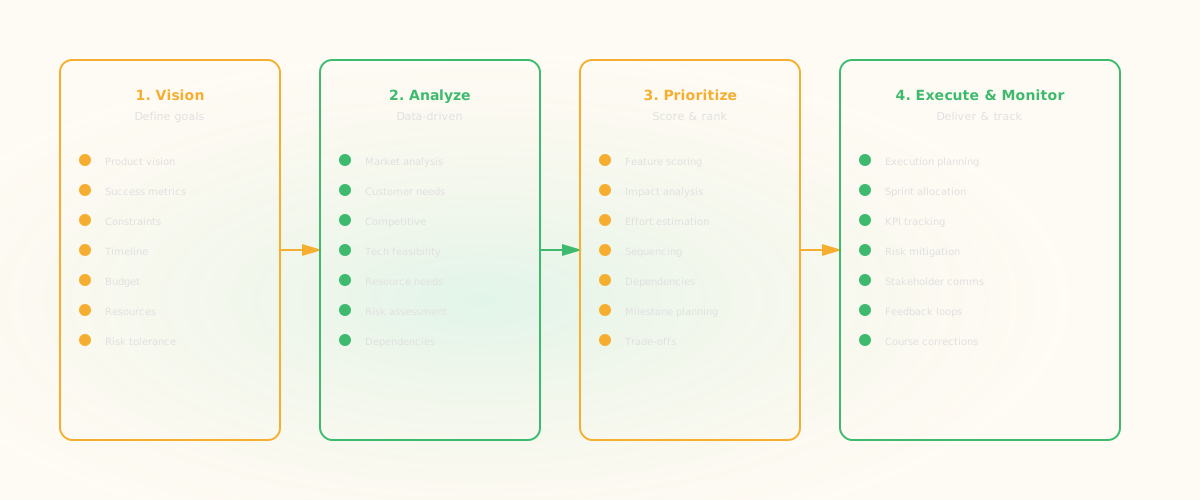
Structure your AI roadmap in three layers:
Layer 1 - Infrastructure and Data. Before estimating any feature, inventory your current state: Do you have a feature store? Can you serve models at sub-100ms latency? Do you have labeled training data pipelines? Are your model serving and monitoring tools in place? Feature-level estimates are meaningless without this foundation. Allocate infrastructure and data work first. If you're building from scratch, expect 2-3 months of infrastructure work before first model work.
Layer 2 - Model Capabilities. For each AI feature, create estimates with three components: (1) Data preparation (weeks), (2) Model development and iteration (weeks), (3) Evaluation ( - ) testing the model on production-like data (weeks). Use reference estimates from similar projects. A team's first model in a new domain typically takes 2x longer than a team's fifth model in the same domain because learning curves matter.
Layer 3 - User-Facing Features. These are the product features users interact with. Build these only after model evaluation confirms the AI component works. If your recommendation model needs evaluation, your product feature launch should start after evaluation completes.
Estimation Guidelines:
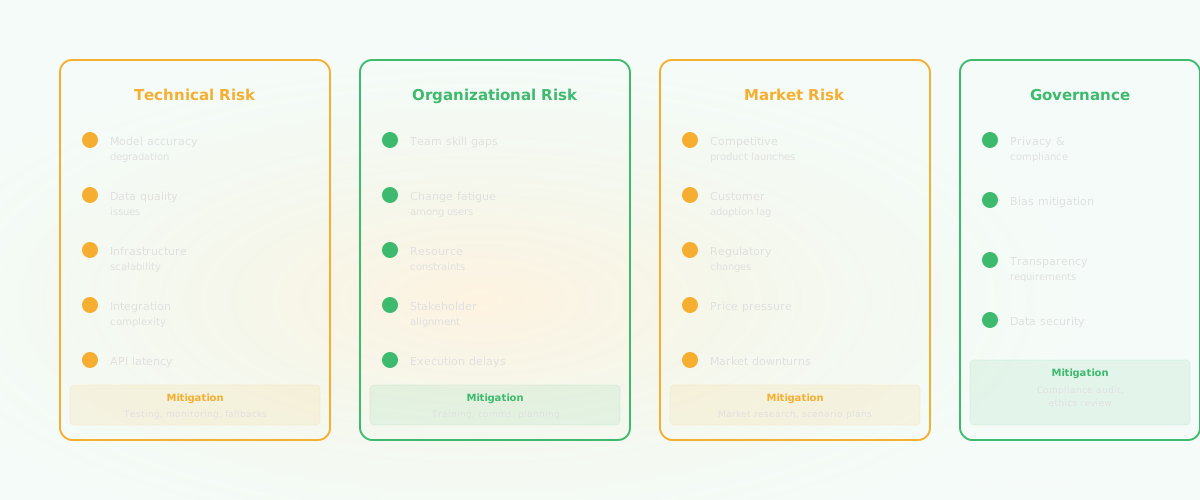
Risk Management: For each AI feature, identify the "model risk" ( - ) the probability that evaluation will fail and require iteration or rework. For a team using models they've trained before in the same domain, model risk is 15%. For a team venturing into a new domain, model risk is 50%. Adjust roadmap timelines accordingly, and communicate risk to product leadership explicitly.
Misconception 1: You can estimate AI features the same way as traditional software. Correction - AI features have a two-stage uncertainty: whether the model will work as intended (model risk) and whether the product integration will work (engineering risk). Traditional software mostly has engineering risk. You need probability distributions and risk thresholds, not point estimates.
Misconception 2: Once a model is trained, shipping the feature is straightforward. Correction - model evaluation, A/B testing, and production monitoring are often longer than model training. A team that spends three weeks training but only one week on A/B testing is guaranteeing post-launch surprises. Budget evaluation time equal to or longer than training time.
Misconception 3: Buying a pre-trained model eliminates estimation uncertainty. Correction - a pre-trained model still requires evaluation on your data, fine-tuning for your use case, and integration work. It reduces uncertainty compared to training from scratch, but doesn't eliminate it. Budget 4-6 weeks to fine-tune and validate a pre-trained model for production use.
Q: Should we commit to AI roadmap dates the way we do traditional software? No. Provide date ranges with confidence levels: "We're 70% confident we'll have sentiment analysis by end of Q2, 95% confident by end of Q3." Model risk makes false certainty dangerous. If leadership demands a hard date, make the probability threshold explicit.
Q: How do we know if a model is "good enough" to ship? Define success metrics before you start training. For fraud detection, "catches 95% of fraud with <1% false positive rate." For recommendations, "increases engagement by 5% in A/B test." Evaluation should test these metrics on production-like data, not just lab data.
Q: We want to add AI to multiple features. How do we prioritize? Prioritize by (1) model risk (features where you have prior domain experience), (2) infrastructure readiness (features that use your existing data and model serving), and (3) business impact (features that move key metrics). Start with low-risk features and build confidence before high-risk bets.
Keep reading
Related resources