Glossary
AI feature prioritization analyzes customer data, usage patterns, and competitive signals to surface patterns. Learn how to use AI to inform product decisions.
Building Glue, I've learned that AI in engineering isn't about replacing engineers — it's about eliminating the 60% of their time spent on coordination, context-gathering, and operational overhead.
AI feature prioritization is the use of artificial intelligence to support or partially automate the product prioritization process - - analyzing customer data, usage patterns, market signals, and strategic alignment to help product managers decide what to build next. The key word is "support." AI surfaces signals, reduces analysis time, and highlights patterns humans might miss. But the judgment calls at the heart of prioritization - - which customer segments matter most, what the company's strategic bets are, how to handle political trade-offs between executives - - remain human decisions. AI is a tool for making those decisions better informed, not a replacement for decision-making.
Feature prioritization is where strategy meets execution. It's where the company decides what to build, and that decision ripples through engineering (capacity planning), product (roadmap), and customers (expectations). Get prioritization wrong and teams build features nobody wants, miss features customers need, or chase shiny objects while ignoring fundamental gaps.
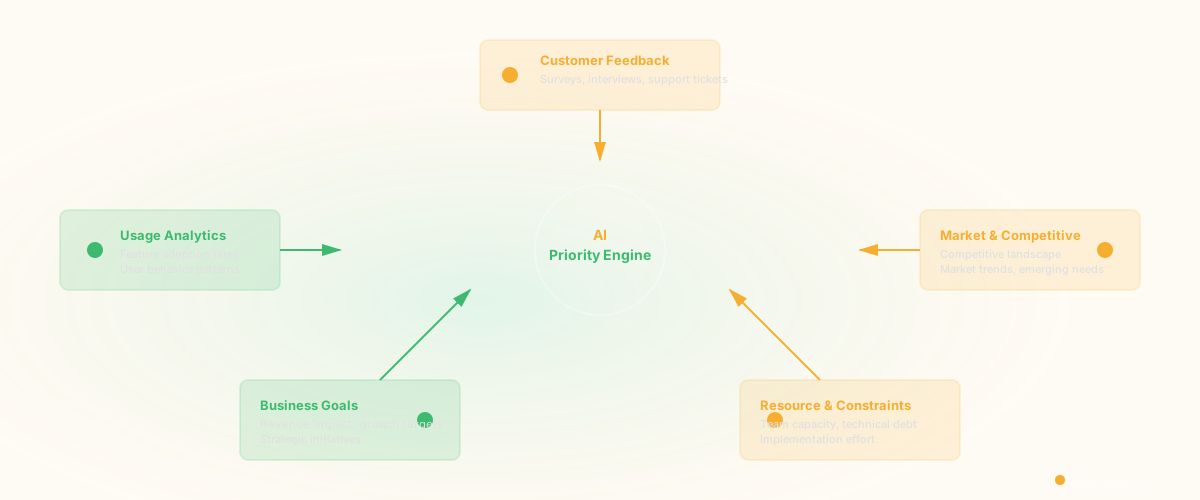
The challenge is that there's more data to consider than any human can process. Customer support tickets mention feature requests scattered across thousands of messages. Usage analytics show which features users actually use vs. ones they ignore. Market reports flag trends. Competitive products ship features. Churn data shows which segments are leaving. Strategic goals shift as the business evolves. No PM can read all support tickets, analyze all usage data, monitor all competitors, and make a coherent prioritization decision weekly. Something gives: either the analysis is superficial, or it's slow, or it's incomplete.
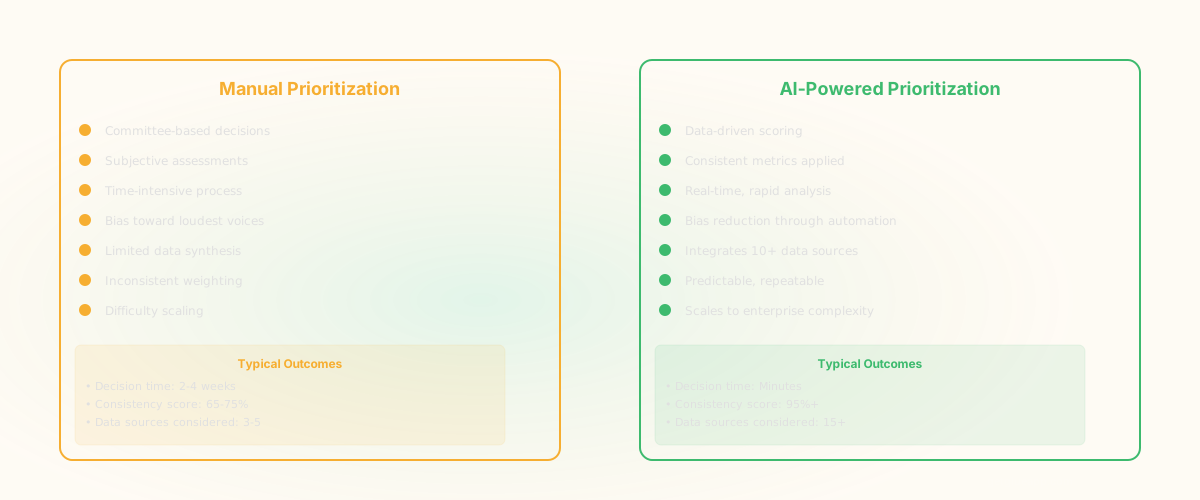
AI tools address this by processing vast amounts of data and surfacing high-signal patterns. What if a system automatically read all support tickets and said: "Your top 50 customers have asked for feature X 147 times in the past quarter, feature Y 43 times, and feature Z 8 times"? What if it analyzed usage data and said: "Features A and B are used by 45% of users but generate 8% of revenue; features C and D are used by 5% of users but generate 35% of revenue"? What if it tracked competitor behavior and said: "In the past 3 months, 12 competitors shipped features in the X space, zero in the Y space"? That's the kind of signal that makes prioritization decisions better.
AI prioritization operates on a spectrum from basic to sophisticated:
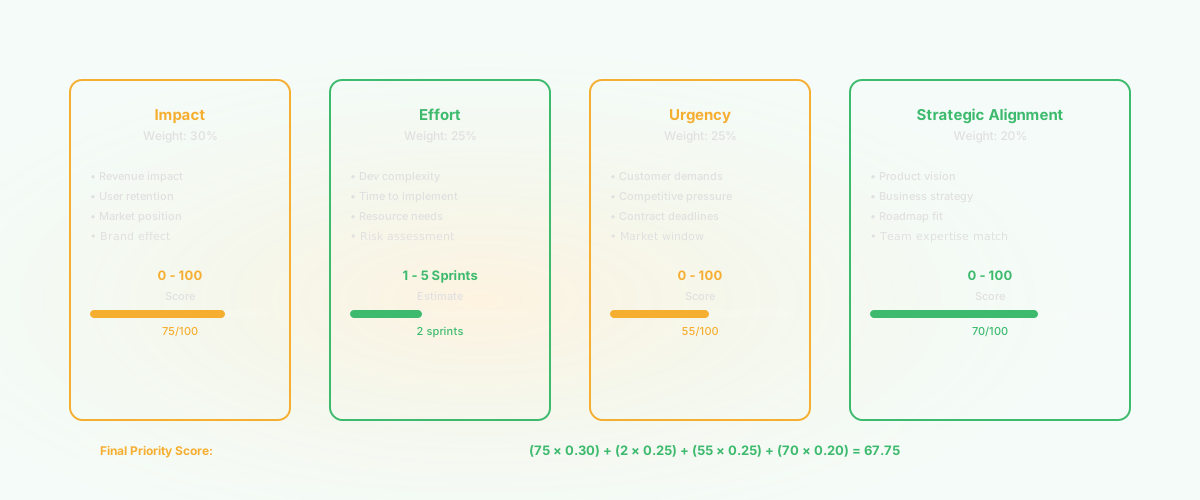
Scoring automation is the simplest form. You define a prioritization model: Feature Value = (Customer Impact × 0.4) + (Strategic Alignment × 0.3) + (Technical Feasibility × 0.3). Then you feed features and their scores into the model, and it ranks them. This is useful for consistency - - you're applying the same weighting to every feature, not judging them based on which was mentioned most recently. But it requires humans to score each component.
Pattern detection from customer data goes further. AI systems read customer feedback (support tickets, survey responses, feature requests) at scale and identify patterns. "These 12 customers represent 30% of revenue and all mentioned wanting feature X." "Feature Y appears in 5% of support conversations about churn." "Enterprise customers request feature Z four times more often than SMB customers." These patterns emerge from data too large for manual analysis.
Usage analytics analysis surfaces how customers actually use the product. "Feature A is used by 1,000 customers but 80% of them use it just once. Feature B is used by 500 customers but with 8 interactions per user per month." Which is more valuable - - broad adoption with light usage, or narrow adoption with heavy usage? AI can help quantify the impact of usage patterns.
Competitive intelligence analysis monitors competitor products and surfaces what they're building. "Three competitors launched AI-powered features in the past month" or "Nobody is building in space X despite it being available for 2 years." This doesn't replace strategic thinking about competition, but it surfaces patterns faster than manual competitive research.
Churn prediction and analysis connects product features to business outcomes. "Customers who use feature X churn at 2% annually; customers who don't use it churn at 8%." This doesn't prove feature X prevents churn, but it highlights a correlation worth investigating. "New users who activate feature Y within the first week have 25% higher lifetime value than those who don't."
Feasibility assessment integration adds technical context. Rather than separating business impact from technical complexity, AI can integrate both. "Feature A has high business impact but is highly technically complex" vs. "Feature B has moderate impact but is trivially easy to build" vs. "Feature C has moderate impact and moderate complexity." This helps PMs see the effort-to-impact ratio directly.
The most sophisticated systems combine multiple signals. High customer demand (from support ticket analysis) + high strategic alignment + low technical complexity + available customer segment = high priority. Low customer demand + conflicting with strategic bets + high complexity + small addressable market = low priority. Most features fall in the middle, where judgment calls matter most.
A product team reviews prioritization monthly. They have 30 potential features to consider. Historically, this meant reading a sample of support tickets, checking usage metrics, and debating what to build. Now they use an AI prioritization tool.
The tool analyzes the past quarter's support tickets (2,300 total) and surfaces:
It analyzes usage data:
It surfaces competitive intelligence:
Now the PM has high-signal data to inform the decision. "Feature X should be top priority because many customers ask for it, but let's first check: do the customers asking for it have high lifetime value, or are they mostly low-value customers?" AI surfaces the correlation, PM applies business judgment.
The decision becomes transparent: "We're building Feature X because high-value customers are asking for it. We're not building Feature D because all competitors have it and it doesn't differentiate us. We're delaying Feature Z because it's only requested by free users and doesn't affect retention."
Start with data collection. AI prioritization is only as good as the data it analyzes. Ensure support tickets are being captured, usage events are being logged, customer segments are identified, and strategic goals are documented. Many organizations discover their data infrastructure is incomplete when they try to implement AI prioritization.
Define your prioritization model. Before feeding anything into AI, agree on your weighting. How much weight does customer demand carry vs. strategic alignment vs. technical feasibility? Different companies answer differently. Document your model so AI can apply it consistently.
Use AI for signal detection, not decision-making. Let AI surface patterns and score features. Use AI to highlight outliers ("this feature is requested by many customers but we haven't built it yet" or "this feature has high strategic alignment but zero customer demand"). But the final decision should be human judgment informed by these signals.
Update signals regularly. Customer demand changes. Competitors ship features. Strategic priorities shift. Refresh the analysis monthly or quarterly, not once per year.
Validate AI's output. Does the tool's ranking match your intuition? If it doesn't, is your intuition wrong, or is the tool? Sometimes disagreement surfaces blind spots in your mental model; sometimes it means the tool isn't calibrated correctly. Investigate.
Misconception: AI prioritization removes the need for human judgment. Reality: AI surfaces signals; humans make decisions. If you're trying to remove human judgment from prioritization, you're trying to remove strategy from the process. The goal is to make human judgment better-informed, not to eliminate it.
Misconception: AI prioritization gives you objective, unbiased decisions. Reality: AI encodes the biases of whoever built it. If the model weights "customer revenue" more than "strategic innovation," it will always prioritize revenue-generating features over experimental ones, which might not be the right trade-off. Understand the biases encoded in the tool you're using.
Misconception: You need perfect data for AI prioritization. Reality: You need good-enough data. Incomplete data is better than no data. "We don't have perfect churn analytics" shouldn't prevent you from using incomplete churn data to inform prioritization. Use what you have and improve data quality over time.
Q: How does AI prioritization account for strategic bets? A: It depends on how you feed strategic information into the model. If you score strategic alignment explicitly (how well does each feature align with strategic goals?) and weight it heavily, strategic bets will come through. But you have to encode strategy into the model; AI can't infer it from data alone.
Q: Can AI prioritization replace product managers? A: No. AI can surface which features customers want most, which are easiest to build, which competitors offer. But strategy, judgment calls about trade-offs, understanding customer context beyond what data says, and making decisions that align with company values - - these are human responsibilities. AI is a tool for doing those things better.
Q: How often should you re-prioritize based on new data? A: You can re-analyze signals continuously, but you shouldn't re-prioritize your roadmap constantly. Chasing data week-to-week makes execution impossible. Better practice: analyze signals monthly or quarterly, use analysis to inform the next prioritization cycle, and commit to a roadmap for that cycle. Update based on major changes (a key customer churns, market shifts), but avoid re-prioritizing on noise.
Keep reading
Related resources