
The PM AI assistant in 2026 is shifting from output generation (writing PRDs, drafting roadmaps) to context intelligence — helping product managers see and understand their codebase, surface architectural constraints, identify ownership patterns, and connect technical reality to product decisions. Most current PM AI tools are built on the false assumption that PMs need help creating output; the real bottleneck is that PMs lack visibility into their own system's architecture, dependencies, and code health, which leads to uninformed prioritization and unrealistic estimates.
Building Glue, I've learned that AI in engineering isn't about replacing engineers — it's about eliminating the 60% of their time spent on coordination, context-gathering, and operational overhead.
Most PM AI tools are terrible because they're built on a false assumption: that PMs need help creating output.
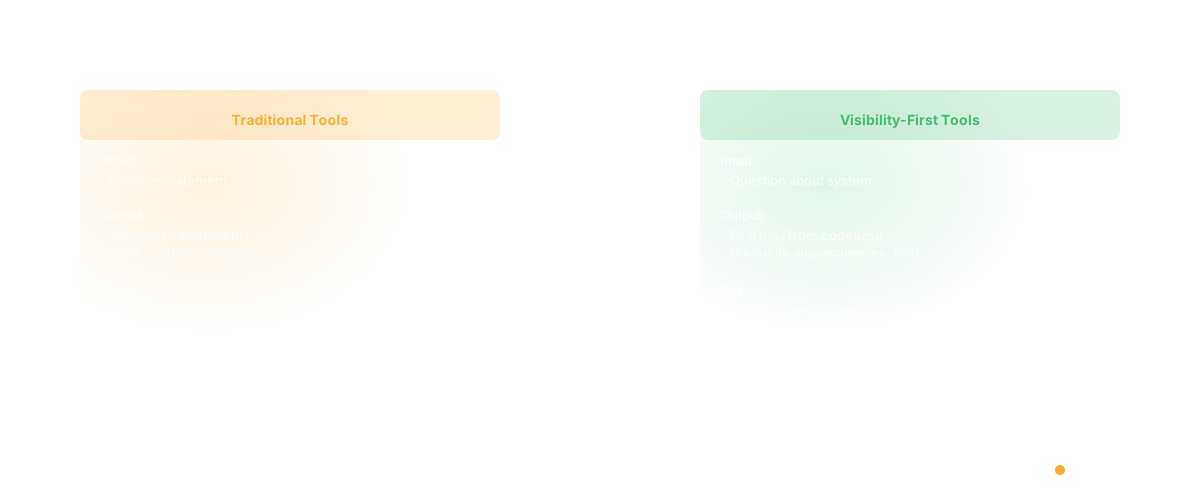
I've spent the last year watching PMs use various "AI assistants" that promise to help with their jobs. Most of them work like this: You feed them a problem. The tool generates a PRD, or a roadmap, or a competitive analysis. The PM reviews it, maybe edits it, ships it.
This is backward.
The real problem isn't that PMs can't write documents. The problem is that PMs don't have visibility into what's actually in their product.
What's Actually Broken
Most PM AI tools help with leverage - more documents, faster. What they don't help with is understanding.
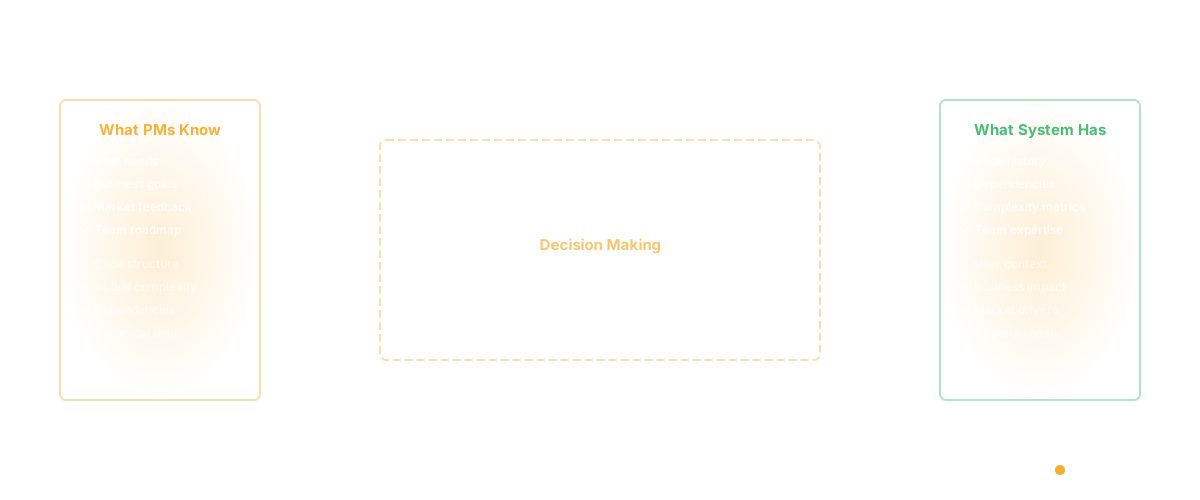
You sit in a meeting where an engineer says "we need to refactor the auth module." You don't know if that's critical or excuse-making. You can't see the module. You don't know when it was last touched, who knows it, how many other systems depend on it, how often it causes bugs. You're making a priority decision blind.
You look at last quarter and wonder why you didn't ship as much as you planned. Was it scope creep? Team capacity? Bad estimation? Unforeseen technical complexity? You have a gut feeling but no data. You can't see what actually happened in the codebase.
A user says "why does feature X take so long to update?" You don't know. The code might be a nightmare. It might be that it touches fifteen other systems. It might be that only one engineer understands it. All of those answers point to different solutions. But you can't see it, so you guess.
This is the gap. PMs don't need more output tools. They need more input tools - visibility into what's actually in the system.
What Genuinely Useful Looks Like
A useful PM AI assistant does this:
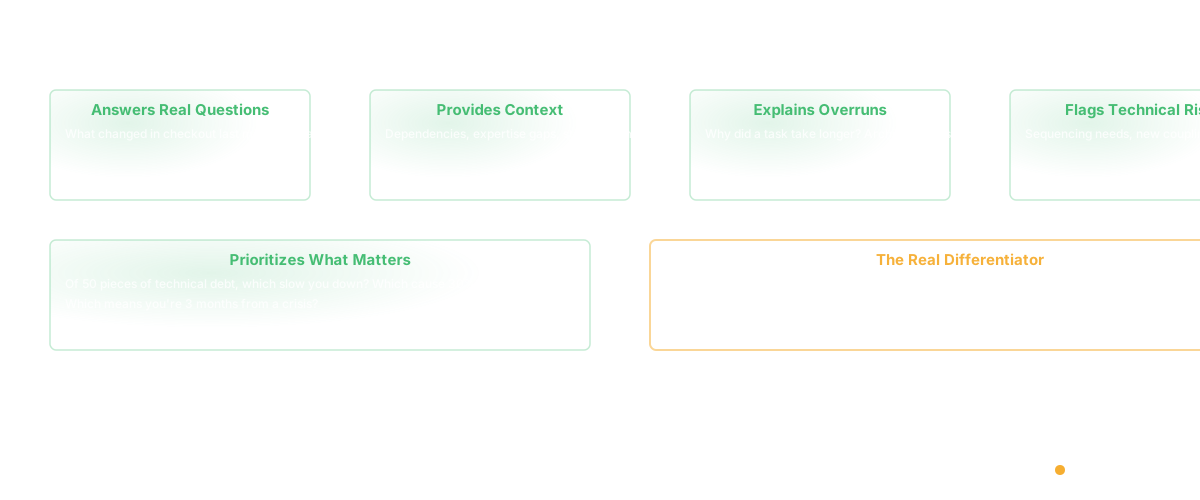
It answers questions about what's actually in the codebase. "What changed in the checkout flow last month?" You get a list of commits, what they touched, who made them, what bugs they fixed or introduced. "What modules touch the payment system?" It shows you the graph. "When was the authentication module last refactored?" With actual dates and who did it. "What's the oldest code in the critical path?" Boom. You're making better decisions because you know what you're deciding about.
It gives you context before you estimate. You're planning a feature. The AI tells you: "This will touch three modules. Two of them are stable. One was rewritten twice in the last year and has 15 dependencies. Here's the team composition - you have one person who knows that module well, one person who's worked on it once." Now you can estimate with information. Or you can plan for better knowledge distribution. Either way, you're not blind.
It explains why things took longer than expected. A story overran. You ask why. The AI shows you that this supposedly 3-point form actually connects to five different services, and one of them has a synchronous call that's known to be slow. Now you know: This isn't an estimation failure, it's an architectural problem. That's actionable.
It flags technical risk before it becomes a planning crisis. You're planning the next quarter. The AI tells you: "You're planning features that touch the auth module, but that module is scheduled for security updates. You can do both, but you'll need to sequence them." Or "This feature set will create 47 new dependencies between modules that currently have no coupling. You probably want to think about that." You're surfacing risks that would have bitten you in execution.
It shows you what actually matters. You have 50 pieces of technical debt. Which ones actually slow you down? The AI shows you: "This debt doesn't affect feature velocity, but this debt costs you 30% of your debugging time, and this debt means you're three months of maintenance work away from a crisis." Now you can prioritize.
Why This Is Hard to Build
Most AI tools solve the easy part - generating text. What's hard is generating answers about things the AI can actually see.
If your AI assistant doesn't have access to the codebase - real access, with commit history, code structure, dependencies - it's just a fancy autocomplete. It'll give you frameworks, but it can't give you visibility.
That's why we built Glue the way we did. Not as a document generator, but as codebase intelligence. The AI part is actually useful because it has something real to analyze. A PM can ask "what changed in checkout last month?" and get an actual answer based on git history, not a hallucinated answer based on training data.
This is the future of PM AI. Not tools that help you produce more, but tools that help you understand more. The document-generation part becomes free - any AI can do that. The differentiation is in visibility.
What This Means for Your PM Stack
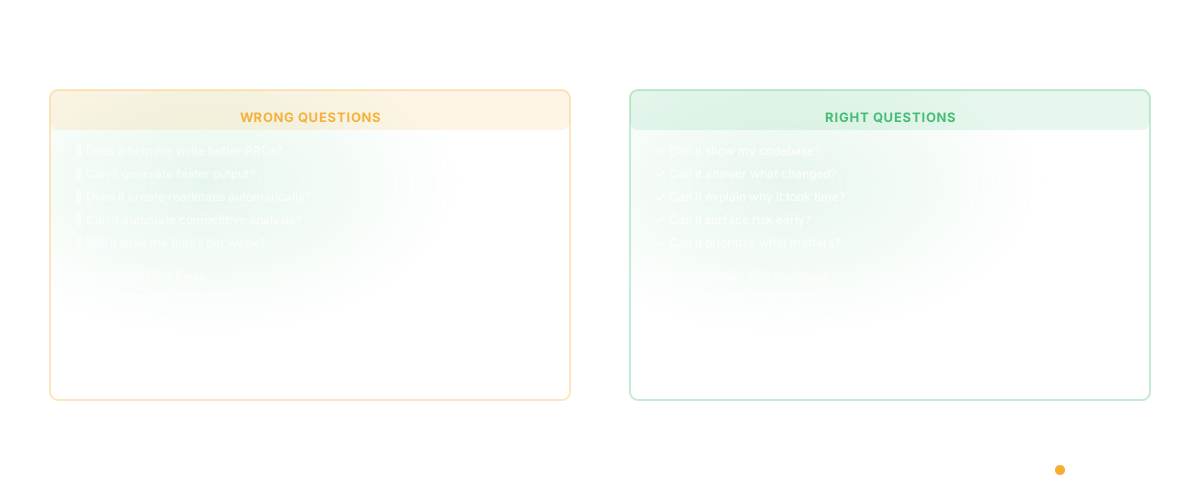
If you're evaluating PM tools in 2026, the question isn't "does it help me write better PRDs?" You can use ChatGPT for that. The question is "does it help me understand my product's technical reality?"
That means: Can it show you your codebase? Can it answer questions about what's in there? Can it help you understand why things take as long as they take? Can it surface risk before you hit it?
If it can't, it's a productivity tool. Which is fine - you need those. But it's not actually solving the PM problem. It's solving the PM busy-work problem.
The tools that will matter are the ones that give PMs visibility into systems they couldn't see before. That's not AI, technically. That's integration. But when you combine integration with AI - "here's what I see, now synthesize it" - that's when PM tools become genuinely useful.
A Concrete Example
I used Glue yesterday and asked it: "Tell me about the changes to our dashboard in the last month. What did we touch? Who touched it? What was the most complex change?"
It showed me:
- 67 commits, mostly small improvements
- Three engineers touched it
- One commit was a significant refactor of the charting component, done by our most senior engineer
- Most changes were incremental, but the refactor introduced new dependencies on the data layer
Now I can answer the PM question I had: Should we add more dashboard features next quarter, or invest in dashboard infrastructure? The answer is obvious from the data - we just did a major refactor, so we have room for features. If the answer had been "this code is a fragile mess," we'd prioritize infrastructure instead.
I didn't need an AI to write a PRD. I needed AI to help me see and understand the system. That's the gap.
Frequently Asked Questions
Q: Isn't this the same as codebase visibility tools for engineers? A: Similar but different. Engineer tools show you metrics - complexity, coverage, etc. PM tools show you narrative and context. Why did this change? Who understands it? What does it connect to? What breaks if we touch it? Codebase intelligence bridges this gap by surfacing dependency mapping and ownership data in PM-friendly formats. Different questions, different visualization, same underlying data.
Q: What if I use Glue but my engineers don't want to expose the codebase? A: That's a sign of a bigger problem. Teams that hide their codebase from PMs are usually hiding something - massive debt, fragility, knowledge concentration. That problem doesn't go away by keeping it hidden. It gets worse. If you can't get visibility, that's your real risk. The visibility will be uncomfortable at first. That's good - it means you'll finally address the actual problems.
Q: How much of my PM time will this actually save? A: Honestly? Not that much. What it does is let you spend that time on better questions. Instead of "is this estimate realistic?" you ask "what architectural changes do we need to make?" Instead of "why did we overrun?" you ask "what dependencies did we miss?" The time stays the same. The quality of thinking goes up. That matters more than saved hours.
Related Reading
- AI for Product Management: The Difference Between Typing Faster and Thinking Better
- The Product Manager's Guide to Understanding Your Codebase
- AI Product Discovery: Why What You Build Next Should Not Be a Guess
- Cursor for Product Managers: The Next AI Shift Nobody Is Talking About
- Product OS: Why Every Engineering Team Needs an Operating System
- Software Productivity: What It Really Means and How to Measure It