
Bus factor measures how many team members would need to leave before a project stalls. A bus factor of 1 means a single departure can freeze critical systems. To reduce bus factor risk, implement systematic knowledge sharing through pair programming, code ownership rotation, and architectural documentation. Teams that invest 10-15% of sprint capacity in knowledge distribution see 40-60% faster recovery when key engineers leave, and eliminate the single-point-of-failure bottlenecks that slow down feature delivery.
At UshaOm, our bus factor on the payment module was literally one. That engineer went on vacation for two weeks and three features froze. That's when I started documenting everything.
I've walked into engineering teams where one person owns half the critical systems. Usually they're good at their job - that's why they have so much responsibility. But I always ask the same question: "What happens if this person gets hit by a bus?"
Most teams say "we have documentation" or "we can figure it out." Both answers are wrong.
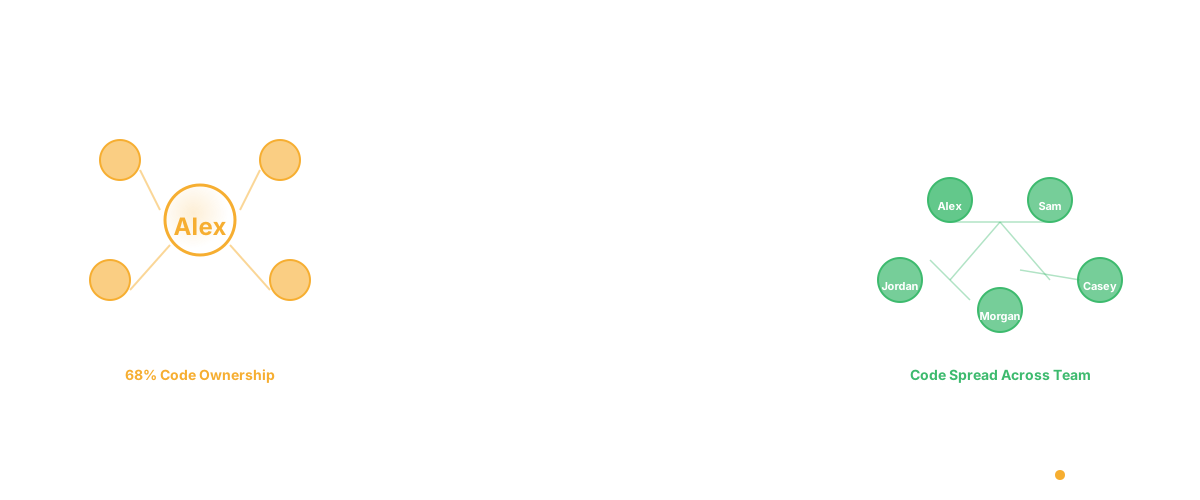
Bus factor risk isn't a knowledge problem disguised as documentation. It's a systems problem disguised as a knowledge problem. Knowledge concentration is a rational response to how most teams actually work. You reward speed. You reward problem-solving. You make knowledge transfer hard (because it takes time). You celebrate the person who ships the biggest features. Over time, you get heroes. Heroes build moats around their knowledge because that's how you stay valuable.
Fixing bus factor doesn't mean "write better documentation." That's what every team says and it doesn't work. Fixing bus factor means changing the incentive structure so that knowledge sharing is the path of least resistance instead of the path of most resistance.
How the Problem Actually Works
Let's say you're a seven-person engineering team. Your infrastructure is Kubernetes on AWS. One person, let's call them Alex, set it up three years ago. Alex knows where everything is. Alex knows why we made certain decisions. Alex is the one who debugs the weird networking issues. Alex hasn't taken a vacation in eighteen months.
Why does this happen?
Not because Alex is hoarding knowledge. It's because of how the system evolved:
-
When the infrastructure was built, there was an urgent deadline. Alex shipped it. The alternative ( - ) not shipping ( - ) was worse than the alternative of having exactly one person who understood it.
-
Once it was live, it worked. Why invest heavily in documentation and knowledge transfer? The immediate return is zero. The cost is real time. So that investment doesn't happen.
-
The next crisis comes. Someone needs to fix the production database. Alex fixes it in two hours. Everyone is grateful. Alex's bus factor increases.
-
Three years later, Alex knows more than anyone else. But now knowledge transfer is actually expensive - not in time but in opportunity cost. If Alex spends a day documenting the system, that's a day Alex isn't shipping features. The team's velocity goes down.
-
So Alex doesn't document it. The rational choice is to not document it.
This is how monocultures form. Not through malice. Through rational incentives.
The Actual Risk Metrics
Bus factor risk is real, but most teams don't measure it. Start here:
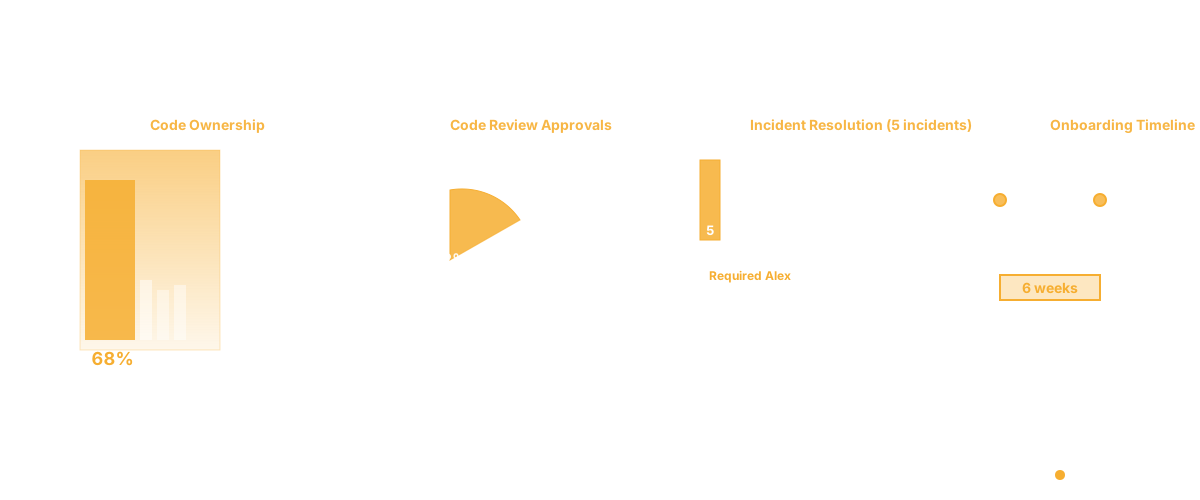
Code ownership concentration. Run a git analysis on your codebase. For each critical module or system, count how many people have committed code. If a module has only 1-2 authors out of a 10-person team, that's concentration risk. If 30% of your critical code is written by fewer than 3 people, you have a problem.
Code review patterns. Who reviews critical code? If the same person approves most changes to infrastructure, database schema, or core services, you have a concentration point. That person is a single point of failure.
Incident response. Look at the last five production incidents in your critical systems. How many of them required one specific person to resolve? What was the MTTR with and without that person?
Knowledge transfer rate. When someone new joins the team, how long until they can confidently make changes to critical systems? If it's more than three months, you have knowledge silos.
For a 7-person team, any of these should set off alarms. For a 20-person team, you've got more margin. The risk scales with team size but the principle stays the same: knowledge should be distributed.
How to Actually Fix It
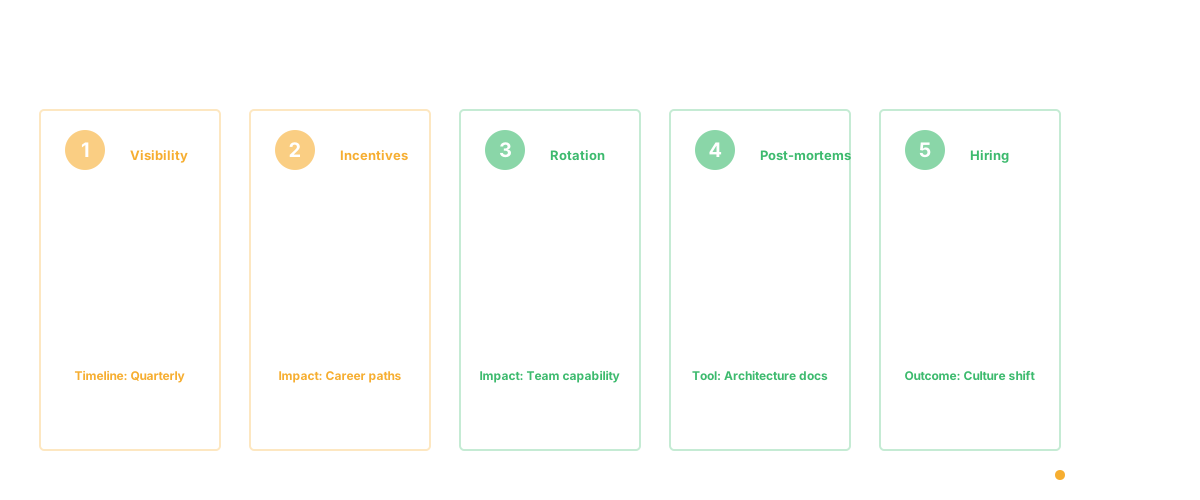
Fixing bus factor requires changing three things: visibility, incentives, and process.
First: Make concentration visible. Run a quarterly code ownership analysis. Show the team a visualization of "who owns what." Make it normal to talk about concentration risk. Make it a metric you track, like you track deployment frequency or test coverage. Teams that measure this find it naturally changes behavior - visibility creates pressure to fix it.
Second: Change how you evaluate people. If promotion and raises depend on shipping big features, you get heroes. If they depend on being replaceable ( - ) on sharing knowledge, on enabling teammates ( - ) you get distributed knowledge. This is how you change incentives at scale. A senior engineer who spends two weeks documenting a system and training three other people on it should be evaluated as highly as someone who ships a new feature. Most teams claim this but don't actually do it in promotion decisions.
Third: Rotate assignments deliberately. Don't wait for someone to leave to distribute knowledge. Rotate code review pairs. Have different people take on-call for different systems each week. If your CI/CD is owned by one person, rotate that responsibility. Make it normal to be exposed to different parts of the system.
Fourth: Use incident post-mortems to surface implicit knowledge. After every production incident, ask: "What did we know that prevented this faster resolution?" Usually the answer is "Alex knows the caching layer was rewritten in that weird way." Write it down. Add it to your architecture docs. This is how implicit knowledge becomes explicit.
Fifth: Make the change explicit in your hiring. If you're hiring for a team with high bus factor, explicitly look for people who have worked in distributed-knowledge teams. Ask in interviews: "Tell us about a time you worked on a system where you had to make it understandable to people other than yourself. What did you do?" People who've done this know it's valuable. People who haven't need to learn it.
Practical Example
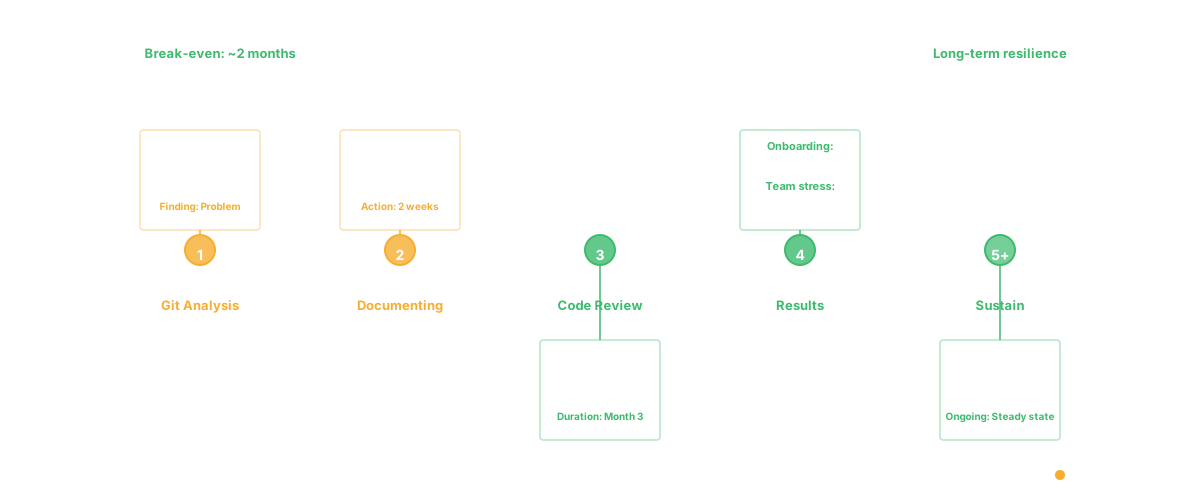
I worked with a team that had a classic bus factor problem. One person owned the data infrastructure. The team's onboarding was six weeks. Half of that was waiting for this person to have time to explain things.
We did three things:
-
We ran a git analysis and found this person had authored 68% of the data layer code. We made it visible.
-
We had this person spend two weeks documenting the data model, the migration strategy, and the design decisions. Not exhaustively ( - ) but the top 20% of knowledge that explained 80% of the system. They documented it not by writing a huge document but by creating a series of ADRs (Architectural Decision Records) for the major decisions.
-
We rotated code review. Every data infrastructure change went to this person for approval ( - ) but now it also went to a rotating set of junior engineers. It was explicit: "Your job on this review is to ask questions until you understand the design intent."
Four months later, onboarding dropped to four weeks. The bus factor person was less stressed. New engineers could make changes to the data layer with guidance instead of fully blocked on waiting for review. It wasn't magic. It was just making knowledge transfer a routine part of work instead of an afterthought.
The Uncomfortable Truth
Bus factor risk is fundamentally a leadership problem. It means your team is optimized for short-term velocity at the cost of long-term resilience. It means you're okay with concentration risk because right now, it's working. It means you haven't invested in the infrastructure of knowledge sharing because it feels less urgent than shipping features.
The fix isn't technical. It's organizational. It requires leadership to say "we're going to spend time distributing knowledge" and then actually protect that time in the backlog. It requires changing how you hire and promote. It requires measuring the thing you want to improve.
Most teams don't do this until someone actually leaves or gets sick. Then they panic and try to extract knowledge from the departing person in compressed time. That's painful and it doesn't work well.
Do it now. While you have time. While the person isn't leaving. While it's proactive instead of reactive.
Frequently Asked Questions
Q: What is bus factor in software engineering and how to reduce it?
Bus factor is the minimum number of team members who would need to leave before a project or system stalls due to knowledge loss. A bus factor of 1 means a single person's departure can freeze critical work. To reduce it, implement code ownership rotation where every critical system has at least two knowledgeable engineers, invest in architecture documentation that captures decision rationale not just current state, use pair programming on high-risk components, and dedicate 10-15% of sprint capacity to knowledge sharing. Codebase intelligence tools can automatically identify single-owner hotspots before they become risks.
Q: Won't this just slow us down short-term?
Yes, it will. For about 4-6 weeks, you'll have less velocity while people are learning critical systems through pair programming and ownership rotation. After that, you'll have higher velocity because fewer things are blocked on waiting for one person. The break-even is usually around two months.
Q: What if we can't afford to rotate people?
You can't afford not to. The cost of someone actually leaving or being unavailable is higher than the cost of knowledge distribution. This is a risk management question: pay a small cost upfront or pay a huge cost later.
Q: Should we pair the expert with new people on every change?
For critical systems, yes. Not forever ( - ) but for enough changes that the new person can handle 80% of them independently. Once they've done that, spot-check their work instead of co-authoring.
Related Reading
- Knowledge Management System Software for Engineering Teams
- Software Architecture Documentation: A Practical Guide
- Conway's Law: Why Your Architecture Mirrors Your Org Chart
- Developer Onboarding Metrics: How to Measure and Accelerate Time-to-Productivity
- Code Dependencies: The Complete Guide
- What Is a Technical Lead? More Than Just the Best Coder